- Home
- Hip arthritis
Hip arthritis
Hip arthritis is more treatable than once thought if we start early enough with prevention.
This page was last updated by Dr Barrie Lewis on 27th June, 2019.
This is a long page; it's a complex subject and I won't insult your intelligence with a few platitudes about how much chiropractic can help. If you don't have at least half an hour right now, rather come back later.
If you have significant groin pain, then make the time. Degenerative
changes in the lower limb aren't just uncomfortable; they're also
disabling and that's even worse. Walking becomes painful and difficult.
It's wear and tear, and is the most common
type of inflammation of the pelvis. The protective hyaline cartilage over both the
ball and socket, known as the acetabulum, the roof covering the femoral head, is progressively worn away, leaving the bare bone
exposed within the joint.
So,
who is prone to it? There are a number of conditions that
predispose one to getting it; like a short leg, or an old
injury, say in a car accident, for example. We'll discuss them in some detail lower down.
There's always the possibility of getting an infection, like tuberculosis, though it's rare, and there are several hereditary conditions that make one prone to the degenerative changes found in the hip; they are seen almost daily at a busy chiropractic coalface.
The good news is that there's much to be done, if you start taking evasive action early enough.
Osteoarthritis typically affects patients over 50 years of age, although it can and does start in younger people too, particularly if they are obese or have certain genetic conditions that make them predisposed.
Pain in the groin and radiating down the front of the thigh are common complaints; another is difficulty putting on shoes and socks.
Hip arthritis
Hip arthritis occurs mainly after fifty but correction of sacroiliac fixations is extremely important in both prevention and treatment; so is mobilisation of all stiff joints.
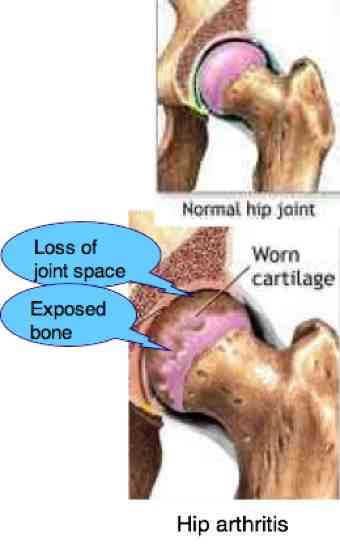
The frustrating part is that sometimes this degenerative change in the hyaline cartilage lining both the ball and socket starts in young people for no obvious reason. They don't have a short leg, nor are they overweight. Currently their diet is fine, though one has no idea of what they were fed on as children, or whether changing from breast milk to formula too soon could have been the cause.
Childhood trauma is lost in the mists of time, but they don't have one of the genetic conditions like hip dysplasia. Perhaps exposure to chemicals, either plant toxins like pesticides on food, certain prescription drugs or even the fun drugs that young people are fain to experiment with these days.
I think vaccination is an unlikely cause, as most of the children are vaccinated and don't have this unexplained, premature degenerative change in the hip that some young people get.
It's probably totally fanciful, an anecdote, but I've noted that folk with tattoos, particularly those with huge sharp claws, pincers and daggers seem to get pain in the area. I've seen no research, so best forget that.
But there are certainly conditions, that certainly predispose one to hip arthritis.
Femoro Acetabular Impingement Syndrome
FAIS is almost certainly genetic, as siblings are more than twice as likely to have the condition, but trauma could play a part. The very sporty child... ballet, yoga, gymnastics, football... Extra bone is laid down in and around the hip in the young person. The key early sign is stiffness, without pain in the young hip, and of course continuing progressively and relentlessly as we age, if nothing is done to hip arthritis.
Can your teenager pull his knee all the way to the chest? If he pulls the knee towards the opposite shoulder, is there pain in the groin or hip?
Routinely now I examine every hip, as much can be done to treat this not uncommon condition, and prevent hip arthritis. An ounce of prevention ...
It is imperative - for many reasons - that we do not allow the growing child to also become obese. The prevalence of painful degenerative osteoarthritis in the hip then becomes much, much higher.
FAIS comes in two forms: Pincer and CAM
The other form of FAIS is the CAM deformity - a bump on the neck of the hip. It tends to rip into the labrum of the hip causing pain in the groin. Sometimes in the clinic we find a mixed hypermobility with a CAM deformity - the result is pain in the groin or side of the hip.
Untreated and carefully managed the likelihood of hip arthritis increases greatly. Aggrating factors are a short leg, as in this case file... Hypermobile hip dysplasia CAM FAIS
FEMORO ACETABULAR IMPINGEMENT SYNDROME Case File shows how this condition can and should be treated to reduce pain and prevent hip arthritis. Alas it can't be cured and if the offending pincer or cam growth are surgically removed, they just regrow.
Dysplasia
Whereas Femoro Acetabular Impingement Syndrome refers to too much coverage of the ball of the hip, in Developmental Hip Dysplasia you have too little coverage. The
end result is much the same. Both lead to hip arthritis if the
conditions are not detected early and carefully managed; the Pavlik harness is an essential part.
Inter alia this means that the sports of choice are cycling and swimming, as long distance running and hiking, ballet and heavy athletics will just give way to injury, pain and ultimately a hip replacement.
The child with hip dysplasia who also has the yen to run is a problem. A good friend of mine, at 54 is in a wheelchair much of the time, or walks with two crutches, and is on daily morphine. He's had his third hip operation now, and the surgeons say they can do no more. He was very sporty as a child ... why didn't somebody warn his parents?
Moderate and severe cases will subluxate and dislocate from birth and so DDH is normally detected by the conscientious pediatrician. Your chiropractor too, if s/he treats Colic Chiropractic may do some of these tests: Hip Dysplasia Ortholani Galeazzi ...
Understanding what is hip dysplasia and the tests used to diagnosis it is very important for parents where there is a strong family history of hip arthritis, and for paediatrians and chiropractors.
And yet more about how hip dysplasia begins in-utero.
3. Mixed FAIS DDH
Very occasionally both Femoro Acetabular Impingement Syndrome (which typically causes stiffness) and Developmental Dysplasia of the Hip (INCREASED range of motion, just the opposite of FAIS) may coexist in the same hip.
The symptoms are the same: pain in the groin, often spreading down the front of the thigh towards the knee. There may be increased or decreased range of movement.
Mixed FAIS DDH gives a higher chance of getting hip arthrtis, but this is not necessarily so. What is vital to distinguish between these true hip conditions, and those such as Meralgia Paresthetica and Maignes syndrome that cause REFERRED pain from the back. Operating on the spine of a patient with Mixed FAIS DDH is doomed to failure. Read on... MIXED impingement and dysplasia ...
4. Slipped Capital Femoral Epiphysis ...
Another important condition which occurs predominantly in young girls (5:1) is the Slipped Capital Femoral Epiphysis (SCFE) syndrome. Unless carefully managed it leads inevitably to debilitating early osteoarthritis. Catching it early is essential, which is what chiropractors are trained to do.
Google appears to frown on too many links, so phrases in bold, like that above, need to be put into the Site Search function in the navigation bar on your left if you want more information.
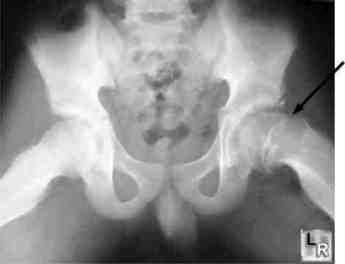
SCFE usually presents with pain in the thigh and knee, typically in a young obese teenager. Delay in the diagnosis leads to an ever increasing slip of the growing end-plate of the hipbone, and high risk of morbidity. It occurs in roughly 1/ 1000 children, but eight times higher in obese adolescents.
Your child has groin, thigh, knee pain? Don't buy into the 'growing pains' myth. Get him/ her to a skilled musculo-skeletal therapist. Early diagnosis is essential, as the results of surgery for severe slips are not good:
Long-term follow-up study of one hundred and twenty-one patients with SCFE.
Boyer DW; Mickelson MR; Ponseti IV
J Bone Joint Surg Am 1981 Jan;63(1):85-95.
We evaluated 121 patients who had had slipped capital femoral epiphysis twenty-one to forty-seven years after the diagnosis was made.
The results were very good in most of the eighty-three hips with the slip left unreduced.
Fifty-four hips that were treated by procedures designed to improve the alignment of the slipped femoral head had more complications and less favorable results , but in general, these were the more severe slips.
However, there were enough slips of comparable severity that were treated unreduced to suggest that the long-term results, even in moderate and severe slips, were better after in situ fixation than after operative and manipulative treatment (as performed between 1915 and 1952). Twelve of the thirteen hips with acute slips were reduced (the thirteenth was one of the eighty-three unreduced hips) and aseptic necrosis developed in three, while nine had good results.
Certainly what is vital is that the child with hip/ groin/ upper thigh/ knee pain has an X-ray to establish the diagnosis, getting all weight off the hip with the use of crutches, and cessation of all sport. Otherwise... severe, early hip arthritis.
5. A Short Leg: LEG LENGTH INEQUALITY
Research has now proved that a short leg is one of the causes of hip and knee arthritis. Scientists speculate that mechanical factors, including joint instability and malalignment from a short leg, contribute to the progressive degeneration of the hip and knee cartilage.
Tip Whilst a simple heel lift to correct a leg length inequality is important, depending on the scoliosis caused by the short leg, this has to fitted by an expert. We of course recommend your chiropractor!
Health is additive. A transverse position in utero causing a hip dysplasia, plus a short leg leads inexorably to hip arthritis.
HIP DYSPLASIA CaseFile ...
- Read more: LEG LENGTH INEQUALITY …
- LEG LENGTH INEQUALITY CaseFile ...
Glucosamine Sulphate
Effect of glucosamine sulfate on hip osteoarthritis:a randomized trial. The effectiveness of glucosamine sulfateas a symptom and disease modifier for osteoarthritis is still under debate.
OBJECTIVE: To assess whether glucosamine sulfate has an effect on the symptoms and structural progression of hip osteoarthritis during 2 years of treatment.
INTERVENTION: 2 years of treatment with 1500 mg of oral glucosamine sulfate or placebo once daily.
CONCLUSION: Glucosamine sulfate was no better than placebo in reducing symptoms and progression of hip osteoarthritis. International Standard Randomised Controlled Trial Number: ISRCTN54513166
- Does glucosamine chondroitin sulphate help?
- Chicken bones broth is better still for the inflammatory conditions.
- Vitamin D and it's role in diabetes and hip pain.
6. Perthe's Disease
Never neglect the limping child, mostly in the 5-12 age bracket. The first sign of Perthe's disease is pain in the hip, and a marked limp. Remember, Growing Pains is a non-existent mythical disease. Never dismiss your child’s hip or groin pain as ‘growing pains’ – prompt and correct management of Perthes is absolutely essential to prevent devastating early hip arthritis. Ignore your limping child and you may be condemning him or her to a nightmare of early hip arthritis. Early as in thirty odd.
I have two patients who had undiagnosed Perthe's disease in the hip as children. Both have had multiple hip replacements, the first before thirty. Both are now fifty odd, the one permanently on crutches, the other in a wheel chair.
The limping child. Take note! And, "growing pains" is a euphemism for "I don't know." It doesn't exist.
NB. Your child may present with KNEE pain. Always ask about the hip.
7. Trauma
Other factors that can contribute to developing hip arthritis include traumatic injuries to the hip and pelvis, as in serious falls and motor vehicle accidents.
It's dangerous getting out of bed in the morning! However, even more people die in bed! Seriously though, most falls in the home occur in the bathroom and on the stairs. (See our newsletters for extensive coverage of safety in the bathroom and on the stairs - sign up at the bottom of the page.)
What are the common symptoms of hip arthritis?
- Pain and stiffness , particularly in the groin, with activities such as walking. A limp is common.
- Flexion of the hip (pulling the knee to the chest, and particularly towards the opposite shoulder becomes stiff.) Try pulling first one knee to the chest, and then the other. Are they equal? Now rotate the hip. Still the same? Another movement that is lost, but one which is difficult for the patient to detect, is internal rotation.
- Disabling pain in the sacroiliac joint ANATOMY is often a major feature of the condition. Even more than the pain in the groin, it is the fixation in the SI joint that may lead to disabling pain hip and thigh pain.
- Vague ache referring down the front of the leg towards the knee. Often misdiagnosed as a knee problem, but in fact is actually a referred pain from the hip.
Chiropractic Help
Chiropractic and hip arthritis go hand in glove; sometimes surgery is inevitable, but even after the operation a freely moving sacroiliac joint is vital to enable the patient to walk freely.
Sacral subluxations lead to piriformis spasm with pain a painful trochanteric bursa and pain radiating down the lateral thigh.
These are the kinds of issues that every chiropractor sees on a daily basis; they are not at all uncommon. Certainly at Chiropractor Hilton it's a subject that consumes me because it can be so disabling. Prevention remains better than a cure.
FROM THE COAL FACE
Doctor, my neighbour has twisted my arm into coming to see you. I'm afraid I don't think you can help, but I am desperate.
Tell me about your problem, Sir. He was a seventy-five year old man. He walked with a slight limp, but it was not that obvious. He used no stick.
I cannot walk. I get pain spreading down the front of my thigh towards the knee. It started about twenty years ago, but it is now getting much worse.
Have you seen your doctor?
Yes, I have. He sent me to a neurosurgeon who says that I have lumbar stenosis which is causing the pain in the leg. My own doctor wants me to have a hip replacement operation. He thinks nothing else will help.
Well, let me examine you, and see what I can find.
Is there any point? How can you open up the canal when it is too small and tight for the nerves? He was a regular doubting Thomas.
First, let us have an examination and only then the diagnosis and thoughts about treatment.
He did indeed have lumbar stenosis; but that was not the cause of the
pain in his leg. A two minute examination revealed very limited flexion,
adduction and internal rotation of the hip. His own house doctor was more knowledgeable than the neurosurgeon; or, perhaps the latter could only see the dollar signs.
Both the patient and I were astonished just how much chiropractic could help his condition. Within a few months he could sleep through the night without pain and walk for half an hour. It gave him a new lease of life.
The neurologist had not examined his hip, and assumed things; which made an ass of him. Am I one occasionally? Absolutely, there is no doctor who isn't. Indeed, there are plenty of doctors, chiropractors and surgeons who graduated in the bottom half of the class; fifty percent of us. Luckily I can claim to be an upper fifty but not in the top ten though.
One of the important sayings in healthcare is, remember the patient can have two diseases. He did; one in his back and another in the hip.
The decision whether to have a total hip replacement or not is not easy. The cost is enormous, and perhaps you do not have insurance, so it's out of the question, anyway. Perhaps you have had prior issues with an anaesthetic, or high blood pressure, or simply your gut feel that it's not for you.
Chiropractic may well be part of the solution, and I have had very few patients over the years who have not responded at all to chiropractic, but the progress is likely to be limited depending on how advanced your hip arthritis is. If obese you will certainly have to lose weight and you will have to look to your diet.
The alternative is a disabling and painful hip. Patricks faber test is an important part of the examination.
This hip pain questionnaire will help and your doctor decide whether you are responding to treatment. It takes less than five minutes to fill it in.
X-ray
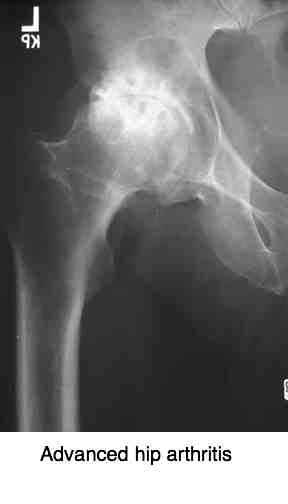
Notice:
* Flattening of the head of the hip bone.
* Loss of the joint space.
* Sclerosis - white bone being laid down.
* Cysts forming in both the head and/or the acetabulum.
Upper leg pain spreading down towards the knee is the norm.

Cysts within the ball of the hip? Nope, one of the most beautiful photos taken from the Hubble telescope of the halo of light around a star in the Milky Way. It's been called Starry Night, so named because it reminded astronomers of the Van Gogh painting.
Research
Recent research on hip pain done in a collaboration between six medical institutes, and published in BMJ 2015, has come up with some very disturbing results:
1. Most patients with frequent hip pain did not have radiographic hip arthritis.
2. Most patients with radiographic hip arthritis did not have frequent hip pain.
What it means is that the hip arthritis seen on the x-ray may well be what is called an "incidental finding". True but quite unrelated to the pain that you are experiencing; a hip replacement will not relieve your symptoms.
A testimony received
I am a fifty year old woman diagnosed with severe osteoarthritis of the hip twelve months ago. I first realised all was not well when, after bathing I attempted to stand upright with feet together and noticed that my knee stuck forwards. The medical treatment I have received has been substantial and I have been unimpressed.
I was recommended by a friend to see a chiropractor and I happily agreed as I was in a lot of pain with a very marked limp. And after only a couple of sessions, the pain and the limp are much improved. I now only attend when needed and the relief is almost immediate. I cannot thank him enough for the help and advice he has given me. I dread to think what sort of condition I would be in by now had I gone for an operation. I have found your website invaluable for information on my condition.
I must confess this is the exception that proves the rule; I have never succeeded in treating a patient with severe osteoarthritis so quickly.
- Weight loss is the most important first step in the treatment of hip arthritis. Significant weight loss will save many patients from the knife. While weight loss is never easy, the inevitable deterioration and pain, loss of independence, and threat of surgery should motivate you to get the extra kilograms of butter off. It can be done. Weight loss in the obese helps reduce not only the pain of this degenerative condition, but it reduces the progressive nature of knee arthritis too. Consider our free Weight Loss Programs. They work!
- Accept that activities that cause pain should be limited. This is perhaps easy for the older person, but in young people, not being to dance, or jog is difficult. The alternative sadly is an early hip replacement.
- Cycling and aquacise are good options for hip arthritis, knee arthritis too: Knee arthritis and exercises ...
- Walking is always good, but obviously the distance and terrein will be limited by how advanced your hip arthritis is. Walking benefits ...
- Use of a stick in the hand opposite to the affected hip reduces the demand placed on the hip arthritis joint.
- Chiropractic treatment of the sacro-iliac joints, best done using a ‘Thompson Drop technique’ can make a very significant difference. The usual side-posture chiropractic techniques have to be modified. Report immediately if your chiropractor's treatment gives sharp stabs of pain in the groin. Read more: SACROILIAC JOINT TREATMENT …
- Mobilisation of the hip by YOU the patient on a daily basis is extremely important. It reduces the stiffness, and helps increase the flow of nutrients into the joint, and removes toxic waste products that build up in the joint.
- Your chiropractor should do cross friction of the joint capsule and surrounding muscles, in particular the Adductor magnus. It will be painful.
- Mobilising using a Mulligan Mobilisation belt is also very beneficial for hip arthritis.
- Specific stretches and strengthening exercises are vital in the management of hip arthritis. Hip exercises ...
- Chicken bones broth is better still for the inflammatory hip conditions.
- Non-steroidal Anti-Inflammatory Drugs (NSAIDs) are commonly prescribed for hip arthritis. They have a place but used on a long term basis have serious side effects for the stomach, heart, kidneys and liver.
- Surgery for hip arthritis sometimes simply cannot be avoided. Done by an expert surgeon many people’s life styles have been dramatically improved. Just look at the fabulous Tom Watson! It is of course major surgery, and the risk of a fatty embolus to the heart, lungs and brain as well as the risk of dementia should the anaesthetic not go well, all must be weighed.
I have no regrets: I am brutal in the practice. Every obese person needs to be told clearly, very clearly, at least once, that obesity WILL, INEVITABLY, WILLY-NILLY lead to severe disability and pain in older age, and often starting much sooner. Thereafter I hold my tongue. I too have my vices ... for which I too will pay!
Find me an obese seventy
year-old not suffering from disabling hip, knee or ankle arthritis. Not
too mention high blood pressure, diabetes ... Weight loss can be
achieved, it much be achieved - or face the consequences. It can be
done!
FREE WEIGHT LOSS PROGRAMS >>
It's all about
Right Choices.
For a simple three minute test of fitness , look here: KASCH PULSE RECOVERY TEST >>
For more information on NSAIDs click here ANTI INFLAMMATORY DRUGS >>
Never, ever take two anti-inflammatory drugs simultaneously; like aspirin and Ibuprofen.
• For more medical information about
HipReplacement ...
• For more about the danger of developing " Anaesthetic Alzheimers " disease after surgery, click here:
ANAESTHETIC ALZHEIMERS
Complications of hip surgery
Total hip replacement is of course major surgery. Apart from the dangers of the anaesthetic all the risks that pertain to major surgery are relevant. In the main the risk of a embolism to lung, heart or brain.
Added to that is the risk of prosthesis failure. In 2011 DePuy Orthopaedics voluntarily recalled their total hip replacement orthotic and their hip resurfacing orthotic. Described as the Rolls Royce of hip implants it soon became evident that the hip failure rate was unacceptably high at 12%.
May, 2013: Du Puy is facing at least 6,000 lawsuits in the USA, over a 1,000 in the UK and 170 from South African alone.
"I now suffer from debilitating pain in my pelvis and intestines since hip replacement surgery two years ago. I was a very active person; but now I am obliged to take anti inflammatory drugs for the remainder of my life."
Sarna Coetzee (after a DePuy hip implant was fitted.)
One of the common shortcomings of total hip replacement is unequal leg lengths causing a pelvic tilt and scoliosis of the spine leading to chronic sacroiliac and lower back pain. Read more from sacroiliac joint case file.
To find links to topics in bold use the site search function in the navigation bar on your left.
PREVENTION
It's been proved that exercise class benefits arthritis; exercise class benefits arthritis is now beyond debate.
In short, if your hip is a bit stiff take it now, today, to your chiropractor. Start to exercise it every day, make the changes recommended on this page and Lady Luck will be given a big helping hand and perhaps you can avoid progressive hip arthritis and major hip surgery. Do it.
Does diet have a place in the management of hip arthritis?
Osteoarthritis is a disease of hyaline cartilage, the very hard super smooth lining of the bones in a joint. It is a vulnerable tissue as, unlike bone itself and muscle, for example, cartilage has no blood supply of its own. It's totally dependent on movement for a healthy supply of certain nutrients and oxygen in the fluid swishing about.
Even if you have normal movement of the joint, if your diet does not contain those necessary nutrients, and adequate oxygen, or is high in inflammatory dietary foods, then you may still get arthritis in the joints.
Smoking of course limits the oxygen in the blood stream by about 20 percent, and thus every tissue in the body.
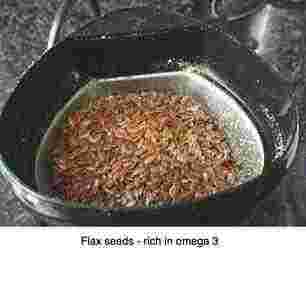
Many foods have been scientifically proved to help, and I list only four here. A chicken bones extract that you can easily make at home; a fish bouillon which you can read about at our how much fish oil page; interesting facts about strawberries unexpectedly include arthritis prevention; it's spring in Holland and we've just enjoyed the first fruits of the harvest, guaranteed to reduce degenerative joint disease, and also improve your eyesight, and reduce cancer; and freshly ground flax seed is the richest vegetable source of omega three.
One food has been proved to promote arthritis, but only if it's found in excess. Polyunsaturated fatty acids are part of the essential diet. You can't live without them.
But if your diet has too many polyunsaturates, raising the omega 6 to 3 ratio, then it becomes strongly inflammatory in joints, muscles, blood vessels and organs.
The solution is to eat some seed oils, especially cold extracted if you can find them, but most of your vegetable oil should come from the olive which is very low in polyunsaturated fatty acids, and avocados.
There is growing interest in the role of capsaicin, the heat in chilis, as an a natural anti inflammatory and painkiller. Jalapenos are my favourite; they have many other beneficial properties incidentally.
A few jalapeno plants, covered with their bright red fruit, will provoke interest and discussion in any flower bed. Read more at anti inflammatory chili.
- Chicken bones
- How much fish oil?
- Interesting facts about strawberries
- Flax seed nutrition information; I prefer flax seed for my omega 3. It doesn't repeat as much as fish oil.
Groin and thigh pain
A key feature of hip arthritis is groin and thigh pain. Especially in the young person it needs to be evaluated before it turns into stubborn hip arthritis.
IMPORTANT CONSIDERATIONS @ HIP ARTHRITIS
Smoking
Orthopaedic surgeon, Jonathan Cluett, states that stopping smoking before hip arthritis surgery is a must. It is generally recognised that smoking is one of the prime reasons for a poor outcome from all surgery; there's simply too little oxygen for the tissues to heal.
I was yesterday consulted with a new patient with severe low back and leg pain. He is having difficulty urinating, and can't lift his heel from the ground. The first surgery was a botch, the second much better and for a month he had much less pain. But nobody warned him to stop smoking (so he says anyway), and now it's a real mess. With inadequate oxygen those tissues never had the chance to heal properly. He's looking to chiropractic for a miracle. Those we do at once, the impossible takes a little longer!
I've spelt it out to him: Stop smoking or I won't accept you as a patient, because we won't win. We may not anyway.
- Stop smoking permanently
- How disabling is your pain? Hip pain questionaire
- Go from HIP ARTHRITIS to our Early symptoms of arthritis home page
- Pain in the groin and front or side of the thigh. It may not be hip arthritis ... Meralgia paresthetica
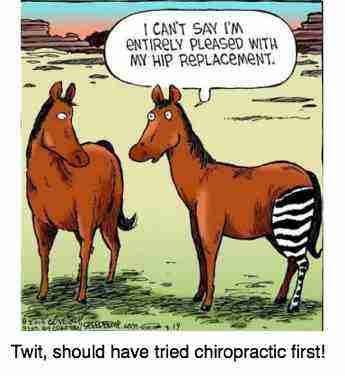
On the lighter side of hip arthritis
- Home
- Hip arthritis
Did you find this page useful? Then perhaps forward it to a suffering friend. Better still, Tweet or Face Book it.
MONTHLY NEWSLETTER. Signed up yet? It is free.
BACK ISSUES
Chiropractic Help Backissues ... our monthly newsletter, click here for all the old issues.
- Issue #53: No short cuts to better health / Simple balance and quad strengthening exercises
- Issue #52: Needs an adjustment / Everything must change
- Issue #51: Elective surgery in the elderly / Cooling and reheating starches
- Issue #50: Make time for breakfast / Scrambled eggs and parsley
- Issue #49: Consulting a locum / Green salad /Eggs Florentine
- Issue #48: Hips and the sacroiliac joints/ Bacon and eggs
- Issue #47: Life without medication/ Eight coloured foods
- Issue #46: Lower backs and ankles/ kaempferol and cancer prevention
- Issue #45: Tingling, weakness and malaise/ vitamin B1
- Issue #44: Applying general chiropractic principles to the hand / Omega-3
- Issue #43: Art and science of chiropractic / Kale
- Issue #42: Tum sleeping / Flaxseed
- Issue #41: Adult potty training / Beetroot constipation
- Issue #40: Ominous lumbar signs / Too much medication?
- Issue #39: Swapping chiropractors / Butter is back
- Issue #38: Making a correct diagnosis / Make your own pesto in five minutes.
- Issue #37: Have your wisdom teeth out in the chair
- Issue #06: Safety on the Stairs / Ginger
- Issue #05: Safety in the home / Red foods
- Issue #04: Whiplash and the Joints of Luschka / Parsley
- Issue #03: How to stop falling / Danger of a low fat diet
- Issue #01: Tingling in the arms and hands / Apples
(PS. If you find them irrelevant to your needs or an exercise in tedium, one click will UNsubscribe you.)
- Home
- Hip arthritis
