- Home
- Sprained ankle
Sprained ankle
A sprained ankle happens at least once to almost everyone; occasionally it can ruin the rest of your life; many tissues are commonly involved.
Lower leg injuries often occur when there is weakness of one or more muscles on the side of the lower leg, commonly one of the Peroneus muscles. Normally these muscles should prevents the ankle from twisting, most commonly inwards, called inversion.
This page was last updated by Dr Barrie Lewis on 23rd March, 2019.
The talus bone moves mainly in one mode, called dorsi and plantar flexion; up and down. When an ankle is sprained, the bone subluxates within its socket, see below, causing jamming. This is what causes the severe, sharp pain of a sprain.
The talus may remain partly locked for years, if not correctly freed with the appropriate adjustment, changing the whole movement pattern of the foot, knee and hip. At chiropractic coalface 2 you can read about how the Dutch national marathon champion had to stop running because of knee pain that was directly caused by an untreated ankle sprain.
The talus sits on top of the calcaneus, or heel bone, in what is known as the subtalar joint. Can you also see the ankle mortice in the pictures below?
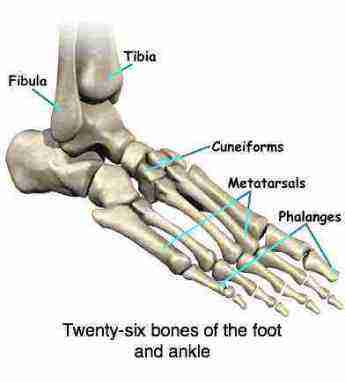
There are so many bones and joints, with so much pain potential.
The joint or, ankle mortise, as it is called, is formed between two leg bones, the tibia and the fibula and the talus.
The talus fits snugly into a socket formed by the tibia and the fibula, moving like a hinge and allowing the foot to move up and down, supported by an array of ligaments.
Trauma is probably the most common cause of ankle joint pain, but other conditions like a flat foot, or an arthritic hip that change the gait could also be a factor.
Very serious injuries can happen to this complex as you can read about in this ankle joint pain casefile.
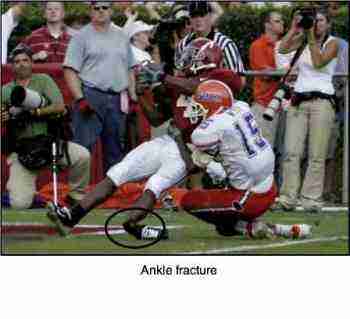
The more common fractures are of the ends of the long bones, the tibia and fibula. However, fracture can occur of any of the ankle bones.
Whenever there's enough force to break a bone, assume that there have been torn ligaments too.
How reliable are xrays? A missed fracture can have terrible consequences for the ankle. Scroll down for this case of avascular necrosis.
Careful correction of any ankle mortise and subtalar joint subuxations is a very important, and oft neglected, part of the successful treatment of a sprained ankle.
- Ankle joint pain casefile; a serious injury on the stairs.
- Ankle joint pain case file; runner's foot.
- Chiropractic Coalface 2
- How reliable are x-rays?
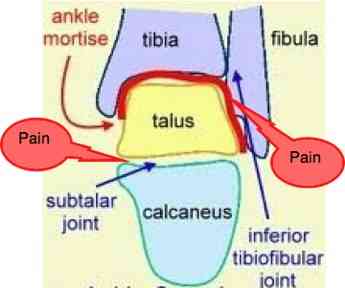
Ankle mortise and Subtalar joints
LIGAMENTS
There are ligaments on both sides of the ankle that hold the bones together. They give the joint stability. They connect bones together while tendons connect muscles to the osseous structures.
In an inversion sprained ankle, the most common injury, usually it is the ligaments on the outer side that are stretched and occasionally ruptured. Bruising is a sign that there has been some tearing of the tissues.
Should that correction of the subluxations in the ankle not be done, it leads to vital changes to the biomechanics of the foot. This is usually the underlying cause of chronic pain, plantar myofascitis and more difficult to predict changes in the knees, hips and spine.
Yes, that arthritic knee may be the result of an old ankle injury that wasn't properly cared for.
An ankle guard may be useful during the healing phase of the damaged ligaments. Research shows that small movements of the joint, rather than total immobilization as in a cast, for example, promotes faster healing in the treatment of a sprained lower limb.
The trend today is towards a boot that limits movement, provides pressure to reduce swelling, but can be removed for icing, bathing and gentle non weight bearing exercises.
Crutches may be vital for a period in a serious injury. However, keep the ankle mobile and moving, gently if it's swollen and sore, by doing the alphabet exercises. Soon something coming up on YouTube for you, but for the moment just wriggle the joint about whilst you are sitting.
A strong recommendation; if you know your ankle is not getting better, get a scan. Fractures of the one of the tarsal bones lurk and are often missed on plain xrays, sometimes with very serious consequences.
Muscles of the ankle
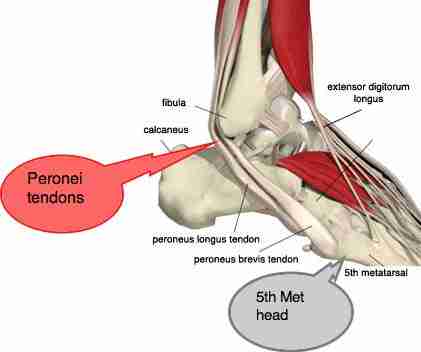
There are also many tendons that cross the ankle to move the foot and the toes. Tendons connect muscle to bone, enabling you to move your foot; the muscles of the ankle are commonly involved.
The muscles usually affected lie on the outer side of the lower leg. There are three of them called the peronei group, plus a few others, mainly for moving the toes.
The contraction of Peroneus Brevis may be so sudden and severe, in attempting to prevent inversion ankle sprain, that it ruptures off its attachment to the bone. This is called a Jones fracture and immobilisation in a cast is essential.
As with all conditions, much of the emphasis needs to be with get properly better, before returning to active sports.
Sprained Ankle Treatment @ Chiropractic Help
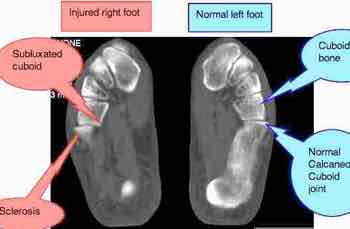
- Displaced bones are often associated with sprained ankle, usually the Talus bone, the Calcaneus bone and the Cuboid bone. Correction of these subluxations is an essential part of the treatment of a sprained ankle. For more about the immobilisation arthritis that comes from uncorrected subluxations. Chiropractic subluxation ...
- The ankle ligaments may be associated with ankle sprain, with stretching and possible tearing of these ligaments. Swelling and bruising are common findings. Rupture is uncommon.
- Muscle and tendon sprain may also occur. The achilles tendon and the muscle on the outer part of the leg are most frequently involved in ankle sprain.
- Less commonly, bones may be fractured in a sprained ankle. Most usually the knobby on the outer side of the ankle (the lateral maleolus) and the end of a bone on the side of the foot may be involved. They are the attachments for the ligaments and tendons of the ankle which are often stronger than the bone itself (aka an avulsion fracture ). Immobilisation is then essential, and occasionally a pin or plate may be necessary if a fracture has occurred in your ankle sprain. It doesn't take much imagination to guess this is a job for a good orthopaedic surgeon ...
There is some interesting research that magnetic care may help in the healing of ankle fractures and sprained ankle.
ANKLE SPRAIN TREATMENT
- ICE should immediately be applied after a sprain of the ankle. This can best be done with an ice block immediately over the effected painful area. COLD HOT THERAPY ...
- COMPRESSION may be important if it starts to swell. This is done with a compression bandage which should be professionally applied, but needs to be loosened regularly to allow movement of the joint (which has been shown to promote healing) and so that ice can be applied.
- ELEVATION is necessary if more extreme swelling occurs.
- CHIROPRACTIC HELP
management of this very painful condition is particularly successful
because it addresses subluxation of bones that usually occurs, and looks
for the underlying cause which may be in the low back or sacro-iliac
joint. Remember, it is the weakness of a muscle that allows the ankle to
invert and sprain. For more information on Chiropractic ankle sprain treatment ,
click here: ANKLE SPRAIN TREATMENT ...
- REHABILITATION of the ankle is essential. For more about ankle exercises , click here: ANKLE EXERCISES ...
X-RAY may be important to rule out fracture. It will then need to be cast for 6 weeks. A crack may not show up immediately, so the X-ray may need to be repeated after 10 days if fracture is still suspected.
If you don't rehab your ankle then plantar myofascitis is one not unlikely result.
Hip arthritis
- KELLGREN LAWRENCE Hip arthritis grading system.
A chronically fixated ankle mortise or subtalar joint after a sprain that was not adequately managed, prevents normal pronation whilst walking and running.
This changes the whole gait cycle producing
strain on all the joints above. Hip arthritis is but one consequence.
This Kellgren Lawrence grading system is a useful measure of the
severity of the degenerative change.
Hip arthritis starts insidiously with discomfort and stiffness in the groin, side of the pelvis or buttock, often around fifty years of age. Initially it's intermittent, coming and going, eventually after about a year becoming a constant nagging ache with some sharp stabs.
Because it changes the biomechanics of walking, it begins to affect the sacroiliac joint and buttock pain is not uncommon.
Eventually raising the leg to put a sock on becomes painful and restricted. The key, as with all disease, is an early diagnosis and the correct treatment. In the case of hip arthritis that might just be a simple set of exercises done faithfully and some dietary changes to include rich sources of omega 3.
Fatty fish like salmon and freshly ground flax seeds are the best sources.
I will endeavor to answer every question you pose about your health. Please write in decent English if it's your home language.
The more detail you give the more useful you will find my reply.
Do you have a question about your health?
Do you have a question? Shoot! Please include important details such as when the problem started, what increases and relieves the pain, which movements cause dizziness, for example, whether the pain radiates to all the fingers or just the thumb and forefinger, or just certain parts of the leg.
A two line question will get an answer of zero value.
About Dr Barrie Lewis DC
What Other Visitors Have Said
Click below to see contributions from other visitors.
Post 4month ankle sprain now pinch nerve pain leg 
Pinch nerve up back leg.
I need far more information to give you a useful reply, Dee.
Dr B
sprained ankle
Hello.
I sprained my ankle 2 weeks ago; went to hospital, and had x-ray, and been wearing an air cast and on crutches. Today is the last day og the air …
My foot and whole leg still hurts Not rated yet
About 2 months ago I was trying to move my boyfriend's motorcycle (out of spite, trying to make a point, I'm 105 lbs) which is about 800 lb and I slipped …
Occasional acute pain in ankle following sprain Not rated yet
Occasional acute pain in ankle following sprain requires a professional evaluation.
Good evening, 3 months ago I rolled my right ankle badly playing …
Leg different than before Not rated yet
I have spinal bifida occulta just above my tail bone. Chiropractors have been trying to straighten my scoliosis caused by this. In the process they have …
Sprained ankle and am experiencing pains in knee and thigh Not rated yet
Three weeks ago I sprained my right ankle while playing soccer. I was running and my foot went to the side and I heard a "pop". I immediately experienced …
Left leg chronic daily pain and atrophy Not rated yet
Orthopedist put me in a boot for right Achilles tendinitis. During that period I hurt my left leg, and no one could figure out what was injured. Mri showed …
Multiple ankle sprains Not rated yet
I was a gymnast for 9 years and during the last three years of my career I had sprained my ankles about 10 times. After this I decided to quit and move …
Ankle sprain Not rated yet
I was playing basketball and I took a wrong turn, and rolled my ankle. Now I have this huge bruise sticking out that's literally where my bone that's off …
Foot/ankle problems Not rated yet
Hi, when I was in sixth grade I sprained my foot when I tripped on my toe. Now I am in eighth grade and during that period of time my ankle would hurt. …
Left ankle pain -causing other pain Not rated yet
Hi; around 2009 I turned to walk; there was a very small stomp like a sidewalk but really low & wasn't visible. By me turning to walk away, I had a twist …
hip and thigh weakness after minimal exertion Not rated yet
In early June of 2013 I noticed a slight feeling of tightness in my right thigh near the hip bone. Within days I was experiencing rapidly increasing muscle …
Tingling burning hip Not rated yet
Tingling burning hip
I sprained my right ankle two months ago and recently have had a hard time sleeping. When I sleep on my side, my right hip has …
Knee pain Not rated yet
Knee pain
Can an old ankle break cause Knee to become bone on bone?
Dr. Barrie Lewis
Most certainly. Take an old dry stick and …
outer ankle pain and swollen Not rated yet
Outer ankle pain and swollen
On the outer side of my ankle is swollen, and hurts and I run and point my toes, I am in track and run a lot. What could …
Sprained left ankle ,foot hurts and so does whole leg. Went to ER 2x and my own Dr. Said to use crutches Not rated yet
My left leg hurts so bad and I can not lift it to put it on the bed or couch.My knee cap hurts too mostly at bedtime. What do you suggest?
…
broken fibula in two places. Not rated yet
Soprt injury during gymnastics. Broken Fibula in two places. Ankle and below the knee. I am worried that i have ruptured ligaments. How do these heal if …
ankle pain Not rated yet
Ankle okay to stand on but, hurts to bend ankle to walk.It started when I got cellulitis in my right ankle. the cellulitis healed but,pain still stayed …
Very Swollen foot caused by rolling ankle Not rated yet
I was at camp and I was running across a rock and thought it was just a rolled ankle so i didn't elevate it or anything but it hurt and now my whole fott …
Kellgren -lawrence grading Not rated yet
In most of the research papers the abmormality in bones are calssified on the basis on kellgren lawrence garde values. ... I have some questions related …
Ankle/foot injury Not rated yet
I was returning a serve in tennis. I leaped out to get to the ball and landed on the outside of my right foot. I heard a crunch or pop-like sound and …
Multifactorial lower back pain and immobility. Not rated yet
Hi
I am 49 and in constant pain and unable sometimes to move.
I have been diagnosed with facet joint arthropathy (mri) after 20 years of back pain …
ankle pain Not rated yet
was playing football about 10 years ago and hurt my ankle which when got advice said it was ligament dammage but every now and again my ankle seems to …
hurt ankle Not rated yet
now pain in my groin and thigh
Dr. Barrie Lewis
The details provided are too scant to provide an intelligent answer, but recognise …
lateral right ankle sprain Not rated yet
i had this untreated for 4 years, i need to know which muscles are tight, i used to squat alot and did alot of single leg excercise. i feel alot of spasms …
IMPORTANT CONSIDERATIONS
- Home
- Sprained ankle
Did you find this page useful? Then perhaps forward it to a suffering friend. Better still, Tweet or Face Book it.
MONTHLY NEWSLETTER. Signed up yet? It is free.
BACK ISSUES
Chiropractic Help Backissues ... our monthly newsletter, click here for all the old issues.
- Issue #53: No short cuts to better health / Simple balance and quad strengthening exercises
- Issue #52: Needs an adjustment / Everything must change
- Issue #51: Elective surgery in the elderly / Cooling and reheating starches
- Issue #50: Make time for breakfast / Scrambled eggs and parsley
- Issue #49: Consulting a locum / Green salad /Eggs Florentine
- Issue #48: Hips and the sacroiliac joints/ Bacon and eggs
- Issue #47: Life without medication/ Eight coloured foods
- Issue #46: Lower backs and ankles/ kaempferol and cancer prevention
- Issue #45: Tingling, weakness and malaise/ vitamin B1
- Issue #44: Applying general chiropractic principles to the hand / Omega-3
- Issue #43: Art and science of chiropractic / Kale
- Issue #42: Tum sleeping / Flaxseed
- Issue #41: Adult potty training / Beetroot constipation
- Issue #40: Ominous lumbar signs / Too much medication?
- Issue #39: Swapping chiropractors / Butter is back
- Issue #38: Making a correct diagnosis / Make your own pesto in five minutes.
- Issue #37: Have your wisdom teeth out in the chair
- Issue #06: Safety on the Stairs / Ginger
- Issue #05: Safety in the home / Red foods
- Issue #04: Whiplash and the Joints of Luschka / Parsley
- Issue #03: How to stop falling / Danger of a low fat diet
- Issue #01: Tingling in the arms and hands / Apples
(PS. If you find them irrelevant to your needs or an exercise in tedium, one click will UNsubscribe you.)
- Home
- Sprained ankle
