- Home
- Carpal tunnel syn
Carpal tunnel syndrome
Carpal tunnel syndrome is a double crush syndrome, in the neck and wrists usually, but sometimes mimicked by the pronator teres muscle; tingling in arms and hands is the norm.
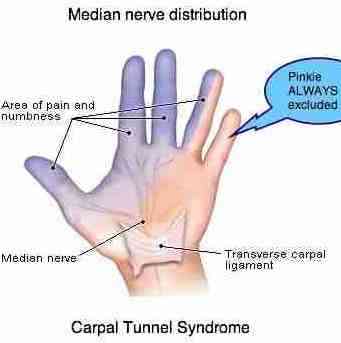
This condition usually awakens the sufferer in the early hours of the morning with tingling and sometimes an achy pain on the thumb side of the hand; the little finger is always excluded.
Often it is worse in your dominant hand due to repetitive use of the lower arm causing over activity of the pronator teres muscle and stretching out the brachial plexus of nerves in the neck.
It's common for example in the mouse arm of folk who spend the whole day on computers, and carpenters who are hammering or using a screwdriver.
So too those who are carrying heavy bags in the hands, like grocery shopping.
Any condition that causes swelling in the arm can also affect the nerve. For example, preeclampsia of pregnancy.
But perhaps the tingling has started in the other hand too? Does the pain spread from the fingers up into your forearm?
Is there tingling in arms and hands? Usually it's one side only, or one is far worse. It certainly could also cause shoulder pain. You probably have carpal tunnel syndrome. It effects the median nerve.
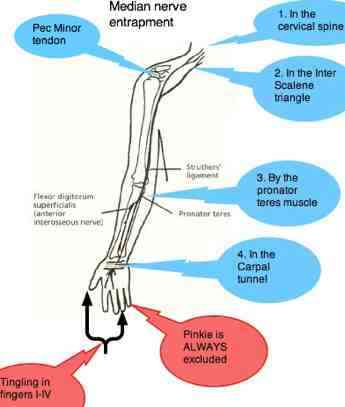
This is known as a double crush syndrome. The median nerve is irritated in two or more places. While diabetes and an under active thyroid need to be considered, the usual cause of is an irritation of the nerves either
- As the the nerves exit from the cervical spine; see neck pain anatomy.
- As the nerves pass between the first rib and the collar bone; see thoracic outlet syndrome.
- And as the median nerve passes through a tunnel in the wrist.
- Or as the median nerve in the forearm passes between the bellies of the pronator teres muscle.
Conditions such as pregnancy and wrist injuries that cause temporary fluid retention can also cause median nerve irritation.
The median nerve passes between the two heads of the pronator teres muscle in the forearm where an entrapment may also occur.
Tingling in arms and hands
Tingling in arms and hands has to be carefully examined and followed up. It's not always carpal tunnel syndrome; in fact it usually isn't.
And it never is if the pinkie is involved.
"Yet in a certain number of cases where diagnosis of the carpal tunnel is revealed....one can obtain remarkable improvement by a cervical manipulation."
Dr. Robert Maigne, MD
"Orthopedic Medicine, a new approach to vertebral manipulations," Maigne and Liberson.
Pronator teres
The medium nerve can also be trapped as it passes between the bellies of the pronator teres muscle; the same pattern of tingling in arms and hands is produced as in carpal tunnel syndrome.
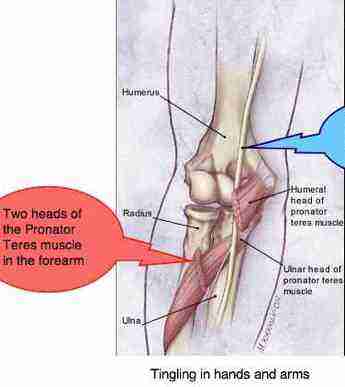
- Pronator teres syndrome causes a severe pain radiating down lower arm to fingers 1-4, mimicking CTS.
What is carpal tunnel syndrome?
You have probably come to this site asking what is carpal tunnel syndrome?
Sites of injury are in the lower neck region, the shoulder, around the elbow and in the wrist. Do you have tenderness in the forearm just below the elbow? Pain in the neck or shoulder or chest?
Another potential site of irritation of the nerve is as it passes under the tendon of the pectoralis minor muscle.
Press first, quite deeply, in the forearm of your good arm, or the less tingly arm, and then in the naughty arm. Is it quite tender? Even stronger, does it start off the tingling in your fingers?
Turn your head to the side and look up. Neck pain or tingling? Raise your arm above your head. Does it increase the tingling? Raise your arms to the side and then stretch them backwards.
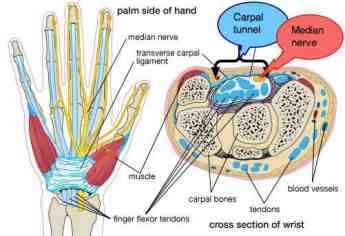
The bones of the wrist are called the carpals. The nerve that controls the thumb side of your hand, the median nerve, travels through a narrow tunnel especially created to protect the nerve.
Carpal tunnel syndrome is a progressive condition caused by compression of the nerve, starting in the neck, perhaps in the forearm and finally in the carpal tunnel in the wrist. It may eventually cause weakness and wasting of the thumb muscles. How strongly can you press your thumb against the tip of your other fingers?
Can you seen the tunnel formed by the carpal bones, surrounding and protecting the flexor tendons that control the fingers, and the yellow median nerve?
And can you see the transverse carpal ligament in blue that holds the bundle of tendons and the median nerve in place, and stabilise the wrist? More about that ligament later.
What are the causes of
carpal tunnel syndrome?
So, what are the causes of carpal tunnel syndrome?
There is little research proving that repetitive and forceful movements of the hand and wrist during work are the cause of carpal tunnel syndrome. However it is suspected.
Contrary to popular belief, research shows that computer use does not increase the risk of carpal tunnel syndrome. However, poor computer ergonomics does increase the risk of hand and arm pain.
What
does increase the risk of CTS is an old neck injury. Read more about
how an "old whiplash" may cause IMMBOLISATION ARTHRITIS, one of the main
causes of CTS.
So does the water retention of pregnancy.
Inter scalene triangle
The inter scalene triangle is a narrow space in the lower neck through which the artery and nerves to the arm pass; your chiropractor will probably do Adson's test to check if this is the underlying cause of your carpal tunnel syndrome.
Early diagnosis and treatment is important because of the risk of permanent damage to the median nerve. This starts with a good physical examination of the neck and the upper limbs. Your chiropractor will look for change in reflexes, weakness and atrophy of muscles, and sensory changes in the hands. In particular for 'two-point discrimination'. Can you distinguish whether one or two pins are pricking, comparing the effected and the unaffected hands, particularly when they are less than 10 mm apart.
There are four important neurological tests:
- Tinel’s test, in which s/he will tap on the median nerve in your wrist.
- Phalen's test, a wrist-flexion test is done by pressing the backs of the hands together.
- Adson's test in which the pulse in your wrist will be tested, while turning the head and taking in a deep breath. This test is looking for an impingement in the area of the Inter scalene triangle ...
- Upper Limb Tension Test ...
You can do this last test at home.
Do these tests cause tingling or give electric shocks in the first three fingers, and sometimes the ring finger but never the pinkie?
Nerve conduction tests, ultrasound imaging and MRI can be useful, but usually serve only to confirm what is already known.
Questionnaire
Patients often question whether they are fussing about nothing. The Boston Carpal Tunnel Syndrome questionnaire will give you an objective measure of how severe your symptoms are and, after Chiropractic Help treatment, whether it was effective or not.
The arm pain quick DASH questionnaire is more general but is certainly also appropriate.
Lower Cervical Facet Anatomy
The lower cervical facet anatomy is vitally involved in the shoulder-arm-elbow-hand-syndromes and Why do we hiccup. These pages will
give you an idea of the reasons behind it:
Read more about the LOWER CERVICAL FACET ANATOMY ...
An aside: WHY DO WE HICCUP ?
Chiropractic help
Chiropractic help is always directed at the cause of the tingling in your hand and arm, and not the symptoms per se; the pinkie is always excluded in carpal tunnel syndrome.
Depending on where the nerve is being crushed, usually either in the neck, the forearm or the wrist, your chiropractor will use various techniques to release the pressure on the nerve. One of the common sites of the ‘double crush’ is between the first rib, the collar-bone and some neck muscles.
The symptoms of Carpal Tunnel Syndrome often begin long after an injury to the collar-bone and upper thorax, in a fall for example on the outstretched arm.
S/he may stretching the muscles of the forearm where the nerve is sometimes entrapped, as well as adjustments of any subluxations of the carpal bones in the wrist.
You may be given some Carpal Tunnel syndrome exercises that sometimes help.
Vitamin B6 reduces fluid retention and may help, particularly in pregnancy. Best from green leafy veges like broccoli and spinach. New research indicates that B6 overdose from pills can be a problem, so rather from foods rich in the B vitamins.
Then there will be chiropractic rehabilitation of the joints and muscles to prevent re-occurence. S/he may recommend a reduction of heavy activities of the arm, and even a wrist splint.
Reported dangers of CTS surgery
The reported dangers of CTS surgery include bleeding, infection, and nerve injury. Some pain, swelling, and stiffness can be expected. Minor soreness in the palm is common for several months after surgery. Severe problems are rare. You may be instructed to elevate your hand and move your fingers after surgery. This helps minimize swelling and stiffness.
Most patients see their symptoms improve after surgery, but recovery may be gradual. On average, grip and pinch strength generally return by about 2 months after surgery. Complete recovery may take up to a year. If significant pain and weakness continue for more than 2 months, your physician may instruct you to work with a hand therapist. If carpal tunnel syndrome has been present longer and the nerve is more severely affected before treatment is attempted, recovery is slower and less complete.
It is reported that corticosteriods injections usually bring only temporary relief and can contribute to tendon rupture.
Are there risks from chiropractic treatment? It must be acknowledged
that no treatment exists that is not without some element of risk. There
is no treatment of the upper cervical spine, where most potential
(albeit extremely rare) complications may occur.
- For dangers of chiropractic treatment. STROKE CHIROPRACTIC
- (doctor caused) Iatrogenic Illness ...
- Dangers of anti inflammatory drugs such as Ibuprofen ...
- Index finger sprain
Useful links
- Chiropractic Conditions is a central page at our site. It provides you simply and easily with the sorts of diagnoses that the average DC would be treating.
- Healthy Living Tips is another vital page at Chiropractic Help. Sparkling wellbeing is not just about having your subluxations adjusted. This link gives you some insights into different foods you could and perhaps should be eating.
FROM THE COALFACE.
Two months ago I was consulted my a man for severe pain in the leg whilst walking. At the same time he informed that he was scheduled in a week's time for a carpal tunnel syndrome operation.
Perhaps foolishly, I decided to focus on why he came to see me: his leg. However, when he told me the pain was in his fourth and fifth fingers, I simply said it was most atypical of a carpal tunnel syndrome, and got on with the treatment of his sacro iliac joint. No point rocking the boat.
Yesterday, he was unable to shake my hand, his fingers were so painful. A quick examination confirmed that this was indeed no carpal tunnel syndrome. Diagnosis is important. It's little wonder the operation didn't help, the pain has nothing to do with the median nerve. In fact he has developed severe shoulder pain since the operation.
Happily, the pain he has had in his leg is about 50% better, and he can walk for an hour with the dog with no great difficulty. He has now gone on 3 months holiday, and we will re evaluate both his neck shoulder hand pain and the status of his sacro iliac joint.
Update: His leg pain was moderately good on holiday, thought the rehab exercises proved vital. He now comes for an occasional but regular chiropractic treatment.
Medical opinion is that he experienced a nasty post-surgical condition called reflex sympathetic dystrophy. Happily a combination of physical therapy and chiropractic has proved very beneficial for his hand and shoulder.
FROM THE COALFACE II
5 months ago a man consulted me with an acute right carpal tunnel syndrome. Tingling in the first three fingers of the right hand wakened him every night in the early hours. He had had the condition for 7 months - it was unresponsive to his doctor's treatment, and surgery was planned.
The classic test of Phalen was strongly positive.
I warned him that there was no strong research confirming that chiropractic helps CTS, but because he had a fixation of the first rib, affecting the Inter Scalene Triangle I was fairly certain I could help him.
He came in this morning for his two month maintenance treatment. He declared the pain from his carpal tunnel syndrome is 95% over.
That day he was suffering from lower back pain, in fact eminating from the sacrum in his pelvis:
Read more about Sacroiliac joint treatment …
A systemic research review of the literature...
- Arch Physical Medicine & Rehab 2010; 91: http://www.archives-pmr.org/article/S0003-9993%2810%2900229- 7/abstract
- A systemic review of
the literature for Surgical intervention ...
http://www.archives-pmr.org/article/S0003-9993%2810%2900230- 3/abstract
Alas the researchers found that there is no conclusive evidence that there is any non-surgical treatment (chiropractic, or other) that provides any long term benefit.
"The majority of the review focused on the strong and moderate evidence for the effectiveness of corticosteroids (oral and injected) with injections providing the most (short term) benefit. Studies continue to support that injections do not have any positive long term results..." (bold mine)
Night splints (in the neutral position), ergonomic keyboards and local corticosteroid injections provided short term relief.
It's time we chiropractors put our minds to doing some creditable research. I KNOW chiropractic treatment helps CTS! In the long term though an occasional regular maintenance treatment is usually reguired - as with most chronic joint conditions.
No "strong" evidence for any treatment was found.
CARPAL TUNNEL EXERCISES
Along with the chiropractic treatment to release the irritated nerve causing the tingling in your fingers, it would be a good idea to do these carpal tunnel exercises ...
in fact no harm in trying them for a few weeks first.
- Home
- Carpal tunnel syn
Did you find this page useful? Then perhaps forward it to a suffering friend. Better still, Tweet or Face Book it.
MONTHLY NEWSLETTER. Signed up yet? It is free.
BACK ISSUES
Chiropractic Help Backissues ... our monthly newsletter, click here for all the old issues.
- Issue #53: No short cuts to better health / Simple balance and quad strengthening exercises
- Issue #52: Needs an adjustment / Everything must change
- Issue #51: Elective surgery in the elderly / Cooling and reheating starches
- Issue #50: Make time for breakfast / Scrambled eggs and parsley
- Issue #49: Consulting a locum / Green salad /Eggs Florentine
- Issue #48: Hips and the sacroiliac joints/ Bacon and eggs
- Issue #47: Life without medication/ Eight coloured foods
- Issue #46: Lower backs and ankles/ kaempferol and cancer prevention
- Issue #45: Tingling, weakness and malaise/ vitamin B1
- Issue #44: Applying general chiropractic principles to the hand / Omega-3
- Issue #43: Art and science of chiropractic / Kale
- Issue #42: Tum sleeping / Flaxseed
- Issue #41: Adult potty training / Beetroot constipation
- Issue #40: Ominous lumbar signs / Too much medication?
- Issue #39: Swapping chiropractors / Butter is back
- Issue #38: Making a correct diagnosis / Make your own pesto in five minutes.
- Issue #37: Have your wisdom teeth out in the chair
- Issue #06: Safety on the Stairs / Ginger
- Issue #05: Safety in the home / Red foods
- Issue #04: Whiplash and the Joints of Luschka / Parsley
- Issue #03: How to stop falling / Danger of a low fat diet
- Issue #01: Tingling in the arms and hands / Apples
(PS. If you find them irrelevant to your needs or an exercise in tedium, one click will UNsubscribe you.)
- Home
- Carpal tunnel syn
