- Home
- TOS
Thoracic outlet syndrome
A case of thoracic outlet syndrome is characterised by tingling in the arm and hand when the limb is used above the head. It is also often the underlying cause of carpal tunnel syndrome, tennis elbow and the frozen shoulder.
This page was last updated by Dr Barrie Lewis on 9th July, 2021.
Symptoms of TOS
The symptoms of TOS are varied and complex depending on whether nerves or blood vessels or both, in the neck are involved. Generally only one arm is affected, commonly with pain, tingling in the limb, or just a dull ache.
An ache in the muscles of the lower neck is common.
A central diagnostic question to be faced is whether the pain and tingling in the arm is caused by a nerve root issue, as in a severely compromised intervertebral foramen, or in the thoracic outlet.
One small rule of thumb may be useful; working with the arm above the head worsens the tingling in TOS but generally relieves the pain in a degenerative IVF.
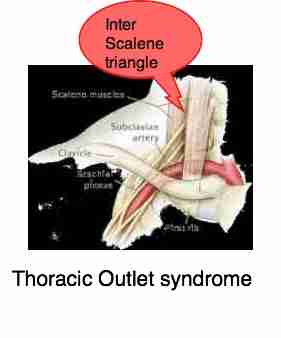
It's not uncommon after a whiplash injury in which there is sudden contraction of the scalene muscles, sometimes subluxating the first rib. Then the inter scalene triangle becomes dysfunctional, affecting the subclavian artery and brachial plexus on their way to the arm.
The classic sign is a reduced pulse in the wrist with certain movements of the head together with breathing.
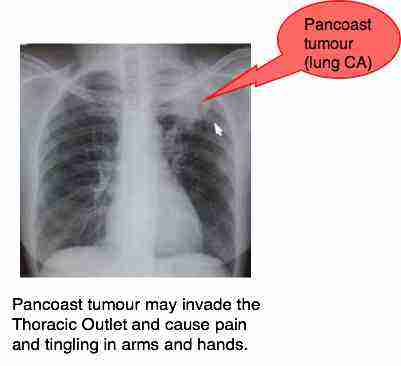
Very occasionally a tumour in the apex of the lung may cause a thoracic outlet syndrome; smokers beware.
1. NERVES
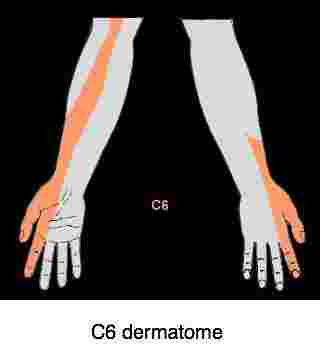
The hallmark of TOS is that a broader spectrum of the arm is often affected, as distinct from a dermatomal pattern, where only a part of the arm is affected.
Why? Because the arm is supplied by five nerve roots, called C5, C6, C7, C8 and T1, so, if you have a pinched nerve in the spine, you are likely to have pain limited to a specific part of the arm, rather than generalised arm pain that may occur in what is sometimes called the first rib syndrome.
You may have just lower arm tingling, in the thumb and forefinger, for example; that's the sixth nerve root from the neck, shown above.
Or in the pinkie and ring finger. That's the C8 dermatome.
In the thoracic outlet syndrome however, not the nerve root per se, but a large bundle of nerves called the brachial plexus is affected, so the pain will be in broader aspects of the arm mostly, and also perhaps over the chest and parts of the shoulder and back.
It is caused primarily from a subluxation of the first rib. This syndrome, because it affects several nerves, also makes you vulnerable to
tennis elbow
and other syndromes of the shoulder and wrist. It's commonly the underlying cause of frozen shoulder and carpal tunnel syndrome for example.
One exception is the eighth cervical nerve root which lies immediately on the first rib. It's affected more than other nerve roots so the ring finger and pinkie may be primarily effected, mimicking a C8 nerve root lesion in the intervertebral foramen.
It's not common, as the vein from the arm only passes through the interscalene triangle in a small percentage of cases, but the venous return from the arm can be affected. Then the arm is likely to swell and it's wise to get a medical opinion; rule out a deep vein thrombosis in the arm.
2. ARTERY
The blood vessel carrying oxygenated blood to the arm may also be affected, in which case the arm may feels cool, and aches with use, a condition called intermittent claudication, more classically felt in the leg.
The arm tends to tire quickly whether from lack of oxygenated blood, or nerve supply, or both. Working above your head, as in using a drill to put in a curtain rail, or hanging the washing, becomes very tiring. More later about why. Mouse arm may also be caused by this condition, if the arm is unsupported.
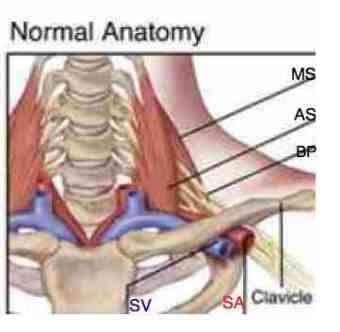
The vein bringing blood back from the arm is rarely involved as it does not usually pass through the "thoracic outlet". If it is affected, the arm may swell alarmingly. Notice here that the vein (blue) does not pass between the anterior and medial scalene muscles.
The triangle formed by the two scalene muscles and the first rib is called the inter scalene triangle.
Thoracic outlet syndrome
Heart Attack
- HEART ATTACK signs ...
- TIETZES SYNDROME CaseFile ... pain in the chest.
- Chiropractic Coalface stories.
Commonly, at the coalface, we see patients who have thought they were having a heart attack if the pain was in the left arm, and also the chest. Sometimes their doctors thought so too. Not infrequently they have been through a whole gamut of cardiac tests, some of them quite invasive and dangerous in themselves.
Obviously, because of the seriousness of a heart condition, this needs to be ruled out first, but our counsel is that, before expensive and invasive tests are considered, it is wise to consult a chiropractor to evaluate whether the pain in the chest and left arm could be coming from the thoracic outlet, rather than a myocardial infarct; or even a Tietze's syndrome.
For an interesting case of a thoracic outlet syndrome, a man who went through a year of misery, and extensive, and very costly medical tests for a heart condition, visit our chiropractic coalface stories.
I'll be waiting for you, whilst you go down these country website lanes, but remember to come back. Sigh, it's so easy to get sidetracked on the web, with so many inviting little cul de sacs.
Use the back arrow to return to this page. Meantime, I'll get a few pictures ready that will show you visually how a first rib subluxation can cause so much pain and tingling in the arm and chest.
If you enjoy reading, chiropractor Bernard Preston tells delightful
inspiring chiropractic stories that will entertain and educate you.
Watch out, expect to be stretched. His hobbies, like soaring with the
eagles, are enthralling, but all the stories are in a chiropractic
context. For an excerpt chapter,
click here.

WHAT IS THE "THORACIC OUTLET"?
aka "Inter Scalene Triangle".
The blood vessels (Subclavian a. and v.) to and from the arm, and a large bundle of nerves (the Brachial Plexus), travel through a narrow passageway that runs in the deep valley just behind and below your collar bone. Run your fingers forward from the large shoulder/ neck muscle forming the nape of the neck. Just before you reach the collar bone you will discover this gully. Deep in it you can feel
- something hard (the first rib) and
- bundles of muscles (the Scalenes),
both of which may cause the Thoracic Outlet Syndrome as the artery and nerves pass through the Inter Scalene Triangle.
Inter scalene triangle
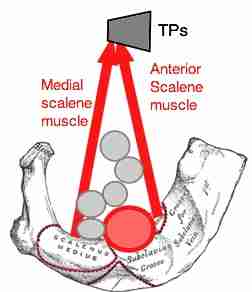
The inter scalene triangle is a passageway made of a triangular gap between the collarbone, the first rib and two large neck muscles (the Scalenes).
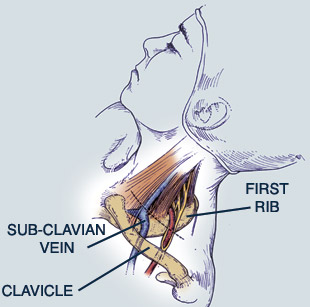
Spasm of the neck muscles, after a car accident, for example, or even after prolonged computer use if the arm is unsupported are often part of the problem.
Subluxation in the region or a hard fall on the limb, which may jam the clavicle up against the rib may contribute to this syndrome.
If there is pressure on the nerves, or the blood vessels, or both, the arm will be affected, usually with a deep ache, and sometimes tingling, and very rarely with wasting of the muscles.
This is the thoracic outlet syndrome.
See how the plexus of nerves, and especially the lowermost C8 root lie on the first rib?
There are other causes of pressure on these nerves and blood vessels. A Pancoast tumour at top of the lung (yes, caused by smoking) or an anomaly that you were born with and others things, but these are rare conditions that may provoke the thoracic outlet syndrome.
Carpal tunnel syndrome
Carpal tunnel syndrome fairly frequently does not respond complete to surgery in the wrist.
Thoracic outlet syndrome may also be a factor in the so called double crush syndrome, and be the underlying cause of a tennis elbow, for example, or carpal tunnel tingling.
Cervical Rib
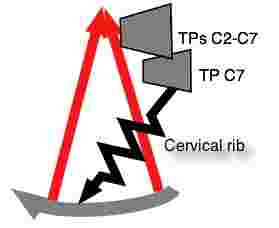
Normally only the thoracic vertebrae in the midback have ribs. Twelve pairs. However, at the transition areas to the low back and neck, sometimes ribs form.
These have been implicated in the thoracic outlet syndrome. Surgeons like to remove them, but I fairly regularly treat people who have had the surgery, and still have the tingling and numbness in the arm.
It's quite a gruesome operation - through the armpit (axilla). Certainly I would suggest you consult your chiropractor for an assessment before having this surgery.
How is TOS diagnosed?
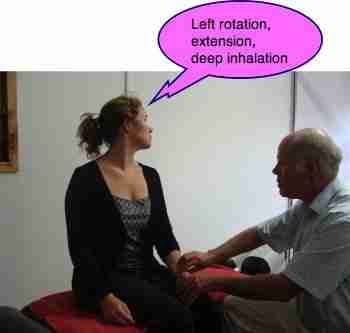
The classical orthopaedic test for Thoracic Outlet Syndrome was designed by a Dr Adson. Your chiropractor will turn your head towards the side of pain, ask you to look up, and take in a deep breath, whilst extending the arm and testing the pulse in your wrist.
You can try it for yourself. Does taking up this position cause tingling or an ache in your arm? Testing the pulse is more subtle, and I think it unlikely you could be objective enough.
Adson's Test
The classic way of doing Adson's test with the arm extended, for me, produces too many false positives: a positive test in a perfectly normal person. So I do it with the arm in the neutral position and, vitally, the pulse must grossly decrease as this position is taken up and return when the head returns to neutral and the patient exhales.
Chiropractic Help Treatment
Chiropractic excels in the management of Thoracic Outlet Syndrome, except in its extremest forms which are very rare. Adjustment of the first rib opens the space in the tunnel, and cross friction of the two muscles that form the sides of the triangle helps too.
Sometimes the joints on either side of the collar bone, may be involved too. AcromioClavicular joint ...
Exercises for the neck and shoulder are important.
This is a complex syndrome, but generally patients respond well to chiropractic management.
Tip: Rest the elbow on a small table placed at your side whilst using the mouse. This takes the stretch off the muscles in the neck, and the nerves. Various commercial supports which attach to the computer station may also help.
Tip: Carrying heavy parcels in that hand is likely to aggravate the pain in the arm, as is working above your head.
Tingling in arms and hands
Tingling in an arm and hand is in clinical experience a common complaint; the fixated first rib and associated scalene muscle spasm is often the underlying cause of many of the arm pain syndromes like frozen shoulder and carpal tunnel tingling; every patient with pain and tingling in the arms and hands should have the Adson's test performed; thoracic outlet syndrome is not rare.
Particularly if the tingling is worse when the hand is being used above the head.
IMPORTANT CONSIDERATIONS
When browsing these links use right click and "Open Link in New Tab", or you may get a bad gateway signal.
Useful links
These two arm pain case histories will be of interest.
Contact me directly right here.
I receive many questions at Chiropractic Help. It might be help for a spinal condition, but it could also be about a failed Carpal Tunnel operation, or some such thing.
I will do that by answering your questions personally, but it will be converted to a Web Page so others can benefit from your questions. Omit your surname if you like.
However, do understand that, in the main, I'm going to be directing you (should it be pertinent) to a Chiropractor in your neck of the woods. I'll respond to all reasonable inquiries, but please be specific, and give some details: which fingers, what increases the pain, and relieves it, injuries, do x-rays show anything, does placing your arm on your head relieve or increase tingling in the arm... without these sort of details, I'm unable to give a sensible answer.
There is no charge for this service, however if you find my answer useful, you might like to consider purchasing my latest book, Stones in my Clog. Gems, both funny and healthful, from the life and work of a Chiropractor. It's only $2.99. Use the site search function.
Pose Me A Question! Pretty please, in decent grammar and spelling.
I will never give or sell your e-mail address to anyone.
PS. If you find my answer instructive, would you please ask a friend to rate the page. Many thanks.
What Other Visitors Have Said
Click below to see contributions from other visitors to this page...
Bicep weakness, aches, and shaking 
Hi, I've been diagnosed with tos neurogalgia and have been rehabing with a chiro for 3 months and off work for the moment. While it's been helping resolve …
Deep stabbing or aching pain in upper back and numb left tip of index finger
Deep stabbing or aching pain in upper back and numb left tip of index finger.
Hello! 4 weeks ago I started to get really bad pain on the left side of …
Burning pain to arm pits, tingling and numbness to my 4th/pinky finger
Why am I still having all the symptoms even after I had a ACDF on my C5C6, had a brachial plexus decompression to my rt side and just recently had a Ulnar …
Pain, spasms in mid back, shoulder blade and right arm
Hoping you can give me some insight as no one else has. The whole thing started when I was doing some vigorous exercises with my arms only. I had some …
Initially there was tingling/numbness in index finger & thumb
Initially there was tingling/numbness in index finger & thumb, then becoming painful.
Hi.
I'm going to try & keep it brief & to the point. It started …
Nimbleness in arm and leg ,
Hello, I've been having trouble with my body for some time or some parts of my body. It all started two weeks ago when I went and got an adjustment and …
Sudden sharp upper back pain after stretching
During a long bike ride, I felt a sharp pain in my left rib, I actually thought for a moment it was a heart issue.
However, two days after the event, …
Do I have Thoracic Outlet syndrome? What should I be doing?
Do I have Thoracic Outlet syndrome? What should I be doing?
I am going to do my best to let you know my symptoms but bear with me that my "injury" seems …
Weakness in right shoulder, trapezius, pectoral and bicep. Also winged scapula
How can this curse be corrected? I've tried various stretches, nerve slides, and an exercise similar to a push up but without bending elbows.
I need …
Tingling in left pinkie and ring finger, sometimes spreads to hand
I have tingling in my left pinkie finger and ring finger for about 3months. It is worse when I lay down at night to watch tv with my head propped up, but …
Numb pinky/ upper inner arm & to chest, just below left collarbone
Hi, I have had this problem for a few years now. Starting with the symptom of a numb left pinky/ & traceable up the inner forearm /near elbow, (which …
Numbness in arm and pain in shoulder
Hello!
My question is around both cure and prevention of my injury/condition.
Symptoms:
My shoulder is painful, more of an ache than an outright …
Sharp pain radiates from collarbone to jaw also dull ache in shoulder and down arm to hand
I have had an ache in my shoulder, arm and hand (left side) for months; then three weeks ago I had a severe pain in my neck (same side as shoulder pain); …
Tingling/Burning/Freezing Hands
I have had this problem now going on a year and my doctor keeps running test after test with no results.
I have arthritis in my neck for about 3 years …
Tingling in left arm, pinkie and ring finger go numb
Tingling in left arm, pinkie and ring finger go numb
I have numbness in my left pinkie and ring finger when bending my arm. Also a decrease in pulse. …
Buzzing in the centre of my chest
Buzzing in the centre of my chest since a fall.
I had a fall seven weeks ago with blunt trauma to the right rib cage causing severe winding. No visible …
Tingling hand (initially mainly thumb and forefinger)
Tingling hand (initially mainly thumb and forefinger but now in all fingers)
I am an otherwise fit healthy 36 year old non-smoking male.
In October …
Tingling in shoulder, neck and down my left arm
What treatment is there to reduce the tingling as I have had this ever since my car accident three years ago? I had a CT scan and the results are C5/6 …
Tingling in fingers
In 2012 after being on the computer for quite a few weeks I had tingling or my pointer, ring, and middle finger, I went to the doctors because I had health …
tinglingand frozen fingers in right hand with pain in upper arm and shoulder.
In 2010 I had a severe auto accident and experienced a blackout. Very soon I experienced a lot of pain, headaches etc, mostly from my left side of neck …
right lower chest wall pain
I was diagnosed with fibromyalgia in my late 20s, and am now in my late 50s. I have recovered (in the last 18 months or so) from a right frozen shoulder …
weak index finger tip
weak index finger tip
I am a guitarist who developed a pain in my forearm and some hand symptoms in my left (fretting, guitar-neck-holding) hand about …
3 months of a tingling finger
Hi, thank you for your site. I had what everyone thought was a pinched nerve at my C6 but only had an xray so we don't know for certain. Most of the pain …
tingling aching arm
Tingling aching arm
This is my third week of the pain. First it was around my shoulder blade and if you rubbed around it, I would holler out in pain. …
Tingling, burning left pinky and ring finger and chest pains.
Ok, this all started after I got whiplash from my trunk crashing down on my head. Now I have tingling and numbness in my left hand (pinky and ring finger) …
Various (Related?) Hand and Joint Issues
Hello,
I'm a 26 yr old male. When I was 16, moving chairs, I started getting burning in my wrist one day. Speaking with a doctor friend, he suggested …
TOS Not rated yet
HOW CAN I LET THE HOSPITALS KNOW IT MAY BE TOS. GRANTED I HAVE HEART DISEASE AND MANY OTHER SYNDROMES AND QUICKLY RULE OUT CAD. IT FEELS LIKE THEY ARE …
Burning and pain down neck and arms, slipped ribs. Please help! Not rated yet
I was diagnosed with bi-lateral slipping rib, where the 10th rib goes up under the 9th. The only part that slips is the cartilage. I have had condition …
Elbow pain, numbness down to ring & pinkie finger, swelling Not rated yet
19 year old female, college softball pitcher. Been pitching since I was 11. No major issues until March 2018. In games, the training staff had to massage …
LEFT SIDE ONLY, NUMBNESS WEAKNESS IN FACE ARM AND HAND Not rated yet
Hello,
I am 34 yo. The only condition worth referring that I have since I'm 22 is Diabetes Type 1. Doing insulin and trying to stay healthy and control …
TOS and blue index finger Not rated yet
I have been diagnosed with TOS and told I have a cervical rib.
GP gave me difene which helps but pain returns when I stop taking them
Tried 3 physiotherapists …
shoulder problem when raised above my head Not rated yet
Hi,
I am a 52 year old painter cum decorator. It sounds silly but when I am painting I struggle to hold my arm up; the brush seems to get heavier and …
Could it be Thoracic Outlet Syndrome? Not rated yet
I've been experiencing shoulder and neck pain for months. I've seen my PCP and a Physiatrist, which have resulted in Physical Therapy for Rotator Cuff …
Right arm - bleh. Not rated yet
Background:
1. I had CTS in this hand with normal return to function about 10 years ago.
2. Earlier this year was diagnosed with RNP. It, too, has …
Tingling fingers, right shoulder pain, numbness on chest near incision Not rated yet
Hello, I have a few questions post surgery. I had my operation done back in October 2015. Here my surgeon removed my cervical rib through an incision done …
Tremor in thumb and arm Not rated yet
Hi,
I would really appreciate an opinion please. I broke my right collarbone in 2 places April 2016 and had a plate inserted, which I had remove 2 weeks …
Sudden immobilizing sharp pain in right side of back Not rated yet
Unsure what to do. The only relief I get is if I can lay flat on my back on a hard surface. Once I am relaxed enough and able to do very slow pelvic thrusts …
Tingling in hand, pain in forearm and back of upper arm along with right shoulderblade, also in armpit and around to the right side of chest; arm tires very easily and alot of muscle wasting Not rated yet
Do these symptoms seem consistent with TOS. If so can you recommend a good chiropractic practice in Arizona for evaluation.
No, Keith, they are not …
Tingling in hands and arms as well as chest ache Not rated yet
Dear Doctor, I would very much appreciate some advice for an issue that has really concerned me for a few years now.
More recent symptoms have been …
Severe deep left arm pain, pins and needles. Thumb and index finger pins and needles and index finger feels cold at tim Not rated yet
Had an injection of lidocaine in upper back by shoulder blade for preparation of removal of surface mole. Couple of days later neck pain started when turning …
Severe deep left arm pain, pins and needles; thumb and index finger pins and needles and index finger feels cold at tim Not rated yet
Had an injection of lidocaine in upper back by the shoulder blade for preparation of removal of a surface mole. Couple of days later neck pain started …
neck pain, severe pain in right arm, shoulder hurts Not rated yet
Well it started as a crook in my neck; then a few days later the pain went to my right shoulder area and then all down my right arm it hurt in sections …
Tingle face, Pain back head radiating, comprehension issues and "lightheaded" Not rated yet
Trying to figure out a path of continued care. I have been thru all major tests. Nuclear stress (heart) eeg, MRI/MRA head/neck. Blood tests all good except …
Neck pain from injury Not rated yet
I have gone to many chiropractors since a car accident in 1993. We were hit in the right side door in an intersection. In Oct 2015, I went to my regular …
Mid back pain with tingling down right arm through to 4th and 5th finger tips Not rated yet
I have a mid back spot pain slightly to the right side of my spine; accompanying this is a 'nerve' or tingling pain through my right arm across the bottom …
Tingling In Right Arm and Numbness of Hands Plus Other Issues Not rated yet
Hey Doc!
I will get straight to it. Here is the run down of my health. When I was in labor with my son (11/3/10), I chose to get an epidural. They did …
tingling and numbness in left hand with sharp pain and some weakness Not rated yet
Intermittent discomfort usually in the morning, my left hand starts tingling and feels numb in fingers 2/3/4 which continues to the outside of my forearm …
tingling in hand always when I lie on that side but also during the day Not rated yet
My doctor has given me Gabapentin but it doesn't seem to help; would a Chiropractor be able to do more? It is stopping me sleeping now.
Hello Mrs Heath, …
Tingling and numbness in arms & fingers but not in thumbs Not rated yet
Tingling and numbness in arms & fingers but not in thumbs is never carpal tunnel syndrome.
HI. I was in a rear ending accident 6 months ago. I have …
There doesn't seem to be a permanent fix to Thoracic outlet syndrome unless you have a removable tumor? Not rated yet
There doesn't seem to be a permanent fix to Thoracic outlet syndrome unless you have a removable tumor? That's true, but it applies equally to virtually …
How should I lay in bed? Not rated yet
I've been diagnosed with TOS... I hate it but I'm gonna learn to deal with it. I'm pretty good about the stretching, proper lifting and posture. I've got …
Right arm tingling and numbness radiating down to the thumb Not rated yet
This is for a friend who has been suffering for about 4 months now and won't seek treatment. I thought if I was armed with some good info I can convince …
Rib cage & shoulder pain Not rated yet
Rib cage & shoulder pain are common complaints at chiropractic help.
I have struggled now for years, & my condition seems to change or gravitate to …
Tingling and burning in left hand and arm. Not rated yet
Tingling and burning in left hand and arm.
Hello,
I am a 28 year old male experiencing tingling, burning, and numbness in my left hand and arm. The …
No neck pain, just sudden loss of strength in my arm Not rated yet
No neck pain, just sudden loss of strength in my arm.
I have no pain. I have a sudden occasional loss of strength in my right arm especially.
Sometimes …
right side body pain that travels Not rated yet
Right side body pain that travels.
Can tos start on outside of wrist joint and top of shoulder then after several months has spread to ribs,clavicle,under …
Jammed neck. Neck circles? Not rated yet
Hi! Just wondering if you could help me please? I have been going to chiropractors since I was 17 and I am now 57. (Neck and back problems as a result …
Pain in lower right should blade/top of ribs that radiates around the front of right rib cage and tingling sensation in forefinger and middle finger. Not rated yet
Could this be something that can be treated by a chiropractor? Thank you.
Hello Joanne,
Yes, these are the kinds of conditions treated by chiropractors, …
Vomiting and tingling in my arm and fingers after treatment Not rated yet
I had an adjustment yesterday. When I got home I began to throw up and had a massive headache. I also had tingling in my arm and pinkie and ring finger …
Tingling in my arm and fingers after treatment Not rated yet
I had an adjustment yesterday. When I got home I began to throw up and had a massive headache. I also had tingling in my arm and pinkie and ring finger …
Shaking in arm pain in face Not rated yet
I have been having some numbing feeling in a line from my forehead, cheek, nose, and chin even down my left arm. I have a lot of neck tension.
I received …
Tingling in face Not rated yet
Chiropractic » Adsons test » Tingling in face
Does this cause tingling in the face? I lift my right arm over me head and my arm goes numb …
Tingling right hand surrounding thumb and forefinger after lung cancer Not rated yet
Chiropractic » Uncovertebral joint Luschka » Tingling right hand surrounding thumb and forefinger after lung cancer
I am one of the very …
Tingling in both hands and both arms and both shoulders to the back of the neck Not rated yet
I have this going on since 2011 up to now I ask my family doctor at time about this he did not do anything about this or he didn't want to take any x-ray …
Pain in collarbone and down arms Not rated yet
Hi
My pain started 5 months ago; whilst weightlifting I felt something move under my collarbone.
I would then feel pain when lifting overhead or doing …
Possible TOS? Not rated yet
Possible TOS?
Until recently I have never had to ride a bus, but I did recently because of car trouble and I got hurt. I wrongly assumed the driver …
Pain, Pulsating, and Tingling in left arm. Not rated yet
Pain, Pulsating, and Tingling in left arm.
What is this pulsating in my elbow, and tingling in left arm and thumb and fore finger with pain? I really …
Tingling and numbness of arms, hands, fingers and feet Not rated yet
What is the medicine to prevent the painful tingling numbness effect of arms hands (point finger and smallest finger on right arm). It is possible tha …
Tingling in hands and forearms Not rated yet
Hello,
I have been having tingling and mild burning sensations in my forearms, wrists and fingers for a couple of weeks now. The sensations occur in …
Tingling Not rated yet
I had a tree fall on my upper right shoulder blade; since then I've had tingling in my right arm and hand. Doctor has already give me steroids twice; the …
Waves of pain in forearm Not rated yet
I had a scooter accident a week ago; nothing broken - phew! I hit my windshield (main point of impact neck/windpipe) but had bruising on my chest and …
numbness, ache, tingling in hand and arm Not rated yet
Thank you very much for this information and service that you provide. I have mild raynaud's syndrome. Some time ago, I started feeling a slight ache in …
numbness, pain and tingling in hands and arms Not rated yet
Hi there,
I have just been in the emergency department for the last 8 hours with what started as tingling in my fingers; more so my middle fingers than …
thoracic outlet syndrome Not rated yet
I have TOS and the right arm is affected. I live in Pa and want to avoid surgery.
Hello Dave,
Firstly let's be sure of the diagnosis. Do you
1. …
Both my hands, all fingers, turn actually blue at the same time. Not rated yet
For the past 5 months, I've had intermittent instances where both of my hands and every finger will turn blue. My hands will be normal temp. The blue …
pain in middle of my spine left shoulder and arm tingling in thumb and fingers Not rated yet
I was rear ended over two years ago; I had a bad whiplash. I also have had pain in my neck the middle of my spine my left shoulder with tingling in my …
Occasional tingling from right clavicle up to face Not rated yet
Good evening. This started on Christmas Eve. Only happened once that night, did not happen yesterday but happened several times today.
No pain, just …
Numbing pain tingling down right arm now ice cold feeling Not rated yet
Thoracic outlet numbing pain tingling down right arm now ice cold feeling
Had this condition twice before.
this time i am getting ice cold feeling …
Shoulder blade tingling Not rated yet
Shoulder blade tingling
I have intermittent tingling along right shoulder blade past 2 to 3 weeks with swelling in right forearm and meat of hand made …
tingling in hands and arms Not rated yet
I get numbness and tingling in my hands and arms
I have a stiff body. I'm not really a stretch savvy person so I'm always stiff
I have a sore …
- Home
- TOS
Did you find this page useful? Then perhaps forward it to a suffering friend. Better still, Tweet or Face Book it.
MONTHLY NEWSLETTER. Signed up yet? It is free.
BACK ISSUES
Chiropractic Help Backissues ... our monthly newsletter, click here for all the old issues.
- Issue #53: No short cuts to better health / Simple balance and quad strengthening exercises
- Issue #52: Needs an adjustment / Everything must change
- Issue #51: Elective surgery in the elderly / Cooling and reheating starches
- Issue #50: Make time for breakfast / Scrambled eggs and parsley
- Issue #49: Consulting a locum / Green salad /Eggs Florentine
- Issue #48: Hips and the sacroiliac joints/ Bacon and eggs
- Issue #47: Life without medication/ Eight coloured foods
- Issue #46: Lower backs and ankles/ kaempferol and cancer prevention
- Issue #45: Tingling, weakness and malaise/ vitamin B1
- Issue #44: Applying general chiropractic principles to the hand / Omega-3
- Issue #43: Art and science of chiropractic / Kale
- Issue #42: Tum sleeping / Flaxseed
- Issue #41: Adult potty training / Beetroot constipation
- Issue #40: Ominous lumbar signs / Too much medication?
- Issue #39: Swapping chiropractors / Butter is back
- Issue #38: Making a correct diagnosis / Make your own pesto in five minutes.
- Issue #37: Have your wisdom teeth out in the chair
- Issue #06: Safety on the Stairs / Ginger
- Issue #05: Safety in the home / Red foods
- Issue #04: Whiplash and the Joints of Luschka / Parsley
- Issue #03: How to stop falling / Danger of a low fat diet
- Issue #01: Tingling in the arms and hands / Apples
(PS. If you find them irrelevant to your needs or an exercise in tedium, one click will UNsubscribe you.)
- Home
- TOS
