- All You Need to Know
Arm Pain
Arm pain is a very general term but, underlying many of the conditions of the upper extremity, is an irritated or frankly pinched nerve root in the neck; it's called a brachial neuralgia.
In its acute phase this is probably one of the most disabling conditions faced in the chiropractic clinic. The deep, penetrating ache is relentless and it is difficult to find a position which lessens the numbness and tingling. It's often especially bad at night.
This page was last updated by Dr Barrie Lewis on 9th May, 2021.
A characteristic finding is the so called shoulder abduction relief sign. Raising the limb above your head brings a measure of relief as it takes the stretch off the nerve.
Conversely, carrying a bag of groceries will increase the traction on the tethered or irritated fibres, exacerbating the ache in your arm.
The definitive examination for a pinched nerve is called the upper limb tension test; see the video lower down showing you how to discover if you have an irritated root that is causing causing the ache.
Neck problems are a common reason why people visit their chiropractor. Typically it doesn't start from a single injury, though it may; a car accident or a fall from a horse, for example. Instead, the condition usually develops over time from the stress and strain of daily activities, which include the traumas that almost everyone experiences.
Plus, there is much confusion and disagreement even amongst the experts.
This week we have a letter from a person with three months of severe arm pain whose neurologist told her that she has a thoracic outlet syndrome because raising the limb relieved the ache.
Normally, that would increase the tingling and discomfort, but would lessen symptoms if the nerve was tethered; the so called shoulder abduction relief sign is associated with a root impingement, and it's TOS patients who get increased paresthesias, not relief, when raising their arms.
Arm pain
Arm pain is a very common affliction; often, but not always obviously, the cervical spine is the underlying cause of shoulder, elbow and hand problems.
Sports injuries such as blows to the
head in boxing and diving into shallow water are a frequent cause of injuries to the cervical spine; and neck and shoulder trauma as in rugby and falls from horses are often the cause of an acromioclavicular joint syndrome. These whiplashes are often the underlying cause of arm pain.
Let's face it, getting up in the morning is dangerous. If we want to avoid all injuries, then it's better to stay snuggled up under the blankets; only, more people die in bed than those out enjoying a full life.
Grasping this neck anatomy is vital if you want to gain a real understanding of what's happening. The cervical spine is formed by seven vertebrae, to which we should add
the upper two or three thoracic bones, as they are often involved. The whole structure is stabilized by the facet joints, ligaments and muscles.
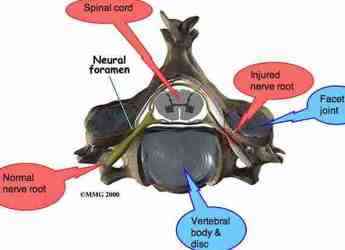
Through a small foramen the nerve root escapes on its way to the upper extremity.
Each vertebra is formed by a round block called the body, and a bony ring which surrounds and protects the spinal cord.
As
the cord travels from the skull down through the spine, it sends
out branches between the bones; they are called nerve roots. This is where much arm pain begins as these fibres follow a hazardous journey beginning in the brain and ending in the finger tips.
These roots form the nerves that go to the arms and hands, passing via a small bony tunnel; it's called an inter vertebral foramen.
As the nerve emerges from between the vertebrae via the foramen it may become irritated or pinched by a slipped disc, swelling from the facets or arthritic changes within the canal. More commonly, it has now been proved that fixated joints release noxious chemicals that stimulate so called nociceptors, causing tingling and pain in the arm.
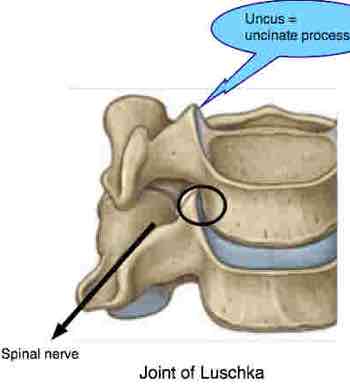
At the entrance to the foramen stand the joints of Luschka like guards protecting the nerve root from a slipped disc. Only sometimes they are turncoats, becoming arthritic after whiplash, and then sending pincer like projections into the canal.
For more information about the chiropractic subluxation and how they cause arthritis in joints, see here;
- Chiropractic Conditions is a central page at our site. It provides you simply and easily with the sorts of diagnoses that the average DC would be treating.
- Healthy Living Tips is another vital page at Chiropractic Help. Sparkling wellbeing is not just about having your subluxations adjusted. This link gives you some insights into different foods you could and perhaps should be eating.
Slipped disk
Slipped disk in the neck is the cause of severe arm pain.
An intervertebral disc is made up of two parts. The centre, called the nucleus pulposis , is like egg white. It provides most of the ability to absorb shock. The nucleus is held in place by the annulus, a series of strong rings of cartilage. If the gel in the nucleus tears through the annular fibres, then you have
a slipped disk
which may pinch the nerve and cause arm pain. Neck arm pain go hand in hand.
Slipped disc in neck is one of the most painful causes of arm pain, and especially at night. It is one of the most difficult and serious conditions treated at the chiropractic coalface.
There are two facet joints between each pair of vertebrae, one on each side of the spine. The alignment of the facet joints of the cervical spine allows freedom of movement as you bend and turn your neck. They are the most common cause of neck pain. Should a piece of the capsule become entrapped, then you have the classical stiff neck that we in chiropractic help on a daily basis. Bread and butter. If allowed to become chronic, then irritating chemicals may be released which inflame the nerve causing tingling or pain in the arm.
What is a brachial neuralgia?
The arm is innervated by nerves that emerge from the lower neck. Their function is two-fold: To bring information to the brain from the arm (such as pain, should your fingers be burnt by hot oil for example), and secondly to send information to the muscles of the arm, enabling you to rapidly move your hand away from the source of pain (the boiling oil!)
These nerves emerge from the neck via the tiny neural foramen seen in the picture above, travelling through the armpit, via the elbow and to the forearm and fingers.
Irritation of these nerves is what causes most of the painful conditions of the shoulder, elbow, wrist and fingers.
A frank pinching of the nerve root in the neck is what we call a brachial neuralgia. It may cause extreme arm pain, tingling, numbness and even weakness of the muscles, most usually the triceps. Less severe arm pain, and especially tingling may be caused by noxious chemicals released within a fixated joint as the cartilage starts to degenerate.
Read more about immobilisation arthritis.
Joints of Luschka
Protecting the nerve root from a slipped disc is a small "uncinate process" that makes up the Joint of Luschka, aka an UncoVertebral Joint. After a whiplash type injury this joint becomes arthritic, particularly in people who click their own necks, and because it is immediately adjacent to the nerve root it may begin to irritate the nerve. This is major reason for cervical spine surgery. Prevention is the the key when it comes to the uncovertebral joint Luschka.
Frozen shoulder
Frozen shoulder is one of the most debilitating conditions faced in the chiropractic clinic; the arm pain is severe and untreated often lasts for a year or more.
Because the shoulder muscles, the capsule, the ligaments and fascia are supplied by nerves from the neck, a chronic irritation of the nerve is usually the underlying causes of many shoulder syndromes, such as Frozen Shoulder Syndrome …(a capsular condition) - at this page you'll find some vital frozen shoulder exercises on You Tube.
Rotator cuff
Rotator Cuff Syndrome is a muscular condition in the shoulder; arm pain whilst exerting the muscle, without movment of the joint, is the diagnostic criterion.
The hinge between your collar bone and the shoulder blade, the AcromioClavicular Joint, is central to normal shoulder function. For more information about how chiropractic helps the muscles, joints and nerves, the shoulder anatomy, click here: SHOULDER ANATOMY.
If you are a woman, take your spouse with you and everybody will be more at ease. Your chiropractor may have to address a muscle deep in the armpit, right adjacent to your breast, making you both uncomfortable; sexual advances chiropractor are rare, but just to be safe, take hubby along. I personally have had a complaint laid against me, so you know I'm not exaggerating; luckily the judge found in my favour!
For more information about Rotator Cuff strengthening exercises, click here:
ROTATOR CUFF STRENGTHENING.
Arm pain is a serious condition. It's often EXTREMELY PAINFUL and is one of the conditions that will likely cause your chiropractor to be running late.
Tennis elbow
Tennis elbow, or lateral epicondylitis, is pain on the outer side of the elbow.
Moving down the arm, should the nerve supplying the extensor muscles of the wrist (they are found around the elbow), then you become prone to tennis elbow, and golfer's elbow too. For more information about how chiropractic helps this kind of arm pain, click here: TENNIS ELBOW ...
Perhaps first try these tennis elbow exercises.
Carpal tunnel syndrome
Carpal tunnel syndrome responds well to chiropractic, but all the sites of impingement have to be located and addressed; it's a diverse and interesting cause of arm pain.
There is much anecdotal evidence that carpal tunnel syndrome responds to chiropractic, but it remains to be scientifically proved. Because it usually falls into the so-called "double crush syndrome" we find CTS responds well to treatment. The nerve may be irritated in the neck, shoulder and in the forearm and wrist. Typically you have tingling in the thumb, fore and middle fingers. CARPAL TUNNEL SYNDROME ...
Included in this Carpal Tunnel Syndrome page you will find a short
questionnaire that will enable you to measure just how bad your CTS is,
and whether the Chiropractic treatment was effective or not in the
treatment of your hand and often arm pain that accompanies CTS.
It is never a bad idea to start with these conservative carpal tunnel exercises first; they may not help, but certainly will not worsen it either as more invasive treatments may.
Note: CTS NEVER affects the pinkie.
Thoracic outlet syndrome
Thoracic outlet syndrome occurs when the artery and nerves to the upper limb are irritated in the inter scalene triangle. Increase arm pain and tingling when working above the head are characteristic.
A fairly common
condition is the irritation of the nerves causing arm pain by a
subluxated first rib in the neck. If it also affects the artery
supplying the arm, then it is called a thoracic Outlet Syndrome; the
classic sign is increased pain and tingling in the lower arm as you
raise your arm above your head, as in hanging the washing. Not to be
confused with a slipped disc in which case raising the arm reduces the
tingling in the arm.
ADSON'S TEST FOR TOS
The classic test for Thoracic Outlet Syndrome examines the effect that moving the head and first rib have on the artery running down the arm to the hand.
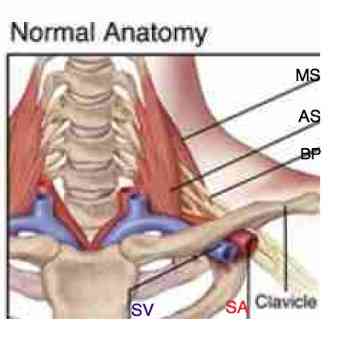
The "thoracic outlet" is made up of a space behind the clavicle (collarbone) and above the first rib which is shown but not labelled above. Through this space three important structures pass on their way to the arm.
- BP or brachial plexus of nerves
- SA or subclavian artery
- SV or subclavian vein
Two of these structures, the brachial plexus and the subclavian artery, but not the vein, first escape from the chest cavity via a narrow triangle known as the "inter scalene triangle".
This triangle is bounded by the
- AS or anterior scalene muscle
- MS or medial scalene muscle
- the first rib, with the clavicle anteriorally.
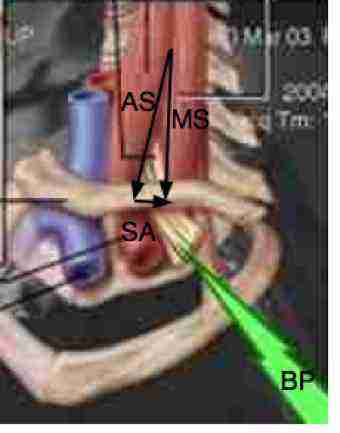
First rib syndrome
The anterior and medial scalenes insert in the first rib.
The first rib syndrome is really just another name for the thoracic outlet condition, the anterior boundary being the clavicle.
Cervical ribs
Cervical ribs can cause a bizarre grouping of arm pain and other symptoms.
Very occasionally CERVICAL RIBS may invade the so-called inter scalene triangle through which the artery and nerves to the arm must pass. Only about 1/ 1000 people have a cervical rib and in the vast majority they are too small to be clinically significant. But occasionally it may cause severe arm pain and tingling in arms and hands, especially when the upper extremity is lifted above the head as in holding the telephone to the ear, or hanging the washing.
See how a large cervical rib can cause arm pain and tingling in the arms and hands and even effect the artery.
In this cervical rib casefile the patient had absolutely no palpable radial pulse in the forearm. It is little wonder the arm ached with use.
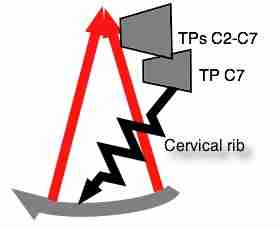
Medicine likes to remove the offending rib surgically. A patient this week had the procedure some six months ago, and it made absolutely no difference to his arm pain, but I have seen no research showing how effective the surgery is.
Chiropractors adjust the subluxated rib, I think very
successfully, though once again I have no stats for you. Certainly it is
much simpler than the grisly operation which is done through the armpit. The anaesthetic itself is not without dangers...
For more information about Anaesthethic Alzheimers disease (memory loss after an anaesthetic) click here. ANAESTHETIC ALZHEIMERS ...
- Bilateral cervical ribs, carpel tunnel syndrome, cervical disc bulging and inactive ulnar nerves
Chiropractic neck pain treatment
Your Chiropractor may use a variety of techniques to free up the tethered nerve root causing your arm pain. Most of them involve manipulations, what we call an adjustment. In the hands of an experienced practitioner it's a very safe procedure, only very, very occasionally causing serious problems. A lot safer than anti inflammatory drugs that kill thousands. Literally.
Treatment may also include stretching of the neck, treatment of the muscles of the neck and an array of physiotherapy devices.What is surprising is that even in the most degenerative neck, with huge arthritic spurs surrounding the nerve root, adjustment of the vertebrae above and below the arthritis relieves the arm pain.
Rotating the arm like a windmill sometimes helps a brachial neuralgia, but will aggravate a rotator cuff syndrome.
Sleeping with your hand under the head may relieve the pain of a pinched nerve in the neck.
Simple traction devices can be very useful in the treatment of a brachial neuralgia.
A survey of a large number of studies concerning traction for arm pain came to the following conclusions:
Neck pain is a frequently reported complaint which can be disabling and costly to society. Mechanical traction is often used as an adjunct therapy in outpatient rehabilitation.
This study was to evaluate the effectiveness of traction for cervical spine conditions.
Of the seven selected trials, six clearly set out to prove what they already "knew to be true", or in research lingo only one of the randomised controlled trials had a low risk of bias. It found no statistically significant difference between continuous traction and placebo traction in reducing pain or improving function for chronic neck disorders with radicular symptoms.
Their were as follows:
- The current literature does not support or refute
the effectiveness of traction, intermittent or continuous, as compared
to placebo treatments for people suffering from chronic cervical spine conditions.
- Large better prepared research-based trials are needed to determine if traction is effective in the management of neck pain.
I have used this traction device for home use of arm pain with great effect, as an adjunct to chiropractic treatment. However, there is no hard evidence that it is effective when used on its own, or as an adjunct to physiotherapy. There simply is only one good trial concerning traction used and it neither proved it effective, nor refuted its effectiveness in the treatment of arm pain.
If you have two right hands (Dutch proverb) you might like to make this home traction unit.
From the chiropractic coalface
Mr S, is a 43 year old Dutchman after my own heart. He's a motor cycling fanatic. Only he has a problem. Two years ago he set off on a trip across Europe and within two hours had to return home: severe pain in the neck, radiating down the left arm. For over a year he was unable to ride his motor cycle. Literally. Within ten minute he would have severe neck and arm pain.
I will not pretend his case has been easy. His neck was technically difficult to adjust, but within six months of chiropractic treatment, with the aid of his home traction unit he was motor cycling again. Last night he had dinner with us, and took me for a ride on his new BMW 100, ah sublime. Next week he leaves on 10 day ride through the former Soviet republics. Estonia, Latvia... Chiropractic PLUS his home traction unit pictured above have enabled him to return to his favourite pasttime; it was mine too until I moved to the Netherlands. Traction may not help on its own, but as an add-on to chiropractic, I highly recommend it for radiating arm pain from the neck.
Update: Mr S had a very successful trip with minimal neck or arm pain.
Surgery
Occasionally, this arm pain will not respond to conservative treatment. If the arm becomes weakened, and the nerve pain in the arm remains relentless, surgery may have to be considered.
It can be very successful, though it is a dangerous procedure with a relatively high rate of morbidity and complications. Sometimes there is no other option.
As you can see, when removing bony arthritic fragments and disc material from the foramen, the surgeon is working perilously close to the nerve.

Five NO-NO'S
- If you have a problem neck, and perhaps even if you don't, never carry a child with legs straddling your neck.
- Don't sleep on your tum. It's during the night that the pressure in the disc joints drops, bringing in fresh nutrient and removing waste products of hyaline cartilage metabolism. Your neck will become arthritic long before its time, not to mention neck pain and arm pain. Tum sleeping ...
- Don't hold the telephone between your neck and shoulder. It's one cause of pinched nerve in neck ...
- Don't do pull downs at the gym.
- Don't go messing with a puffadder; this arm pain snake bite will make anyone shudder.
Arm pain case histories
Arm pain case histories do not constitute scientific evidence of the efficacy of any particular treatment, but they do give an inkling of what can be achieved.
50 percent less pain
With all Chiropractic Conditions - what we treat on a daily basis …, medical conditions too, I presume, you want to be very careful when the pain is about half. That's the dangerous time, we often see setbacks, sometimes serious ones: 50 percent less arm pain ...
Another case history
Mr S, a physically fit and strong man, a builder by trade decided to go to the gym. After lifting weights he developed severe pain between the shoulderblades, and then his left arm started to tingle when he turned to the left or looked up.
Various treatments didn't help the arm pain, finally after four months he decided to try chiropractic, after a personal friend, a medical trauma specialist surgeon said only surgery in the region of the first rib would relieve the pain.
On examination, there were several serious findings.
- Spurling's test immediately provoked pain and tingling radiating down to all fingers.
- Adson's test for a thoracic outlet syndrome was positive, with complete obliteration of the pulse in the wrist.
- There was severe weakness in the triceps muscle, loss of the reflex and some paresis in the fingers.
- The upper limb tension test was positive.
- Xrays show uncinate joint of Luschka degeneration and an invasion of the intervertebral foramen at two levels.
There is no doubt about it; had he consulted a neurologist first, he would have been under the knife within the week.
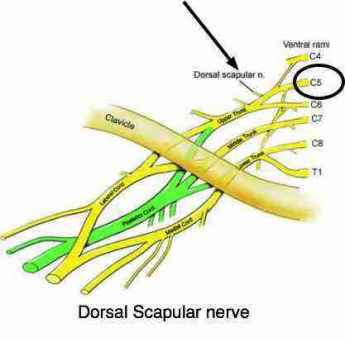
I made no promises; this is probably the most difficult condition facing the chiropractor. Deep upper back pain due to a pinched dorsal scapular nerve is problematic; add weakness, an ache and tingling in the arm and you have a great challenge on your hands.
Nevertheless, to be totally pessimistic also means that one is likely to have lost the battle before the first shot was fired. I was guardedly optimistic. There was also doubt about the diagnosis; was it a problem in the inter scalene triangle causing nerve and arterial pressure, or arthritic spurs invading the foramena, or both?
He consulted me this evening for the seventh visit. He has minimal pain, the strength has returned completely to the triceps muscles, but there remains some weakness of opposition in the hand.
Range of motion of the neck is normal, with no radiation to the arm, but some discomfort between the shoulder blades in the rhomboid muscles, supplied by the dorsal scapular nerve, remains. Spurling's and the upper limb tension test test were both negative.
He feels 90 percent cured, and wanted to return to the gym, the original cause of the problem. Alas, no, was my reaction. And to be very careful with looking up.
All in all, we are both very pleased. The future? Neither of us are sure.
LINKS
- For more interesting cases from the Chiropractic Coalface 2 click here:
CHIROPRACTIC COALFACE 2 ...
- Healthy Nerves are coated with the right fat. For the 'right kind' of fat dressing for your nerves ... OLIVE GARDEN SALAD DRESSING ...
Please do not write using cellphone grammar; you are completely wasting your time; I will not respond.
Have A Great Story About a visit to the Chiropractor?
Please only submit your question from a computer. I will not answer anything written in smartphone grammar.
I'm not looking here for funny stories. That we'll find a place for elsewhere, and you can find an abundance of them in my books at Bernard-Preston.com. James Herriott genre books.
Here I'm looking for things that you particularly love / hate about a visit to the chiropractor. Share it! If we get too many, and we probably will, we'll split them.
Are there things you hate about a Chiropractic consultation? Let's hear about it. Hopefully even more stories about things you love.
You see, we Chiropractors can learn from your feedback, both positive and negative.
Share it!
What Other Visitors Have Said
Click below to see contributions from other visitors to this page...
What could of happened to my lower arm? 
Hello,
On Thursday July 6th 2017 later on during the day around 7:30-8:30ish I started complaining about the lower half of my arm hurting. It hurt …
Neck muscle pain after adjustment
I was told my neck curved the wrong way and that was most likely causing my sinus issues and my left arm twitching. I went for the first adjustment and …
Toothache pain in arm and shoulder
Past three months every day I have a constant dull ache in my shoulder and in my left arm. Sometimes it varies to where it feels sometimes like it's in …
rotator cuff surgery elbow and carpal tunnel surgery
Carpal tunnel surgery
I'm sick of pain - 1 year later still have chronic pain on right side and it moves to left back of neck and scapular which i have …
Carpal tunnel syndrome, or not CTS?
i have ad a discectomey a few years ago and have been pain free. now after lifting and twisting in work the pain is back ten times worse i am losing the …
Manager
I love my chiropractor but I think the office visit time that she alots is too short. I know she is busy and has a lot of patients, but I would love to …
Pain after chiropractic adjustment 
Pain after chiropractic adjustment
I am being treated by a chiropractor after an auto injury to my neck the spine. They are treating me 3 times a week …
Adjusted3 level fushion Not rated yet
I was at the chiropractor for back pain and out of nowhere chiropractor adjusted my neck. 2 days later my triceps started twitching; now I am 75% weaker …
Neck adjustment will not hold Not rated yet
In April of 2020 after a stretch injury my medical doctor told me I needed to see a chiropractor to make sure my first rib was not compressing my brachial …
Neck cracking after chiropractic treatment Not rated yet
I went to a chiropractor to get a maintenance adjustment done as I've never had an injury or any pain. Within a week of having the neck adjustment done …
Pain in scapula area and arm since a fall Not rated yet
Pain in scapula area and arm since a fall.
Over 9 months ago I fell off a ladder. I fractured my right wrist, had surgery with a plate and screws which …
tingling and soreness in arm after treatment. Not rated yet
Tingling and soreness in arm after treatment.
I went to a chiro for the first time yesterday at the recommendation of a friend who had used this one …
Tingling in hands after eating sugar Not rated yet
Tingling in hands after eating sugar
I found your site after looking up information on why my hands will tingle after I eat sugar.
I am 45, newly …
Neck arm shoulder hand problems. Not rated yet
I am a 39yr old mum of three who has suffered mild neck pain for 8 yr due to whiplash, then last year everything began to get worse. Over the last 16 …
know it all Not rated yet
I had used a local chiropractor when I had a crick in my neck. He was knowledgable as well as professional and kind. I had gotten a Migraine due to eating …
One messed up body Not rated yet
In order to give you some idea of what my chiropractor has to deal with when I visit, here is some background to my injuries:
I have what one chiropractor …
Franz Not rated yet
I slammed a baseball bat into a brick wall. I'm a petite gal, 59, not atheletic and this action was out of stress and anger. I did not feel anything at …
- Home
- Arm
Did you find this page useful? Then perhaps forward it to a suffering friend. Better still, Tweet or Face Book it.
MONTHLY NEWSLETTER. Signed up yet? It is free.
BACK ISSUES
Chiropractic Help Backissues ... our monthly newsletter, click here for all the old issues.
- Issue #53: No short cuts to better health / Simple balance and quad strengthening exercises
- Issue #52: Needs an adjustment / Everything must change
- Issue #51: Elective surgery in the elderly / Cooling and reheating starches
- Issue #50: Make time for breakfast / Scrambled eggs and parsley
- Issue #49: Consulting a locum / Green salad /Eggs Florentine
- Issue #48: Hips and the sacroiliac joints/ Bacon and eggs
- Issue #47: Life without medication/ Eight coloured foods
- Issue #46: Lower backs and ankles/ kaempferol and cancer prevention
- Issue #45: Tingling, weakness and malaise/ vitamin B1
- Issue #44: Applying general chiropractic principles to the hand / Omega-3
- Issue #43: Art and science of chiropractic / Kale
- Issue #42: Tum sleeping / Flaxseed
- Issue #41: Adult potty training / Beetroot constipation
- Issue #40: Ominous lumbar signs / Too much medication?
- Issue #39: Swapping chiropractors / Butter is back
- Issue #38: Making a correct diagnosis / Make your own pesto in five minutes.
- Issue #37: Have your wisdom teeth out in the chair
- Issue #06: Safety on the Stairs / Ginger
- Issue #05: Safety in the home / Red foods
- Issue #04: Whiplash and the Joints of Luschka / Parsley
- Issue #03: How to stop falling / Danger of a low fat diet
- Issue #01: Tingling in the arms and hands / Apples
(PS. If you find them irrelevant to your needs or an exercise in tedium, one click will UNsubscribe you.)
- Home
- Arm
