Maignes Syndrome
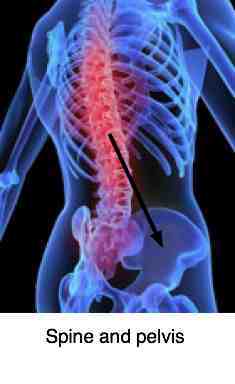
Maigne's syndrome comes from thoraco-lumbar region to the side of thigh and groin too.
Common symptoms are often confusing and overlap with many other conditions. Groin discomfort for example occurs in many diseases; you cannot simply assume that you are suffering from this upper lumbar problem.
That part between the lower spine and the midback, where you can feel the last rib is called the thoraco-lumbar region.
This condition causes lower back and buttock ache and often upper leg and sometimes groin discomfort.
The thoraco-lumbar junction syndrome, as it is sometimes called, has been thought to be responsible for up to forty percent of common LBP.
This percentage is subjectively based upon Dr. Maigne's personal statistical study of 500 cases and is, in my opinion rather high but the upper lumbars are certainly often neglected as a source of referred lower back pain.
Because Maigne's syndrome makes for a diagnostic nightmare, it is often overlooked, causing possibly years of unnecessary pain and disability. Read more from the case file found lower down.
As always, not more tests, but a thorough clinical examination is required. Is there a spinal fixation at the thoraco-lumbar junction? Are the active trigger points in the quadratus lumborum really an incidental finding?
Is the pain in the groin or lateral thigh from a femoral nerve lesion, Maigne's syndrome or hip arthritis? Or could it be something quite different?
Maigne's Syndrome
Back, buttock pain and the groin too, are features of Maigne's syndrome.
Buttock pain
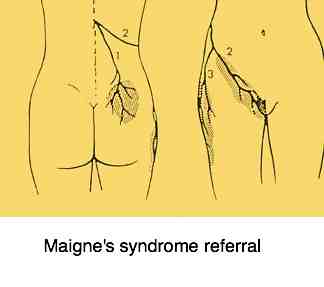
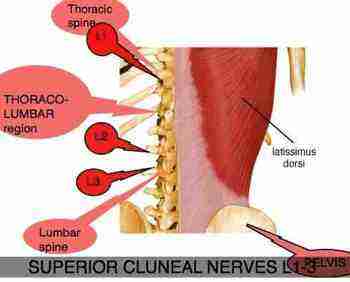
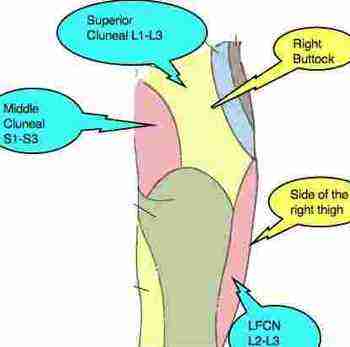
Dr Robert Maigne, a French orthopaedic specialist, proposed that low back pain could in fact originate from the thoraco-lumbar facet joints, mediated by the superior cluneal nerves, lumbar nerve roots 1, 2 and 3,
It's now known as Maigne's syndrome. These nerve roots supply primarily the upper buttock but also sometimes the groin.
A careful examination of the sacroiliac joints, the piriformis and the hip is always in order. Pain in the buttock and groin areas can come from so many different sites. Are there perhaps signs of an inguinal hernia, testicular cancer or swollen lymph nodes?
Prostate cancer, the most common fatal malignancy of men, should always be upper mind; and not only in the older patient. Controversy reigns in medical circles concerning the best routine examination for the disease, so we at chiropractic help will stay out.
Nevertheless, prevention of all malignant tumours but particular of the not uncommon breast and prostate neoplasms, is vital in chiropractic practice, because of their tendency to metastasize frequently to ribs, the spine and pelvis; areas treated on a daily basis at the coalface.
The short answer is every man shall eat a tomato a day, and avocados regularly. Women must reduce animal protein and take hormone replacement therapy only in cases of extreme necessity; lignans are a phytochemical found mainly in whole grains and seeds that block the oestrogen sites.
Superior Clunial nerves
Superior cluneal nerves supply the buttock and according to some authorities there are slips that innervate the skin in the groin area.
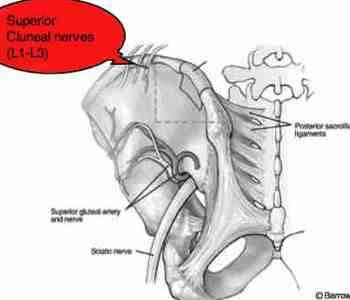
The dermatomal distribution of the cluneal nerves and the lateral femoral cutaneous nerve, LFCN.
Lateral Femoral Cutaneous nerve
As we shall see, a very similar syndrome originating from this region but involving the lateral femoral cutaneous nerve; lumbar 2 and 3, a branch of the femoral n. The syndrome has no name, so I lump it in with Maigne's syndrome,
though technically it is not; it causes pain and numbness on the side of
the thigh and the groin area.
More complex, this lateral femoral cutaneous n. may be involved in a double crush
syndrome where there is often a subluxation in the upper lumbar spine and the nerve is affected in the groin giving symptoms on the lateral thigh only. Then it's called meralgia paresthetica.
A syndrome simply means a collection of seemingly unrelated signs and symptoms. Buttock and LBP are typical of Maigne's cases; but groin pain perhaps, lateral hip and thigh numbness or an anterior thigh burning sensation may all be mimicked by this condition via the lateral femoral cutaneous nerve.
However as I said, this is not technically Maigne's syndrome.
Other conditions often causing buttock pain and affecting this area are the piriformis syndrome, a small buttock muscle through or around which the sciatic nerve must negotiate its way to the leg.
The side of the thigh is also occupied by the iliotibial band syndrome, a long piece of tissue stretching from the tensor fascia lata muscle to the side of the knee.
Another condition is the femoro acetabular impingement syndrome which also can cause groin and side of the hip pain. It is characterised by stiffness in the joint; and may also be found in young people.
Another is hip dysplasia; mild cases are often missed causing upper thigh and groin pain.
These lead unerringly on to premature hip arthritis if not managed carefully.
These are conditions that chiropractic excels in. Well, hip arthritis in its early to moderate stages. Thereafter it is a surgeon's work.
But it is a highly complex area also involving medical conditions like an inguinal hernia, aneurisms in one of the iliac arteries and lymph nodes; and many others. Your chiropractor will make a careful examination of the area, and may well ask for a second medical opinion.
- piriformis syndrome ...
- iliotibial band syndrome ...
- femoro acetabular impingement syndrome ...
- hip arthritis
- Meralgia Paresthetica ...
An aside.
To adequately diagnose and treat the myriad of conditions around the low back, buttock and groin really requires good teamwork; and thigh. Unfortunately Chiropractors are not yet considered part of this team by the majority of the Medical community; to the detriment of the patient.
This is why there is a strong move in Chiropractic to vacate the Complementary Alternative Medicine (CAM) camp and join the medical community proper. This movement has its critics; they fear we could lose our identity.
Only this week I have had two new patients who have had severe disabling pain in this area for over a year. I know I can help them both; but anyway it's a relief that the medical conditions have been ruled out. But they have suffered needlessly because of the suspicion that Chiropractic is still treated with. How can I say with such confidence that I can help them? Because it is almost has become bread and butter; I see these conditions on a daily basis. What is really needed is some good research.
A bit more science.
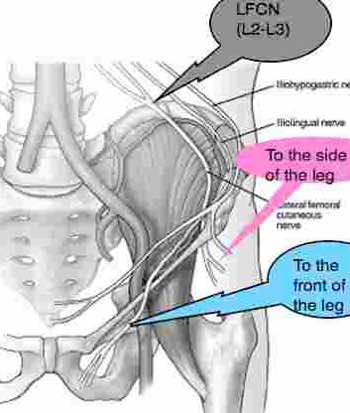
Lateral Femoral Cutaneous nerve (LFCN)
The LFCN arises from the L2 and 3 lumbar plexus. It emerges from the lateral border of the psoas major muscle, not shown, which joins with the the iliacus, seen in the graphic above. The nerve then proceeds obliquely across the pelvis, toward the so called ASIS, a hard bump about 15 cm above and slightly forwards from the hip bone.
Read more about the lateral femoral cutaneous nerve and its importance in chiropractic practice.
CHIROPRACTIC HELP
I increasingly begin treatment of the patient with low back pain with thoraco-lumbar adjusting.
The upper lumbars are often fixated explaining why the side of hip (called the trochanteric region) is so often very painful.
Commonly sacro-iliac joint fixations may be associated with Maigne's syndrome. Clinically, one is faced with a chicken and egg situation. Do the pelvic conditions cause the thoraco-lumbar fixations?
Or do the thoraco-lumbar fixations cause the SI syndromes and low back pain? Mostly, your chiropractor will pay careful attention to all areas of the lower spine and pelvis.
The real cause may also be a short leg. Read more about Leg Length Inequality.
Do you want more information about your back? Spine Universe.
Lumbar and buttock pain coming from the thoraco-lumbar region, Maigne's Syndrome, is a notoriously difficult region to adjust. Thus you should be patient with your doctor. You may not immediately hear loud clicks and dramatic relief of pain.
Common chiropractic adjustment techniques for this low back pain may include a straight straight down adjustment (whilst lying on your tum) which can be very painful, a hyper-extension technique (sitting or standing) or a lumbar roll; McManis traction, an activator technique and Thompson drop too.
An excellent article by Dr Marc Heller, DC on the Chiropractic management of Maigne's syndrome can be found at : http://www.dynamicchiropractic.com/mpacms/dc/column.php?c_id=1517/
Do you enjoy light reading? Bernard Preston writes excellent books about chiropractic and life. Described as "Gems, both funny and healthful, from the life and work of a Chiropractor" you will love these Chiropractic books. BERNARD PRESTON homepage.

Another less commonly known technique in the treatment of Maigne's syndrome is the supine hyperextension techique. Using a standard adjusting table, the pelvic section is raised to perhaps 45 degrees. The patients sits on the pelvic section with his hands behind his neck. The doctor places his hand behind the back at the fixated segment, flexes the torso slightly, and then makes the corrective adjustment in an anterior to posterior direction.
Active trigger points will often be found in the Quadratus lumborum muscles, the TFL, the Gluteals adding to the low back pain; and will be addressed by a variety of techniques.
Hip hike, and pelvic tilt exercises (especially with the hands under the involved segments) are useful; as would alternating ice and heat treatment help with the lumbar pain.
- Specific Maignes Syndrome Exercises
FROM THE COAL FACE
'Doctor, I have a pain here on the side of my buttock. I've been to my doctor, two physios, and another Chiropractor. I am despairing. It's getting worse. It keeps waking me throughout the night.'
'We had better start with a good examination, Mrs P. Would you slip your down to your underwear, please.'
The examination was unremarkable in many respects. All the neurological and orthopaedic tests were negative. The previous practitioners had successfully treated the lumbar spine and the pelvis. But the pain remained. A raw, gnawing pain. X-rays didn't show much of interest, but indeed a moderate curve with the apex at the thoraco lumbar junction, where we found a massive fixation. It was solid as concrete. I don't diagnose it as Maignes Syndrome until the buttock pain has been successfully cleared by the thoraco-lumbar adjustment.
Early in my career, I had the good fortune, to walk past an elderly chiropractor giving a colleague an adjustment at a recent congress. I had never seen the technique before. Or since, for that matter, but I use it every day. I call it the FIST EXTENSION, simply because I know of no other name.
I have only cracked four ribs in nearly thirty years in practice. One of them was using this technique! But it has fixed hundreds of Maigne's syndrome sufferers. Fortunately, a large bouquet of flowers, and a humble letter of apology saved my bacon. I suppose in America I would have had the pants sued off me; and those hundreds of people would still be suffering because I would be too afraid to use FIST EXTENSION again!
The cost of low back pain is becoming a massive burden to society, not least of which because the enormous insurance premiums doctors have to pay. If this little understood Maignes syndrome makes up 40% of low back pain then no wonder we are making little progress. Personally I think that is over the top. That was Dr Maigne's opinion. Once you start to factor in lost time at work.
If you are interested, read on about the economic burden of LOW BACK PAIN.
Smoking and low back pain
Uncomfortable though the thought may be, if you are a smoker you WILL suffer from more low back pain, quite apart from the cancers associated with smoking. Strong research reveals that the lumbar arteries become furred by uses of tobacco reducing blood flow to the spine.
There is a strong correlation between smoking and lower back pain.
Worse you are likely to respond poorly to both chiropractic and surgical treatment for lower back pain.
Low back pain and smoking is the greatest risk factor.
IMPORTANT CONSIDERATIONS
- SacroIliac Joint anatomy ...
- Upper leg pain ...
- The rationale for the Chiropractic Adjustment. CHIROPRACTIC THERAPY ...
- Your first Chiropractic Consult. CONSULTING A CHIROPRACTOR ...
Changing Chiropractors
This is quite an emotive subject; every doctor of any ilk is likely to be upset on hearing that you have left for greener pastures on the other side of the hill. Yet, it shouldn't be so; every chiropractor has his strengths and his weaknesses too.
You are likely to find there are chiropractors and certainly medical doctors, who have never heard of Maigne's syndrome. I hadn't for the first twenty years of practice.
It is easiest if there are several doctors in the practice; awkward perhaps but if you know you are not getting better, it's best to discuss with him or her, could you consult a colleague for an evaluation. Chiropractors should have a thick skin and small egos.
If they haven't, well that is their problem, not yours.
So if changing chiropractors seems sensible to you, do not hesitate.
When browsing these links use right click and "Open Link in New Tab", or you may get a bad gateway signal.
Have A Question about your lower back?
I receive many questions about Chiropractic. It might be help with a spinal condition, but it might also be from a person who can't walk after a hip operation, or some such thing.
I will do that by answering your questions personally, but it will be converted to a Web Page so others can benefit from your questions. Omit your name if you like.
However, do understand that, in the main, I'm going to be directing you, should it be pertinent, to a Chiropractor in your neck of the woods. I'll respond to all reasonable inquiries, but please be specific, and give as much detail as you can.
Do understand that lower back pain is extremely complex, so I can only give general guidelines. There's no substitute for a careful thorough chiropractic examination.
What Other Visitors Have Said
Click below to see contributions from other visitors.
If you find my answer useful, please ask friends to grade it.
TLJ 
I have mild scoliosis and have been told that I have a weak core. I've always pushed myself physically very hard, long distance running, military, and …
Burning toes bottom of right foot toes spreading
It's my whole right side starting my groin area excruciating pain runs from hip, inner and outer thigh, the whole knee into my shin. My right butt is …
Numbness, burning
I recently tried to work out. I have disc issues L5-S1. 2 days after starting I started getting severe burning when trying to sit.
Right buttocks …
Low back pain/ numbness in right hip, bum and right big toe
Home > Maignes syndrome > Low back pain/ numbness in right hip, bum and right big toe
I hurt my low back about 2 months …
Lower back and buttock, hip and groin pain
Home > Maignes syndrome > Lower back and buttock, hip and groin pain
I have fibromyalgia but for the last few months …
Lbp with hip pain.
I have low back pain; always have had. However this time it was different.
The pain I feel is isolated around my QL ON MY LEFT. I will have random …
Left medial leg pain around hip, left lower back pain, high in the lumbar region
Home > Maignes syndrome > Left medial leg pain around hip, left lower back pain, high in the lumbar region
I am a mostly …
Severe crushing back pain, numbness in legs and arms and hands after three spinal surgeries
Severe crushing back pain, numbness in legs and arms and hands after three spinal surgeries; does chiropractic have a role to play?
I have had 3 surgeries …
burning in groin and buttock
Burning in groin and buttock sounds like nerve pain; but is it?
Hi there,
I have been having severe pain for more than two years across my lower back …
Tightness in two places in midback when leaning forward
Tightness in two places in midback when leaning forward
Hi Doc. I was pulling down on the baler from above my head when I felt something happen in my …
I have severe pain in left hip and groin, numbness in side of hip.
I have severe pain in left hip and groin, numbness in side of hip.
I have osteoporosis, psoriatic arthritis and have tested positive for Lyme Disease. …
severe pain in hip/lower back when standing straight
The pain started about a year and a half ago with just numbness down the side of thigh all the way to foot. I was still able to move around just with a …
Right lower back- and right gluteus pain, spasm & irritation
Struggling almost 2 years with this. Was a hurler most of my life (leading right leg. Went to fisio, chiro & docter. Outcome of evaluation: left leg is …
pain and stiffness in my right buttocks area immediately after an adjustment
My right leg was slightly shorter than my left. I went 2 times to the chiropractor and both times he readjusted my right hip. The pain that I had at the …
Chronic Pain in left leg, hip, groin, upper thigh, calf and big toe.
Hi there, First thank you for your site :D
I will first start with the beginning of my pain and the injury that caused it. In May of 06 I fell backwards …
Pain in lower back, buttocks region and the right side thigh bones leg
I am an overweight person who is currently on a doet p[lan. I first noticed the lower back pain when i couldnt bend or get out of bed correctly. I have …
Low back pain that radiates into my hip down to my groin.
Hi! I am a 49 year old female with a history of disc problems. Two in my neck and one in my lower right side of my back. I had a series of injections in …
T12 wedge fracture
Hi, I had a bad fall around 2 years ago. I attended A&E and they said I had pulled a lot of muscles. No x-ray was done. However I suffered pain for a long …
Pain in my lower back radiating down the right buttock and leg.
I am a 55 year old female in pretty good health.I have had this pain for two and a half years now with little or no help from twenty three different doctors/ …
Sharp pain radiating down my front right thigh and pelvic area. Not rated yet
I have sharp pain that comes and goes, only on my right side. Sometimes it is in my pelvic area and sometimes it is just down my right thigh (front) but …
Severe pain right lower back, right buttock, right hip, right groin, entire anterior and posterior right leg with numbness from top of thigh to just below knee along outside of right leg. Not rated yet
I’m 63 year old female. My original injury was right patella dislocation while playing basketball at age 15. Right patella dislocation began to occur spontaneously …
Burning buttock deep ache leg tightness burning shin and lateral lower leg Not rated yet
Pain in buttock right side, deep groin pain, hamstring tightness, burning lower leg shin and lateral lower leg. I was going to a chiropractor to treat …
Flank pain, anterior hip and groin pain, quad weakness/throbbing Not rated yet
Hello! I came across this site when a doctor mentioned Maigne’s Syndrome. I am an elite semi-professional runner who cannot run because of my anterior …
Spine/lumber region severe back pain radiating to the outer and front of the thigh.. Not rated yet
Spine/lumbar region back pain extending to the bony area left about 3" and radiating to outer left thigh and front left thigh. Pain often mirrored on right …
Numbness and tingling in buttocks right thigh groin and back of left leg bottom of right foot Not rated yet
Can these symptoms be related to this MRI?
Hello Amanda,
Understand that because I'm unable to examine, you are getting at best an educated guess, …
Frustrating chronic glute and groin pain and tingling on outside of calf and foot Not rated yet
Home > Maignes syndrome > Frustrating chronic glute and groin pain and tingling on outside of calf and foot
I've been …
Stiff lower back every morning & a feeling like my lower back has gone with a sharp pain when I slump in a chair Not rated yet
Home > Maignes syndrome > Stiff lower back every morning & a feeling like my lower back has gone with a sharp pain when I slump …
Pain in left groin going around back to my hip and buttocks, down my leg. Not rated yet
Pain in left groin going around back to my hip and buttocks, down my leg could be a back, sacroiliac or hip problem; but which?
I am a 58 female. I …
Tingling in legs & feet and pain on the left side of my pelvis. Not rated yet
I'm a 57 year old female. I'm experiencing pain/numbness on each side of the buttocks, a little stiffness in both hips, pain/numbness in the pelvic area, …
low back pain, radiating down left buttock into groin and down anterior thigh Not rated yet
Low back pain, radiating down left buttock into groin and down anterior thigh is probably from the femoral nerve.
My neck is fused at C4-5 & my low …
sudden side pain in the inner left thigh, lower back an buttocks Not rated yet
I have had many tests this past year for my right groin area pain when prolonged standing and when my bowels are full. Now I'm schedule to have a colonoscopy …
Sharp acute pain lower right leg mid shin Not rated yet
I suffered a broken tibia/ fibula in a soccer match 4 yrs ago. I had a nail placed in my tibia and 2 yrs ago had the screws only removed, the nail is still …
Low back pain radiating to upper thighs Not rated yet
Home > Maignes syndrome > Low back pain radiating to upper thighs
Started as left groin pain with certain movements, then …
Right gluteal pain, burning greater trochanter, groin and pubis area Not rated yet
Home > Maignes syndrome > Right gluteal pain, burning greater trochanter, groin and pubis area
Hi, I have had l1-s1 herniated …
Right side low back pain, buttock pain, front groin pain toward the hip, weak leg, tingling and numbness in the lower leg and foot Not rated yet
Home > Maignes syndrome > Right side low back pain, buttock pain, front groin pain toward the hip, weak leg, tingling and numbness …
Sciatica AND Meralgia Paraesthetica..maybe Not rated yet
I am overweight, sedentary, female, age 56. I had two 'traumas', involving my left leg, one falling off an embankment, one running on a treadmill. Not …
sudden onset left side pains: groin, outer hip, lower leg and foot Not rated yet
I. Here is my background:
56 year old male. 5'10", 260 lbs. Periodic, infrequent LBP from mid 20's on, sometimes debilitating, consistently resolved …
Mid and lower back stiffness with aching legs Not rated yet
Hi doctor, I just found your site typing in my ailment; most informative site ever!
I'm 53 and have had herniated discs in the past causing year long …
LOWER BACK PAIN RADIATING TO BUTTOCK AND LEG Not rated yet
Home > Maignes syndrome > LOWER BACK PAIN RADIATING TO BUTTOCK AND LEG
I have lower back pain, sometimes it's both sides …
Quickly increasing pain in left groin and buttock. Not rated yet
Home > Maignes syndrome > Quickly increasing pain in left groin and buttock
It started many years ago. I frequently suffered …
Butt pain of two years duration Not rated yet
Home > Maignes syndrome > Butt pain of two years duration
Hi,
X Ray's showed bilateral pars defect 20 plus years ago. Regular …
Back and groin pain Not rated yet
Home > Maignes syndrome > Back and groin pain
Good Evening Doctor
I'm a 52 year old female and I have no symptoms of menopause. …
lower back and side buttock pain Not rated yet
I have lower back pain only when I stand too long; it is a nasty dull ache that sometimes burns and which radiates to the side of my right buttock and …
Right hip pain with posterior swelling Not rated yet
Home > Maignes syndrome > Right hip pain with posterior swelling
Hello:
I am a big advocate of Chiropractic treatments. …
Lower back pain, burning/ pain in upper left buttocks and left groin area. Not rated yet
My back has been hurting terribly for the last 4 days. I can barely get up and down out of bed or sitting in a chair. It hurts most at night to the point …
Burning in left side tailbone, groin, upper leg worse when sitting Not rated yet
I have a centrally herniated disc with an annular tear at l5-s1, broad based bulge into foraminal zone at l4-l5, and centrally herniated disc at l3-l4 …
Lower right back pain Not rated yet
Chiropractic Help homepage » Femoral nerve » Lower right back pain
I have been in pain for 8 yrs with no relief. It started out just …
I have an ache on upper side of my leg. Not rated yet
Chiropractic » Lower back exercises » I have an ache on upper side of my leg
My left upper leg (panty line) feels as though I need to "crack" …
pain when walking Not rated yet
I have all the symptoms of Maignes, and was given an injection several years ago, which did not relieve the pain. As long as I limit my activity to basically …
Back, buttock, and leg pain since 16 yo Not rated yet
I've had an L5-S1 disc extrusion since the age of 16. Pain always in the left lower back/top of the buttocks (one spot). Also, pain and chronic muscle …
Severe pain in right lower back Not rated yet
I was a victim of domestic violence and was thrown on the ground 3 times.
A few hours later, I developed right lower back pain, mid right back pain …
right buttock pain Not rated yet
right buttock pain
I do not have pain elsewhere. I have been diagnosed with a herniated disc. Could this be the source of the pain? If so, what …
severe gluteal pain Not rated yet
I suffered of Discitis in T10 and was treated for it 2 years ago.
This year I got an attack of lumbar pain which ended up with severe pain in the "upper …
stiffness and tightness in low left part of my back Not rated yet
I sit for a long duration of time at work, but I have no pain when I am sitting. I noticed the pain creeping into my hips when I am sitting though and …
Right buttock and leg pain for 1-1/2 years Not rated yet
Iam a 67 years old female with Parkinsons disease. I have had significant pain in my right buttock and right leg which gets extremely painful when I walk. …
Pain in left leg without numbness or tingling Not rated yet
I have been dealing with pain in my left leg, originating in area of crease in top of leg with pain radiating down to lower calf area. It is very difficult …
pain in lower back, upper hip thigh groin and legs. Not rated yet
This pain is on both sides. Some times left side sometimes right side. But when it is on right side I have only back pain upper hip pain. But in left I …
Maignes? Not rated yet
Maignes?
Something happened to me whilst horse riding two and a half years ago. I felt something go on the right side but I don't know what. Afterwards …
Left side pain starting from middle of back that radiates down to my big toes. Numbness from knee down. Not rated yet
I am 27, and was an active, on the go kind of person until I had my daughter in October 2011, and my back was never the same. I ended up having surgery …
Pubic bone pain Not rated yet
Pubic bone pain, at times feel a numbness in my tail bone area and history of ovarian cysts and pubic bone pain is always just said to be from the cysts …
Maignes Syndrome Not rated yet
Hello,
I've had all the typical symptoms of maignes syndrome for nearly a year now, but I'm unable to find someone who can help treat it in Sydney …
Possible Cluneal Nerve Entrapment Not rated yet
Hi there,
I have been suffering for lower back pain deep in my left side and in my buttock for about 6-7 year. I have had scans and x-rays followed …
I have a limp but no pain Not rated yet
I have a limp but no pain
I don't have much pain anywhere. Some low back discomfort at times but not really any pain. My feet do tingle in different …
Unable to put weight on leg after prolapse disc Not rated yet
Unable to put weight on leg after prolapse disc
Hi,
My boyfriend prolapsed his disc whilst working on a car back in May, he said he tried to get up …
My legs/hips/low back/pelvis area hurt when I walk and I can't stand with my two feet together sometimes. Not rated yet
My legs/hips/low back/pelvis area hurt when I walk and I can't stand with my two feet together sometimes.
Hi there,
I will try and explain the best …
Maigne's Syndrome (?) and other lower back issues Not rated yet
Maigne's Syndrome (?) and other lower back issues
Doctor, I have a long history of back injury and issues, all beginning with a car accident in 1993. …
groin, upper leg pain Not rated yet
I frequent a chiropractor off and on for years. I am a retired wallpaper hanger and painter for the last 30 years. I am 69 years old.
My problem accuser …
Pain in the upper groin area toward the inside front of my left leg. Not rated yet
This just started. I thought I had been bit by something right along the "panty-line" on my left leg. It is up high, runs parallel to the pubic bone, …
Gnawing pain in right buttocks has moved to the left Not rated yet
I've experienced a gnawing, dull pain in the right buttocks for about 2 yrs, but after sleeping horizontally one night, the pain has moved from the right …
Low back Aching/ Side Leg Upper Buttocks Not rated yet
Hi,
I am a 54 year old female with aching pain ONLY WHEN LYING DOWN ! The pain starts in my low back ( I have severe stenosis at L4 or 5. I have had …
Extreme back pain, Femoral nerve pain, numbness Not rated yet
I have had back problems since 1999 but with the exception of a few very bad flare ups I have seemed to manage to live a somewhat normal but careful life. …
Extreme pain in lower leg Not rated yet
I have pain in my right leg that starts a few inches below my knee and radiates down and towards the outside of my leg. I noticed the pain last week, but …
Low back pain Not rated yet
I have a crushed T12 vertebra. Two years ago I hurt my R lower back in a twisting injury. This was a sailing racing injury and the season lasted another …
Severe pain in left buttock Not rated yet
I have had pain in my left buttock for nearly 9 years,with lots of different diagnosis,pulse radio frequency,epidurals,all to no avail.All scans are negative. …
Pleaes help! URGENT request! I will pay your office visit costs. PLEASE! I have to find out asap-I think I am going to lose my toes and feet soon. PLEASE. Thank you, Not rated yet
Oh MY Gosh, I am so excited to have found this site. SO excited. PLEASE can you help me! I will gladly pay you for it. I think what i have is …
Extreme sudden pain in lower back directly above the coccyx and total numbness directly over coccyx Not rated yet
48 year old female, gave birth 1 time, never had any surgeries. Was in a wreck Nov. 1990 while 5 months pregnant, severe whiplash down whole body, it …
Low Back Pain Not rated yet
My daughter, age 16, has had low back pain since age 9.
The muscles on either side of the spine are hard as a rock
24/7. She is in constant pain at …
Tingling and numbness on the knee Not rated yet
Hello Jomei,
One night I got sore muscle form my right buttock and I did massage with a little machine. After that morning, I started to feel numbness …
Upper & Lower back, deep left hip pain Not rated yet
I am a 36 year old mother of two. About 3 years ago I started noticing upper back pain (bra strap level), but worse chronic low back and a deep pain in …
Pain in left buttock, lateral left leg and popping in hip after traumatic blow to left buttock Not rated yet
Home > Maignes syndrome > Pain in left buttock, lateral left leg and popping in hip after traumatic blow to left buttock
…
Thoraco lumbar junction pain (Maignes syndrome) Not rated yet
I just stumbled upon a page about TLJ Syndrome. And then I found your page.
I was reading the symptoms, and they are very, very similar sounding to …
Help with piriformis, and possibly more Not rated yet
Hi,
Came across your site and have the following for the last 6 months or so. Have visited two physio's with the following condition. This has all …
Femoral nerve pain in the buttocks area that sometimes moves to front right leg Not rated yet
I typically have pain in the buttocks area that sometimes spreads to the side and front right leg. I've never experienced this on my left leg and it seems …
Maignes Syndrome Not rated yet
I appreciate your web site.
Just wrote an article on Maignes syndrome,
for Dynamic Chiropractic.
http://www.dynamicchiropractic.com/mpacms/dc/column.php?c_id=1517 …
Elbow pain and tingling in 4th and 5th digit Not rated yet
Home > Maignes syndrome > Elbow pain and tingling in 4th and 5th digit
I bumped my elbow during a fall. Now when I bend …
Lower back pain left side - worse at night! Not rated yet
lower back pain
I am 60 years old, have confirmed lordosis of the spine and degeneration of the spine applicable to my age (MRI scan).
Over the …
Did you find this page useful? Then perhaps forward it to a suffering friend. Better still, Tweet or Face Book it.
MONTHLY NEWSLETTER. Signed up yet? It is free.
BACK ISSUES
Chiropractic Help Backissues ... our monthly newsletter, click here for all the old issues.
- Issue #53: No short cuts to better health / Simple balance and quad strengthening exercises
- Issue #52: Needs an adjustment / Everything must change
- Issue #51: Elective surgery in the elderly / Cooling and reheating starches
- Issue #50: Make time for breakfast / Scrambled eggs and parsley
- Issue #49: Consulting a locum / Green salad /Eggs Florentine
- Issue #48: Hips and the sacroiliac joints/ Bacon and eggs
- Issue #47: Life without medication/ Eight coloured foods
- Issue #46: Lower backs and ankles/ kaempferol and cancer prevention
- Issue #45: Tingling, weakness and malaise/ vitamin B1
- Issue #44: Applying general chiropractic principles to the hand / Omega-3
- Issue #43: Art and science of chiropractic / Kale
- Issue #42: Tum sleeping / Flaxseed
- Issue #41: Adult potty training / Beetroot constipation
- Issue #40: Ominous lumbar signs / Too much medication?
- Issue #39: Swapping chiropractors / Butter is back
- Issue #38: Making a correct diagnosis / Make your own pesto in five minutes.
- Issue #37: Have your wisdom teeth out in the chair
- Issue #06: Safety on the Stairs / Ginger
- Issue #05: Safety in the home / Red foods
- Issue #04: Whiplash and the Joints of Luschka / Parsley
- Issue #03: How to stop falling / Danger of a low fat diet
- Issue #01: Tingling in the arms and hands / Apples
(PS. If you find them irrelevant to your needs or an exercise in tedium, one click will UNsubscribe you.)
