- Home
- SLIPPED DISC
- Slipped Disk
Slipped disk
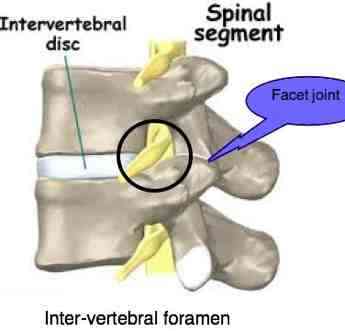
Slipped disk is common and, if treated early before swelling and inflammation sets in, usually responds magnificently to chiropractic help. However, once it starts going down the leg, then it's another matter. Take it seriously in the beginning so that these other disabling and painful symptoms begin.
The intervertebral space is filled with material that lies between each adjacent pair of bones in the spinal column; it can bulge and herniate quite commonly. Few of us escape occasional episodes. Mostly pain in the low back only, with the possibility of radiating down the leg, very rarely in the midback, but also quite commonly in the lower neck, with the possibility of pain and tingling in the arm.
The spinal column is made up of 26 vertebrae that are strongly joined together with ligaments to permit forward and backward bending, side bending, and rotation of the spine.
The facet joint, situated immediately behind the nerve root, helps to control and limit these movements.
Each disc is composed of two parts: a gelatinous material not unlike egg white called the nucleus pulposus, surrounded by rings of a fibrous tissue called the annulus fibrosus.
That gel can bulge and herniate through the surrounding rings. The further it progresses, the more the pain in the leg.
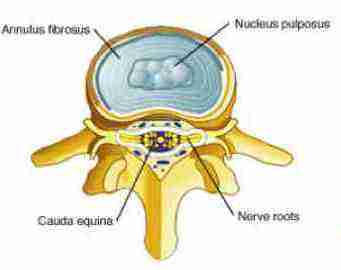
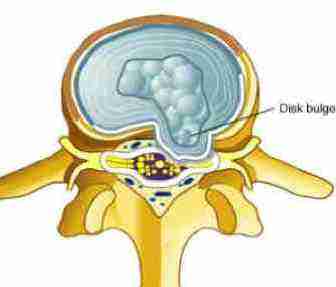
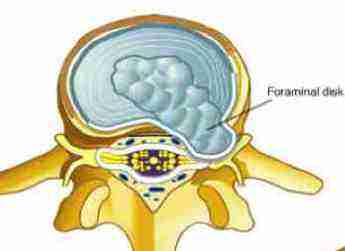
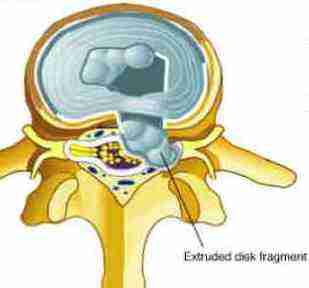
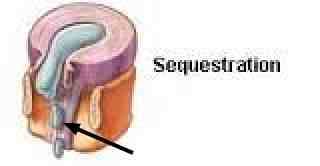
This is typically how it may begin, particularly if you twist and lift, or sneeze at the same time.
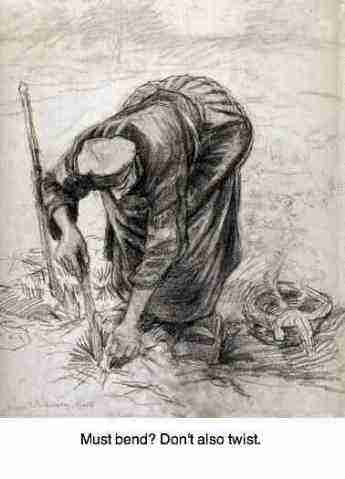
Recognise the artist? You should! Look for a V hidden in the bottom left corner.
From the Coal Face
'I don't need to ask what's wrong with you, Mr Jones. But tell me how it happened, and when.'
The tall angular man looked like the leaning tower of Pisa. He stood with an acute angled posture, yet declined to sit. Instead he perched on the edge of the desk.
'Six months ago, and gave a hard tug on the sheet on my boat, and felt a sharp stab of pain in my back.'
'And then?'
'My doctor said I had sprained my sacroiliac joint. I had some pills, some physiotherapy, and then after a sneeze it started down my leg.'
We eventually won with Mr Jones' back, but I won't pretend it was easy. It wasn't. It all starts with the right diagnosis. His doctor I'm sure would be streets ahead of most chiropractors in diagnosing pain in the abdomen, but in the back he was out of his depth.
Pain with coughing, sneezing, or straining on the toilet is a
sure sign that you need to be careful. It could be a slipped disk in the
making.
Slipped Disk
The prolapsed nucleus pulposis is readily seen below.
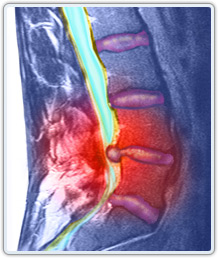
In the neck a slipped disk causes a deap-seated ache in the arm. It can be the most dreadful pain, often worse at night, and the only escape may be putting your hand on your head. Read more about arm pain …
In a slipped disk the inner bubble of gel, the nucleus pulposus, herniates or slips through the surrounding annulus fibrosus
towards the spinal canal. Initially it causes no frank pressure on the
nerve root, but it releases noxious chemicals that may inflame the
nerve.
Sudden wrong movements, sneezes, heavy lifting, or just prolonged sitting may cause further bulging, placing pressure on a spinal nerve; with the begin of ominous tingling and or pain in the leg or arm. Further pressure causes more severe pain in the limb and ultimately damage to the nerve.
First the limb becomes more sensitive to pinprick, and
thereafter numb. Then weakness in the leg may start to develop.
Feeling the pinch? Not in your back, but your back pocket? Don't feel all alone. Research proves that low back pain costs the public, insurance companies and the governments billions of dollars.
Strong research by workman's compensation proves that chiropractic help is more effective, far cheaper, and gets patients back to work much sooner. Read more at lower back pain.
Cervical and Lumbar spine
Slipped disk most commonly affects the low back and neck. Prolonged exposure to a bent-forward work posture is correlated with an increased incidence of disc herniation.
This condition is also commonly called a
- herniated nucleus pulposus
- protruded disc
LUMBAR DISC PROTRUSION ...
- prolapsed disc
- ruptured intervertebral disc,
- bulging or, simply, slipped disc
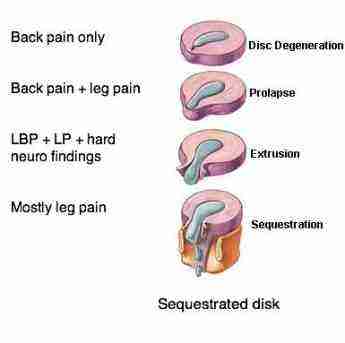
A sequestrated disc has burst completely beyond the confines of the outer fibres, characterised by severe leg pain, and little back pain. Surprisingly, it too may respond to chiropractic, but if it affects your bladder, you must see a surgeon immediately. IMMEDIATELY. If you cannot void your bladder, it can cause serious harm.
Atherosclerosis symptoms low back pain
What are the affect of smoking and cholesterol on your lower back pain? You probably think it's very difficult to quit or change your diet, but current research shows
that smoking and raised serum cholesterol are highly related to low back
pain. Why? They both contribute to inflammation of the arteries supplying the lumbar spine.
THERE ARE FOUR LEVELS OF SLIPPED DISC
For some interesting cases of low back pain (and other) from the Chiropractic Coalface, click here. CHIROPRACTIC COALFACE ...
SYMPTOMS AND SIGNS
Grade 2-4 disc herniations cause pain (or possibly only tingling) that radiates below the knee. The pain is usually aggravated by
- Sitting
- Standing and slow walking (Faster walking may be less painful, though this is not necessarily the case.)
- A positive valsalva manoever.
- Coughing, sneezing and straining on the toilet (the so-called Dejeurine's triad)
- Forward bending
- Side bending, more often towards the side of pain, though this is dependent of the type of herniation.
- The sign of Pisa . You can't stand up
straight! Pain, tingling or simply a tight feeling may begin in the
leg... sciatica and occasionally it can affect the Femoral nerve too.
HELP FOR SCIATICA ...
Antalgia = Ant-algia = away/ towards the pain
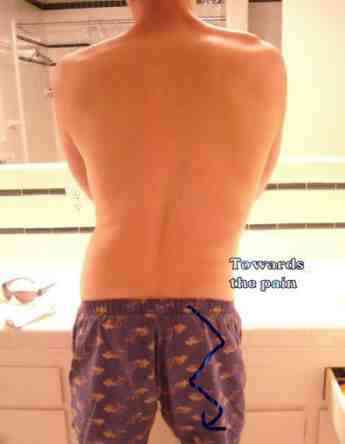
The word "antalgia" means leaning to the side to relieve the pain. It is a reflex action that you cannot control, a temporary posture that the body takes to relieve the pressure on the nerve root. It's a very serious sign, often the prelude to a nasty sciatica if not taken seriously.
Antalgias come in two main types:
- Leaning AWAY from the painful side.
Read more about a POSTERO LATERAL DISK herniation
- Leaning TOWARDS the painful side.
Read more about a POSTERO MEDIAL DISK herniation
The pain of a slipped disk is usually relieved by
- Perching on a high stool or edge of a desk for example
- Lying on the back in the so-called 90/90 position: with the hips and knees flexed
- Sometimes lying face-down on a pile of cushions under the hips
- An ice-pack (30 mins) wrapped in a thin towel is a far more effect painkiller than pills. Follow for ten minutes with a hot water bottle. No more than 10.
Numbness when rubbing the leg, or pricking yourself with a pin is a sure sign of an irritated nerve. In the early stages the skin may be MORE sensitive.
Buckling of the knee, or the inability to stand on the toes or heel is an ominous sign.
Typically, if it's a low lumbar disc, straightening the knee whilst sitting will cause pain in the back and leg.
PREVALENCE
Low backache is extremely prevalent, and is the second most common reason for the people to seek medical attention. Not all obviously are slipped disks. Low back pain accounts for approximately 15% of the sick leave in First World countries, and is the most common cause of disability in persons less than 45 years of age.
Every year 5% of the population will have a slipped disc. Mostly the prognosis for a grade 1 protrusion is good, and improvement often occurs with little or no intervention.
However, if it lasts longer than 12 weeks, some authorities say 6 months, we call it chronic, and the chances of progression with leg pain is now much greater.
While it is not recommended that every sore back needs to go to the doctor or chiropractor, pain which does not improve within a few weeks certainly demands an assessment by your chiropractor.
The causes of slipped disk?
Mechanical low backache or musculoskeletal backache as it is called, is the most common form of back pain. This may result from strain of the muscles or the ligaments in the back or sacro-iliac joints.
Only 1 to 3 percent of the patients with low back ache will have a slipped disk causing frank compression of the nerve root; grades 3 or 4.
Sciatica is the pain due to the irritation of the sciatic nerve root, a nerve which supplies the lower limb, due to lumbar disc prolapse. (There are other causes, such as Piriformis syndrome). Sciatic pain is usually present in the low back and buttock and goes down the thigh and ultimately to the foot.
Several studies have shown that smokers are more prone to get back pain, sciatica and spinal degenerative changes. Smoking also delays bone and disk healing, increasing the chance of surgical failure. Failed Back Syndrome is a reality.
IMPORTANT CONSIDERATIONS
* Your age
* Any history of cancer (like prostate or breast carcinoma).
* Have you lost weight?
* Long term use any steroidal drugs or drugs for AIDS.
* How long has your back been sore?
* Any pain or worsening of pain whilst at rest?
* Drug abuse including smoking.
* Do you have a numb or weak feeling in the leg/s?
* Had a bad fall that injured your back? Fractures? On the ice?
* Difficulty in passing urine
* Previous failed treatment for backache.
* Depression can also be a factor, undermining all your health.
What tests are recommended?
For over 90% of the patients with back pain, no further testing is necessary beyond X-rays in the first month. Otherwise one must proceed with investigations like CT, MRI and bone scan for the back if there is no good response to treatment, or if leg pain is developing. These tests will reveal if there are bony abnormalities, a slipped disk or a spinal tumour.
What are the treatments available?
Low back pain should always be managed conservatively in the initial weeks, unless there is loss of bladder control, or weight loss, or fever.
Non-surgical treatment of slipped disk includes:
- Bed rest: This will reduce the intra discal
pressure and pressure on the nerve roots. Bed rest up to 4 days is
allowed provided it includes gentle exercises and periods of walking
around the house. Prolonged bed rest does more harm to the patient than
good, producing weakness, stiffness and pain. We recommend that you get
up every hour. Massaging bed rest ...
- Activity modification: For some six weeks after a slipped disk, patients are advised not to lift any objects, not to sit much and not to bend or twist the back.
- Exercise: Low stress aerobic exercise is advised. Walking, cycling (only a lady’s bike) and swimming (backstroke) are allowed in the first two weeks. Pain should be the judge.
- Analgesics: For acute pain, an icepack used for up to 30 minutes is best, but paracetamol, or other drugs like diclofenac can be used. Unlike drugs, ice has no side effects.
- Patient education: Patient should be educated how to modify the daily activities, how to lift weight etc.
- Physical treatment for slipped disk. Manipulation has shown great benefit when correctly applied. Inversion and McManis lumbar traction have value, but continuous traction is of no use.
Chiropractic help
Different chiropractors favour differing treatments depending on the seriousness of the condition.
- Mostly, there will be treatment with patients lying on one or both sides, perhaps with a drop mechanism for better effect, and less force. A popping sound may be heard during the adjustment, as the herniated fragment is manipulated back into place.
- Different forms of mobilising traction may be used to good effect. Stationary traction while lying in bed at home or in hospital has no good effect.
- Some chiropractors favour a mechanical device called an activator .
- Deep muscle work, and various modalities have good effect, best done whilst lying on the side.
- Intermittent bed rest may be an important aspect of the treatment in severe cases. Standing up, and walking about hourly is important. As in all acute sprains, ice acts as a powerful pain killer and anti-swelling agent.
- In the recovery phase, rehabilitative exercises are important. For a course of simple low back exercises, subscribe to
Chiropractic Tips ...
- LOWER BACK EXERCISES ... demonstrated on YouTube.
- Active rehabilitation
- Smoking. I can tell you honestly? Straight? If you have a slipped disc and you're a smoker, your chances of recovery are dramatically lowered in the chiropractic clinic. It's been proved to be the biggest risk factor in surgery - and so it is in chiropractic. As a very minimum, this is a good time to cut back hard on your smoking for the six weeks that a slipped disk takes to heal. And every day is a good day to quit. It WILL knock ten years off your life.
At this link you can read how diabetes and joint problems like slipped disk are effected by smoking. Read more about Smoking and Diabetes …
Surgery
In the United States each year, 1.5 million people have lumbar MRI scans to look for the cause of the buttock and leg pain called 'sciatica'. More than 1.2 million of those scans fail to find the cause in the spine. Three hundred thousand of the scans are sufficiently positive that the patient has lumbar spine surgery. Of the 300,000 surgeries for slipped disk, as many as 25% fail to relieve the pain - in many cases this is because the diagnosis of a spinal cause for the sciatica was incorrect.
OTHER CAUSES
There are many other causes of sciatica. For example,
Financial burden of Low back pain
Back pain is providing modern society with a huge financial
challenge. Despite huge jumps in technology, the economic burden to both
individuals and society is soaring. For more interesting facts and
figures,
click here. LOW BACK PAIN ...
For more information on the dangers of anaesthetics follow this link.
More links about SLIPPED DISK and pain in your leg.
- A confusing pain pattern in the leg. The Lateral disc herniation ...
- Maignes syndrome produces pain on the side or front of the thigh and sometimes in the groin.
- A story from chiropractic writer Bernard Preston. Light and easy and informative. INTERMITTENT CLAUDICATION ... increasing leg pain with exercise.
- Return to Chiropractic Conditions - those syndromes chiropractors treat routinely.
Arm pain
This page has concentrated on the lumbar spine. However, a slipped disk in the neck is equally serious; many of the features are similar, only the arm pain, a very deep seated ache especially at night, can be even worse than a sciatica.
- Return from SLIPPED DISK to slipped disc symptoms home page.
- Slipped disc symptoms case file …
- Go from SLIPPED DISK to CHIROPRACTIC HELP home page …
When browsing these links use right click and "Open Link in New Tab", or you may get a bad gateway signal.
- Home
- SLIPPED DISC
- Slipped Disk
Did you find this page useful? Then perhaps forward it to a suffering friend. Better still, Tweet or Face Book it.
MONTHLY NEWSLETTER. Signed up yet? It is free.
BACK ISSUES
Chiropractic Help Backissues ... our monthly newsletter, click here for all the old issues.
- Issue #53: No short cuts to better health / Simple balance and quad strengthening exercises
- Issue #52: Needs an adjustment / Everything must change
- Issue #51: Elective surgery in the elderly / Cooling and reheating starches
- Issue #50: Make time for breakfast / Scrambled eggs and parsley
- Issue #49: Consulting a locum / Green salad /Eggs Florentine
- Issue #48: Hips and the sacroiliac joints/ Bacon and eggs
- Issue #47: Life without medication/ Eight coloured foods
- Issue #46: Lower backs and ankles/ kaempferol and cancer prevention
- Issue #45: Tingling, weakness and malaise/ vitamin B1
- Issue #44: Applying general chiropractic principles to the hand / Omega-3
- Issue #43: Art and science of chiropractic / Kale
- Issue #42: Tum sleeping / Flaxseed
- Issue #41: Adult potty training / Beetroot constipation
- Issue #40: Ominous lumbar signs / Too much medication?
- Issue #39: Swapping chiropractors / Butter is back
- Issue #38: Making a correct diagnosis / Make your own pesto in five minutes.
- Issue #37: Have your wisdom teeth out in the chair
- Issue #06: Safety on the Stairs / Ginger
- Issue #05: Safety in the home / Red foods
- Issue #04: Whiplash and the Joints of Luschka / Parsley
- Issue #03: How to stop falling / Danger of a low fat diet
- Issue #01: Tingling in the arms and hands / Apples
(PS. If you find them irrelevant to your needs or an exercise in tedium, one click will UNsubscribe you.)
- Home
- SLIPPED DISC
- Slipped Disk
