Rotator cuff
Rotator cuff consists of four muscles that can make your life a misery.
This is the name given to a group of four muscles that act to stabilize the upper arm.
They allow you to raise your arm, turn it and move it into many different positions, each carefully controlled and coordinated, as in throwing a ball accurately, for example.
Unlike the hip though, the socket is very shallow to allow for a greater range of motion. This makes the joint more vulnerable to injury, leading to pain, strains and tears.
Complete rupture is uncommon, most usually after a cortisone injection. More commonly, calcium deposits in and around the joint, an ultimately a frozen shoulder may occur.
Rotator cuff muscle tears cause pain and weakness in the shoulder. Usually it starts as a small strain with heavy lifting, or not warming up properly before tennis, for example, or a fall on the outstretched arm.
This may be followed some weeks or months later by a partial tear if the initial minor injury was not correctly addressed. The shoulder will be painful, but you can still move the arm in a normal range of motion. Obviously, the larger the tear, the more weakness and the more pain the injury will cause.
You may become aware that certain movements become painful and possibly slightly restricted. Reaching behind your buttock to remove a back pocket wallet, or loosen the bra may become difficult. Raising your arm to brush your hair may hurt.
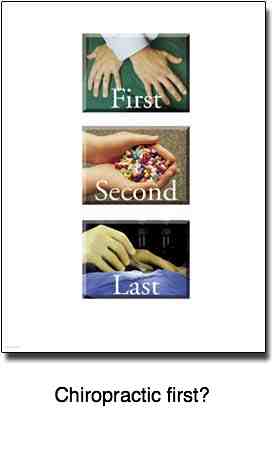
Complete rupture is fairly rare, often occurring after cortisone injections, which should be considered only after chiropractic (or other) conservative treatment has been exhaustively tried without success.
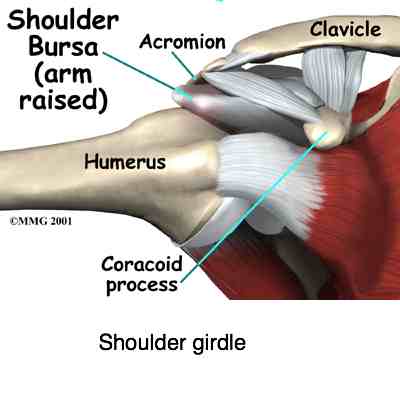
Regular stretching before activity is the key to the healthy functioning of the shoulder muscles and joints. Otherwise wear and tear, or degeneration, of the muscles and tendons occur. Tearing of the rotator cuff tendons is an especially painful injury. A torn rotator-cuff creates a very weak shoulder. Most of the time patients with torn rotator cuff are in late middle age. But rotator cuffs tears can happen at any age.
Upper arm pain and the so called frozen shoulder often involve these four key muscles.
They are the
- Subscapularis (which lies UNDER the shoulder blade),
- Supraspinatus (which lies ABOVE the spine of the shoulder blade),
- Infraspinatus (which lies BELOW the spine of the shoulder blade) and
- Teres Minor (which attaches to the side of the shoulder blade.
To these four muscles we will add the - Biceps muscle for simplicity, since it also a common offender and cause of shoulder pain.
Rotator cuff syndrome. What's that?
Rotator cuff needs to be stretched and strengthened isometrically and then dynamically, and most important the neck, first rib and AC joints must be checked.
Frozen shoulder
Frozen shoulder is another of the conditions that are really secondary to something going on in the lower neck or related to the thoracic outlet.
For some pictures of these muscles, and their anatomy, terms like acromion and clavicle click on this shoulder anatomy link.
What causes Rotator Cuff Syndrome?
Rotator cuff muscle tears can occur from a single traumatic injury, for example a fall on the outstretched arm, causing immediate severe shoulder pain.
If a fracture, or torn ligaments occurs at the same time, then of course the rotator cuff injury may be missed, and the treatment of the fracture, obviously immobilisation, may unavoidably be the very worst treatment for the muscle injury. It can't be helped.
Just rehabilitation of the shoulder, once it comes out of the sling, will be further prolonged and more difficult.
Most tears, however, are the result of overuse of these muscles and tendons over a period of years, starting with a minor injury that is not adequately cared for. People who are especially at risk are those who engage in repetitive overhead sports such as tennis and weight lifting.
This nasty shoulder syndrome frequently starts after a whiplash injury, usually many years earlier and long forgotten. It is indeed difficult to prove the link.
Progressive irritation of the nerves by arthritis or a subluxation in the neck may weaken the shoulder muscles and makes them vulnerable to sprains and strains.
For unknown reasons, smokers are more prone to right shoulder pain.
A frank tear usually doesn't occur unless the muscle is already weakened by some other problem, either in the neck and sometimes in the acromioclavicular joint.
Chiropractic help
Chiropractic help is really for you if you wish to avoid surgery to your shoulder, lower arm or wrist.
Nonsurgical Treatment
The first goal is the correct diagnosis of the condition. This will include an examination of the neck. NECK PAIN ... to see if the underlying cause may be an irritated or pinched nerve.
Classically, in a muscle injury, an ISOMETRIC test (the benchmark test) causes pain. In this examination, the rotator cuff muscle is tested against resistance, WITHOUT movement of the arm.
An echo (Doppler) examination or an MRI may be required in more serious cases of shoulder pain to help with the diagnosis.
Treatment is then addressed at your chiropractor’s findings. Classically this will include a gentle adjustment of your neck, rest from vigorous activities, and ice (if acute), gentle stretching perhaps if the tear is not serious, and finally vigorous, active rehabilitation. ROTATOR CUFF STRENGTHENING ... of the shoulder and neck, so that the tear in the rotator cuff does not re-occur as soon as you return to sport.
Carrying your wallet in your back pocket? A red rag to your chiropractor. BACK POCKET WALLET ...
Anti inflammatory drugs, unless the pain is very severe, should not be used in the first instance because in the initial stage
this is not an inflammatory condition, and ice is more effective and
safer. 14 000 people DIED in one year in the USA alone from gastric
bleeds after using NSAIDs, as they are called.
Cortisone injections are freely acknowledged to be a cause of
rotator-cuff tendon rupture and, together with surgery, should only be
considered after all conservative treatment has been exhausted.
Other factors to consider
Depending how serious the strain is, it may take 6-8 weeks to heal. Graduated return to sport is essential.
As a rule of thumb, if your shoulder is not improving to your satisfaction, think of the following:
- Has your neck been considered as a possible cause of
your arm pain? In particular, the lower cervical facet anatomy should be
considered, that's where the nerves to the arm emerge.
LOWER CERVICAL FACET ANATOMY ...
Neck pain treatment ...
- Has the AC joint been examined?
- In the author's experience, the SUBSCAPULARIS muscle is often the offending rotator-cuff miscreant. Has it been examined?
- Are you following a daily exercise program? Daily stretching and strengthening is vital is you wish to regain the function of your shoulder.
Shoulder surgery
A complete tear (most uncommon) will not heal. Complete ruptures usually require surgery if your goal is to return your shoulder to optimal function, and particular if you have competitive sport in mind.
Elderly patients, and those who have other diseases that increase the risks associated with anaesthetics, should avoid surgery, (in my opinion!) and accept the limitations of a weak shoulder. Far more sensible than risking losing your marbles!
"I'm sick of pain - 1 year later after wrist and shoulder surgery I still have chronic pain on right side and it moves to left back of neck and scapular where I have knots.
I can hardly turn my neck - no insurance now."
Hello Wendy,
You were probably badly advised. The primary cause of the pain in your arm was most likely in your neck - all the surgery in the world in your wrist and shoulder couldn't possibly fix the pain radiating down your arm from a chiropractic subluxation in your neck.
Start saving your pennies, and see a local chiropractor.
Dr B
From the medical literature
Complications of open acromion surgery:
The rate of complications after open acromioclavicular surgery is quite low. They include fracture of the acromion bone, continuing pain, reduced movement in the shoulder join after surgery, a long rehabilitation and exercise process, unexpectedly late return to work, weakness of the associated muscles, wound infection often deep within the bone, detachment of one of the muscles, often the deltoid, and disability.
McShane et al., in a study of twenty nine patients who had an operation to remove the acromion for the treatment of an impingement syndrome, reported an unexpectedly high percentage of complications, mostly after surgery involving detachment of the deltoid muscle. Most of these complications were described as 'technical errors'.
Ogilvie and Harris examined nearly seventy patients who had had persistent pain for more than two years after an open surgery to remove the acromion. Twenty one of the failed surgeries had been performed by the authors themselves and the other fifty odd had been performed elsewhere.
All
patients had a thorough examination to determine the reason for the failure of the acromioplasty. This revealed that forty percent of the initial diagnoses had been wrong; another forty two percent were due to a technical error during surgery, and that
only eighteen percent had the correct diagnosis and
treatment. Even after re-operation with the correct surgery only sixty percent ended with a satisfactory result. No explanation was provided for the forty percent failure of the others.
From the coalface
In December, whilst my colleague was on leave for a month, and I was working seriously overtime, I developed a rotator cuff strain. Such that for about two weeks I had to work out other ways of giving an adjustment to the spines of patients.
THEREAFTER, I developed neck pain. Chicken and egg.
But it was a learning curve for me. I developed new exercises for my shoulder, that I could then share with patients. I realised, perhaps for the first time, that a rehab exercise must REACH the painful activity, but not cause searing pain.
Fortunately, after a couple of treatments of my neck when my colleague returned, together with my own home grown exercises, the pain soon passed over. It's now three months since I had any discomfort, but I'm still doing the exercises every morning; a chiropractor's work is dependent on a strong shoulder.
CHIROPRACTIC HELP Questions
There's no substitute for a thorough examination when it comes to a shoulder condition, but we do try to answer some of your basic questions. In the end though most likely the advice will be to consult your local chiropractor to make the diagnosis... is the problem primarily in your shoulder? Or is it in your neck? Or both?
Gout
When there's severe shoulder pain that doesn't present in the usual manner, then very occasionally gout should be considered.
It's usually worse at night, you may have a history of great toe pain
and swelling, and it usually responds within a few days to NSAIDS.
Useful links
- To go from ROTATOR CUFF to arm pain.
- The dangers of a General Anaesthetic ...
- ARM PAIN Quick DASH score: How bad is your pain?
Suffering from shoulder and/or arm pain?
Do you have any questions about shoulder and/or arm pain that is not getting better? Share it, perhaps others have some insights that may be of benefit.
STOP: Are you writing on a cellphone? I DON'T RESPOND TO SMARTPHONE GRAMMAR. GOOGLE DOWNGRADES SITES WITH POOR ENGLISH AND I DON'T HAVE THE TIME AND INCLINATION TO CORRECT YOUR LETTER.
What Other Visitors Have Said
Click below to see contributions from other visitors to this page...
Sharp stabbing intermittent occasional pain inside shoulder 
Sharp stabbing intermittent occasional pain inside shoulder is near the insertion of the subscapularis muscle.
I have been researching my problem on …
Did you find this page useful? Then perhaps forward it to a suffering friend. Better still, Tweet or Face Book it.
MONTHLY NEWSLETTER. Signed up yet? It is free.
BACK ISSUES
Chiropractic Help Backissues ... our monthly newsletter, click here for all the old issues.
- Issue #53: No short cuts to better health / Simple balance and quad strengthening exercises
- Issue #52: Needs an adjustment / Everything must change
- Issue #51: Elective surgery in the elderly / Cooling and reheating starches
- Issue #50: Make time for breakfast / Scrambled eggs and parsley
- Issue #49: Consulting a locum / Green salad /Eggs Florentine
- Issue #48: Hips and the sacroiliac joints/ Bacon and eggs
- Issue #47: Life without medication/ Eight coloured foods
- Issue #46: Lower backs and ankles/ kaempferol and cancer prevention
- Issue #45: Tingling, weakness and malaise/ vitamin B1
- Issue #44: Applying general chiropractic principles to the hand / Omega-3
- Issue #43: Art and science of chiropractic / Kale
- Issue #42: Tum sleeping / Flaxseed
- Issue #41: Adult potty training / Beetroot constipation
- Issue #40: Ominous lumbar signs / Too much medication?
- Issue #39: Swapping chiropractors / Butter is back
- Issue #38: Making a correct diagnosis / Make your own pesto in five minutes.
- Issue #37: Have your wisdom teeth out in the chair
- Issue #06: Safety on the Stairs / Ginger
- Issue #05: Safety in the home / Red foods
- Issue #04: Whiplash and the Joints of Luschka / Parsley
- Issue #03: How to stop falling / Danger of a low fat diet
- Issue #01: Tingling in the arms and hands / Apples
(PS. If you find them irrelevant to your needs or an exercise in tedium, one click will UNsubscribe you.)
