Rotator Cuff Strengthening
Rotator cuff strengthening is all about shoulder pain and its rehabilitation.
This process is an integral part of the treatment of every injury, otherwise the body part will remain weak and prone to further, and often worse, problems.
This is is the name given to a group of four that act to stabilize the arm. Pain and a condition called adhesive capsulitis often involve one or more of these key muscles.
These shoulder muscles allow you to raise your arm, turn it and move it into many different positions, each carefully controlled and coordinated, as in hitting a golf ball accurately, for example.
Unlike the hip joint though, the shoulder socket is very shallow to allow for a greater range of motion. This makes the upper arm more vulnerable to injury, leading to pain, strains and tears.
Since the shoulder is non weight-bearing, as are the hip and knee, it is much less prone to arthritis. An exception here is the AC joint, between the acromion and the clavicle.
It connects the collarbone to the shoulder blade, is often injured in falls and, should it not be correctly managed with rotator cuff strengthening, it tends to becomes prone to immobilisation degenerative changes of the hyaline cartilage.
The acromioclavicular is second most arthritic joint in the body, after the thumb.
They are the
- Subscapularis (which lies UNDER the shoulder blade), the
- Supraspinatus (which lies ABOVE the spine of the shoulder blade), the
- Infraspinatus (which lies UNDER the spine of the shoulder blade) and the
- Teres Minor. To these four muscles we will add the
- Biceps muscle for simplicity, since it also a common offender that needs strengthening.
Acromioclavicular joint
Acromioclavicular joint is pivotal to understanding the shoulder; adjusting any fixations may be pivotal to rotator cuff strengthening.
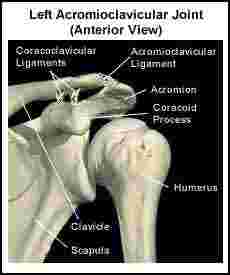
See if you can follow the thin clavicle, collarbone, at the top of the picture to where it joins with the shoulder blade, scapula, at the acromion. This acromio clavicular joint with its ligament is key to shoulder mobility. Chiropractic adjustment of the ac joint is very important.
The shoulder muscles are energised by nerves emerging from the lower neck. An old neck pain injury often lies at the root of shoulder pain. Have you perhaps been involved in a car accident or an old sporting injury?
The so called rotator cuff syndrome is a complex condition involving four shoulder joints, together with their capsules and ligaments, the shoulder muscles and their tendons, their nerve supply and the acromio clavicular joint.
In these shoulder syndromes, the muscles after being strained adhere to each other and the roof of the fossa which is formed by the acromio clavicular joint.
A sports oriented chiropractor will not only adjust your neck but
focus on these peripheral sites of injury, the four shoulder joints,
and a complete set of rotator cuff strengthening exercises.
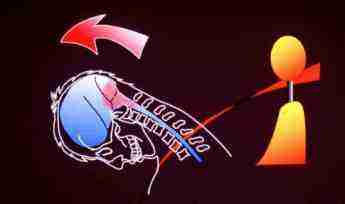
Rotator Cuff Strengthening
Rotator cuff strengthening explains the syndrome and how is it treated?
The simplistic and safest rotator cuff strengthening exercises are the isometric exercises. A very good place to start, as Julie Andrews would say! Sound of Music ... (Sorry, a bit crazy this morning!) When you read you begin with A-B-C, when you sing ... when you strengthen your shoulder you begin with STRETCH-ISOMETRICS-DYNAMICS.
These isometric exercises mean that the shoulder doesn't move! Here are six little exercises to start with. Whilst sitting in a chair, place your elbow against your side with the elbow at 90 degrees, and your hand straight in front of you. Using your other hand,
- grasp your wrist with the good hand, and press straight across, inwards, with your injured arm. Without movement! Against resistance from the good arm.
- Adjusting the fingers slightly, in the same position, now pull outwards, again without movement.
- Now pull your elbow straight against your chest.
- Reaching across, grasp the elbow of the painful shoulder, with your good hand. Now attempt to pull your painful arm away from the body, against the resistance of your fingers; without movement. Gently, because you're not eligible for the Olympics.
- Now press your elbow backwards against your chair.
- Lastly, make a fist with your sore arm. Keeping the elbow at your side, push straight forwards against the good hand, again without any movement.
Do about five to ten repetitions each and every time you take a tea break. Start slowly, particularly if these movements are painful; there is no rush.
Isometrics are more effective that dynamic exercises in the initial phase after injury when it comes to rotator cuff strengthening, but you must do it in different positions. When these six are painless, then do them with the shoulder flexed at forty five degrees, say, and then ninety.
Strengthening exercises with movement should then follow. Once you can do the isometrics without pain, then progress using this inexpensive apparatus. It's a simple affair with a small pulley, and a cord with a handle at each end. Fix it in the door jamb, and pull away, changing the position.
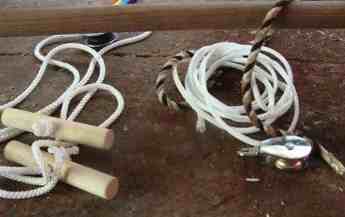
Make your own arm exerciser for a fraction of the price; it's dead easy.
WEIGHT TRAINING
Once you can do that without pain, then it's time to move your ROTATOR CUFF STRENGTHENING on to light weights. Holding any tin can of around 400 g (1 lb) in your hand, start moving the arm in these same directions. Always start with stretching and do it at least twice a day.
A used bicycle tube is excellent for Rotator Cuff strengthening. Hook it over some fixed point, and start doing gentle exercises against the resistance of the tube. Inwards, outwards, forwards ... you can use your imagination, but follow a routine, gradually expanding it as you feel the shoulder getting stronger.
Warm up routine of golfer Padraig Harrington
Whilst none of us amateurs would consider a routine like this before playing sport, if you are a professional sportsman, where fine-tuning makes a profound difference at the finish line, then you may wish to think about Padraig Harrington's preparation before a round of golf.
Padraig was missing four to five tournaments per year due to injury. So he hired chiropractor Dr Dale Richardson to go on tour with him. Now he misses no tournaments. This is the routine that his DC has given him.
- On arising in the morning, 45 minutes of stretching, stabilizing and core muscle exercise as a warm up for the day.
- Take a warm shower.
- Enjoy a hearty breakfast of his own choosing.
- Thereafter follows twenty minutes with Dr Richardson checking that all
the joints and muscles needed by a professional golfer, every one in
the body, are working correctly; then more stretching.
- An hour at the range hitting shots to warm up further.
- Four to five hours on the golf course.
- This is followed by another hour with Dr Richardson giving treatment and cool down procedures.
- Gym work in the late afternoon for ultimate strength and endurance needed by any professional sportsman.
For a professional sportsman, Harrington's words are interesting.
One thing I know from my own experience is that my body needs constant attention, even when I take a few weeks holiday; because I can see even though I would be injury free for say a month, I can feel tightness and pain building up. I never used to pay much attention to those early signs; it wasn't long before that translated into bogeys on the golf course.
The basic principles here are:
- Stretching, warmup and checking that
muscles and joints are working correctly.
- After sport stretching and cool down apply whether you are going to spend the day gardening, preparing for a game of squash, or even just going for a hike.
Frozen shoulder
Chiropractic help is for those who really have not desire to go under the knife for their frozen shoulder pain; it's a frequent consequence if you don't undergo rotator cuff strengthening after an injury.
The frozen shoulder is one of the most painful conditions faced in the chiropractic clinic. Prevention is the name of the game.
Two of the early signs are difficulty taking off a T shirt, for example, and placing the hand behind the back as in removing a back pocket wallet and fitting your bra.
When that starts to happen, do not delay; get chiropractic help sooner rather than later. A frozen shoulder, or adhesive capsulitis, can take three years and more to thaw.
Chiropractic help
Chiropractic help is a site dedicated to enabling you to understand your condition better and how we might manage it. Rotator cuff strengthening is vital after injury; otherwise it simply starts all over again the first time you do some vigorous work.
Links
Having read this page, should you want to read more about shoulder anatomy, (did I hear you exclaim, "four! shoulder joints?") and see some diagrams, then for more info about Rotator cuff syndrome and the Frozen Shoulder please click here:
- From ROTATOR CUFF STRENGTHENING to SHOULDER ANATOMY ...
- Rotator cuff syndrome
- Frozen Shoulder causes and chiropractic treatment
- Shoulder abduction relief sign, a pinched nerve?
Did you find this page useful? Then perhaps forward it to a suffering friend. Better still, Tweet or Face Book it.
MONTHLY NEWSLETTER. Signed up yet? It is free.
BACK ISSUES
Chiropractic Help Backissues ... our monthly newsletter, click here for all the old issues.
- Issue #53: No short cuts to better health / Simple balance and quad strengthening exercises
- Issue #52: Needs an adjustment / Everything must change
- Issue #51: Elective surgery in the elderly / Cooling and reheating starches
- Issue #50: Make time for breakfast / Scrambled eggs and parsley
- Issue #49: Consulting a locum / Green salad /Eggs Florentine
- Issue #48: Hips and the sacroiliac joints/ Bacon and eggs
- Issue #47: Life without medication/ Eight coloured foods
- Issue #46: Lower backs and ankles/ kaempferol and cancer prevention
- Issue #45: Tingling, weakness and malaise/ vitamin B1
- Issue #44: Applying general chiropractic principles to the hand / Omega-3
- Issue #43: Art and science of chiropractic / Kale
- Issue #42: Tum sleeping / Flaxseed
- Issue #41: Adult potty training / Beetroot constipation
- Issue #40: Ominous lumbar signs / Too much medication?
- Issue #39: Swapping chiropractors / Butter is back
- Issue #38: Making a correct diagnosis / Make your own pesto in five minutes.
- Issue #37: Have your wisdom teeth out in the chair
- Issue #06: Safety on the Stairs / Ginger
- Issue #05: Safety in the home / Red foods
- Issue #04: Whiplash and the Joints of Luschka / Parsley
- Issue #03: How to stop falling / Danger of a low fat diet
- Issue #01: Tingling in the arms and hands / Apples
(PS. If you find them irrelevant to your needs or an exercise in tedium, one click will UNsubscribe you.)
