Frozen Shoulder
Frozen shoulder is one of the most painful and debilitating conditions faced in the chiropractic clinic.
PAIN!

What is more it remains extremely painful,and disabling for a long time if not properly managed; up to
three years and longer.
Simple daily activities like taking off a t-shirt or
putting on a coat and even combing our hair become an ordeal. Sleep is
invariably disturbed, another reason why it is so miserable; see the quick dash rating lower down on this page.
Prevention is the key. Nip the pain in the bud before your shoulder turns to ice.
Shoulder pain is caused by many conditions. The majority but not all, are the result of irritation of nerves in the lower neck or upper thoracic spine.
That is why chiropractic treats it so successfully.
But this is one of the more difficult conditions. It can be well managed with our care, however the shrunken capsule may take several months and very occasionally a whole year to resolve, depending on how advanced the problem is.
Medically, the condition is acknowledged to take up to three years to abate.
An understanding of shoulder anatomy will help you grasp the complexity of this painful condition.
To give the arm the large range of motion it enjoys, the socket is shallow and there are four complex joints to give the shoulder stability. To comprehend why it gives such trouble some knowledge of the anatomy will be instructive.
To deepen the socket there is a labrum which is often involved in the impingement syndromes. For example, a fall on the outstretched arm may tear this ring of cartilage. It can only be diagnosed on an MRI or ultrasound scan.
See another photo of the man above several months later at the bottom of this page.
AcromioClavicular joint
Mobilisation of the acromioclavicular joint is central to the management of frozen shoulder.
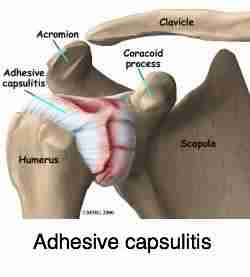
Frozen shoulder
Frozen shoulder is a relatively common and extremely painful chiropractic condition often associated with a first rib subluxation.
- Chiropractic Conditions is a central page at our site. It provides you simply and easily with the sorts of diagnoses that the average DC would be treating.
- Healthy Living Tips is another vital page at Chiropractic Help. Sparkling wellbeing is not just about having your subluxations adjusted. This link gives you some insights into different foods you could and perhaps should be eating.
What is a frozen shoulder?
You may have heard the term and may be wondering what is a frozen shoulder. Adhesive capsulitis, its medical name is a condition that causes substantial loss of movement.
The joint capsule becomes shortened and tight and
adheres to the bone; hence its medical name.
It is one of the most painful conditions treated in chiropractic clinics. Prevention is the word, but it can develop with frightening rapidity.
Arm pain treatments at the chiropractic coalface always begin with a search for irritation of the nerves from the lower neck to the muscles, tendons and ligaments; or capsule. It is usually but not always, central to this condition.
A diagnosis of adhesive capsulitis is often used for any painful shoulder condition associated with a loss of motion which is not strictly true.
The pain and disability in frozen shoulder are often extreme. Any and all movements of the upper arm, particularly internal rotation, become severely limited. Chiropractic treats the frigid capsule particularly successfully but it remains a nuggety problem. There simply is no quick fix.
Often the cause lies elsewhere so the cervical spine, the first rib and the acromio-clavicular joint must all be carefully examined.
The triceps in the upper arm and the subscapularis muscle beneath the shoulder blade are often involved.
A fine emulsion of calcium is sometimes deposited in the glenohumeral joint; it's called toothpaste shoulder for obvious reasons.
Symptoms of frozen shoulder
What are the symptoms of frozen shoulder? It is characterized by an extreme loss of motion. Raising the arm, both forwards and sideways and turning it inwards becomes very limited and extremely painful.
Thus taking off a t-shirt and particularly putting on a coat may cause extreme pain. Reaching the bra hook behind the back is quite impossible.
It is most common in the middle years around 40 to 50 and is twice as common in women.
This condition begins with just a little irritation in the shoulder but rapidly enters the acute phase, characterised by extreme pain, sleep disturbance and functional impairment; you can't brush your teeth, get a cup out of the cupboard or clean the bath.
Because chiropractic addresses function it is able to treat frozen shoulder particularly well.
This is followed by a progressive stiffening phase as the shoulder motion worsens, particularly internal rotation; and raising the arm above the head.
Extreme disability is common with even simple everyday activities such as brushing the hair, dressing and household work causing severe shoulder pain. This phase may last several years if not properly treated.
The final phase if inadequately treated often only begins after a year or two, with a mountain of frustration first to be experienced; it is the resolution or thawing phase identified by the gradual return of both motion and function.
The overall course is variable but can last 12 to 36 months.
Common Causes
- Chiropractic Subluxation and
degenerative changes and NECK PAIN.
- Old neck injuries such as
WHIPLASH CHIROPRACTIC
falls down the stairs, MVAs, horse falls, gymnastic injuries, rugby injuries.
- Shoulder injuries, such as in skiing falls, which may or may not
fracture any one of the arm bones, overuse (weight lifting, or gymming
which is not properly supervised), improper warm-up before sport, and
often there is no obvious cause. It may even start with a stiff neck.
Read more about NECK PAIN ANATOMY >>
- Shoulder surgery.
- It may also be associated with a variety of medical conditions: Hyperthyroidism, Diabetes, Degenerative arthritis of the shoulder, Heart and circulatory diseases.
- Frozen shoulder causes and Chiropractic treatment.
To find links to the topics in bold copy and paste them into the site search function in the navigation bar on your left.
Arm pain Quick Dash score
The arm pain Quick Dash score gives you a more objective measure of just how disabling your adhesive capsulitis really is.
It's a simple test based on a set of questions such as can you wash your back, and open a tight jar?
You can retake the the arm pain Quick Dash score in a month or two to assess just how successful the treatment is.
ATHEROSCLEROSIS
Any and all conditions of the human body are affected by a defective blood circulatory system and that includes FS. Insufficient oxygen means that tissues can't heal. Pathophysiology of atherosclerosis; hardening of the arteries explained in layman's terms.
While these common causes of frozen shoulder may seem quite different, they all result in one or more of the following:
- Irritation of the nerves supplying the shoulder
- Shortening of the capsule of the shoulder.
- Medical
conditions causing a high density of impurities in the blood which can
settle near the shoulder joints, muscle joints, and the belt of muscles,
blocking the normal blood circulation in these areas, which leads to
shoulder pain and loss of motion in the shoulder joint.
All of the above may lead to inflammation in the shoulder joint capsule. This capsule includes the ligaments that attach the shoulder bones to each other.
"Frozen shoulder is very poorly diagnosed and managed."
Dr David Connell, a consultant in radiology at the Royal National Orthopaedic Hospital in Stanmore.
When inflammation occurs within the capsule, there is less
ability for the shoulder bones to move freely within the joints (there
are four shoulder joints). For this reason a frozen shoulder is also
called an adhesive (scarred) capsulitis (inflamed joint capsule).
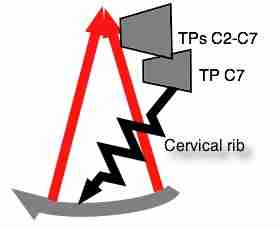
CERVICAL RIBS
Ribs pertain correctly to the thoracic spine but
very occasionally a cervical rib may affect the nerve and blood supply
to the arm causing amongst other things frozen shoulder. Usually the
ribs are small and of little clinical significance, but every now and
then there's a giant.
CERVICAL RIBS.
Arm pain treatments
Arm pain treatments are obviously dependent on the diagnosis; a pinched nerve in the cervical spine causing a brachial neuralgia would obviously be managed quite differently to a frozen shoulder.
Chiropractic help
Chiropractic Help treatment of frozen shoulder is directed at four domains:
- Shoulder pain is most often caused by subluxations in the neck. Neck pain and stiffness is commonly associated with this condition confirming the neck problem. Without treating the cause adequately, often in the neck, NECK PAIN TREATMENT, all other treatment options are slow and dependent on the body's natural recuperative powers. With no treatment at all this condition usually resolves within three years, owing to this natural healing power of the body. Three years of hell.
- Movement. The worst treatment of this condition is immobilisation, as in a sling. It rapidly worsens the pain and stiffness. A gentle set of stretches for the FS, done frequently, numerous times a day, is an essential part of the chiropractic care. As the movement returns, and the pain lessens, active rehab exercises, ROTATOR CUFF STRENGTHENING are essential.
- Key to shoulder treatment is mobilisation and/or adjusting the
AcromioClavicular joint.
- Management of any associated medical conditions such as diabetes is essential.
- Pain control is an important part of the management of this nasty condition. Ironically an ice pack, in a face-cloth, placed over the painful parts for about 20 to 30 minutes is best, followed by moist heat as in a shower, followed by the stretching program. Acupuncture, NSAIDs, and various electrical modalities may be helpful.
- A FS can sometimes be a real bastard, excuse the French. It's a very mean condition. There is new research coming out on the effectiveness of microcurrent stimulation in the treatment of frozen shoulder.
FROZEN SHOULDER EXERCISES
Frozen shoulder exercises are an important part of keeping the condition from returning; they should be done gently, not exceeding the pain boundary.
Surgery should be avoided except in the most extreme cases. Steroid
injections may help but there is risk of infection and tendon rupture.
However manipulation under anaesthetic in extreme cases can have
benefit.
For more information about the dangers of anaesthetics: ANAESTHETIC ALZHEIMERS.
Sleeping on the non-painful shoulder, with a pillow placed in front of the body for the painful arm, is advisable.

It took about four months before Mr S's shoulder settled down, and he admits himself that it only stabilised once he decided to do the exercises faithfully, continuing after the pain had nearly ceased.
Four months and ten treatments.
A word of advice: if the FS has become chronic, the chiropractic regime of increased movement may initially cause increased pain. Don't be dismayed, just do the stretches more gently, more carefully, and perhaps fewer repetitions. Ironically, do more icing, followed by moist heat. Be patient.
It will get better with chiropractic care. This is certainly one condition where the saying, Rome wasn't built in a day, applies.
Treatment of the neck alone is not adequate. If your chiropractor is not treating the shoulder itself, talk to him. Perhaps consider a change to a sports-oriented DC.
Nutrition
Do not underestimate the role of anti-inflammatory foods in the management of our frozen shoulder. Enjoying many coloured foods, daily, extra-virgin olive oil and fatty fish will have a profound part of preventing it in the first place.
AcromioClavicular joint
The hinge acromioclavicular joint between the collar bone and the shoulder blade is often an underlying chicken and egg part of the frozen shoulder; but is it a cause or a consequence?
Nevertheless, in my experience, unless the AC joint is correctly mobilised, the arm never regains normal movement.
Personal Medical Insurance
Do you follow the healthy living tips of life? Not terrified by going without insurance? Able and willing to deposit a fixed amount EVERY month into a dedicated "medical" account. Not a smoker? Ready to eat a healthy breakfast menu most days of the week?
Then perhaps you're ready for a Personal Medical insurance plan. You'll save a mint. But one serious car accident, breast cancer.... it can all go horribly wrong. Personal medical insurance is a very personal decision.
I'm uninsured....! I believe in personal medical insurance. But then I'm 100% committed to following a healthy lifestyle. Are you?
Even a nasty frozen shoulder shouldn't cost you more than 10-15 chiropractic treatments. Perhaps a lot less.
FROZEN SHOULDER TREATMENTS
- a systematic review of the literature
Literature reviews find there is no place for anti inflammatories in the treatment of FS. Vigorous mobilization of the joint, active and passive exercises reaching but not exceeding the pain threshold, deep muscle treatment and a invasive therapy known as hydrodilatation all appear to have some but limited benefit.
There is no research showing that chiropractic treatment helps (that I know of any way), yet it is one of the favourite conditions that I like to treat. But... Rome wasn't built in a day, nor is a chronic frozen shoulder fixed in a week. Come early, within two weeks, and with chiropractic help you can expect the pain to be over in a month, perhaps less.
FS TREATMENTS - a literature review[5].
USEFUL LINKS
- Go from F.S. to shoulder rehab. ROTATOR CUFF STRENGTHENING.
- Staywell Whole Health management; prevention, better than a cure, eh.
- Frozen schouder in het Nederlands.
- AC joint
- FS TREATMENTS - a literature review.
From the Chiropractic Coalface
It was good to see a lady yesterday who brought her husband for a torn calf muscle. He was unable to drive...
Two years ago she had a severely frozen left shoulder. She has almost no pain. Read more at Arm pain case histories ...
Suffering from shoulder and/or arm pain?
Do you have any questions about shoulder and/or arm pain that is not getting better? Share it, perhaps others have some insights that may be of benefit.
STOP: Are you writing on a cellphone? I DON'T RESPOND TO SMARTPHONE GRAMMAR. GOOGLE DOWNGRADES SITES WITH POOR ENGLISH AND I DON'T HAVE THE TIME AND INCLINATION TO CORRECT YOUR LETTER.
What Other Visitors Have Said
Click below to see contributions from other visitors to this page...
Collar bone cracking and pain 

For a while now everytime I go to do a push up my right collar bone starts to pop and crack and it hurts. I never thought about it that much but I ride …
Did you find this page useful? Then perhaps forward it to a suffering friend. Better still, Tweet or Face Book it.
MONTHLY NEWSLETTER. Signed up yet? It is free.
BACK ISSUES
Chiropractic Help Backissues ... our monthly newsletter, click here for all the old issues.
- Issue #53: No short cuts to better health / Simple balance and quad strengthening exercises
- Issue #52: Needs an adjustment / Everything must change
- Issue #51: Elective surgery in the elderly / Cooling and reheating starches
- Issue #50: Make time for breakfast / Scrambled eggs and parsley
- Issue #49: Consulting a locum / Green salad /Eggs Florentine
- Issue #48: Hips and the sacroiliac joints/ Bacon and eggs
- Issue #47: Life without medication/ Eight coloured foods
- Issue #46: Lower backs and ankles/ kaempferol and cancer prevention
- Issue #45: Tingling, weakness and malaise/ vitamin B1
- Issue #44: Applying general chiropractic principles to the hand / Omega-3
- Issue #43: Art and science of chiropractic / Kale
- Issue #42: Tum sleeping / Flaxseed
- Issue #41: Adult potty training / Beetroot constipation
- Issue #40: Ominous lumbar signs / Too much medication?
- Issue #39: Swapping chiropractors / Butter is back
- Issue #38: Making a correct diagnosis / Make your own pesto in five minutes.
- Issue #37: Have your wisdom teeth out in the chair
- Issue #06: Safety on the Stairs / Ginger
- Issue #05: Safety in the home / Red foods
- Issue #04: Whiplash and the Joints of Luschka / Parsley
- Issue #03: How to stop falling / Danger of a low fat diet
- Issue #01: Tingling in the arms and hands / Apples
(PS. If you find them irrelevant to your needs or an exercise in tedium, one click will UNsubscribe you.)
