- All You Need to Know
Acromioclavicular Joint
The acromioclavicular joint contains a small disc and is particularly prone to wear and tear, or arthrosis.
It is second only to the thumb in the arthritis stakes. Most people by the age of 40 have a degree of degenerative change in the hyaline cartilage, which contributes greatly to the syndromes causing limited shoulder range of motion, so common in the 50-plus patient.
This is why chiropractic care of the ACJ is so important, to keep it free and mobile.

The ACJ acts as a pivot giving stability to the shoulder girdle. It is key in to our understanding of the disabled upper limb.
Your shoulder consists of four joints, one of which is the ACJ. The acromion is the bone at the highest point of the scapula, right at the tip of your shoulder, lying just above the socket.
The acromion, part of the shoulder-blade or scapula, articulates with the collar bone, or clavicle at this joint.
During shoulder movements, the clavicle rotates, mediated by the subclavius. This little muscle sits right under the collarbone, having a very important function in all movements of the upper arm.
Can you see the subclavius below the collarbone? It is in pink.
The collar bone is firmly attached to the Acromion and the Coracoid process by very sturdy ligaments. So strong that often the collarbone will fracture, rather than they tear. It is fortunate because bones heal better than ligaments.
AcromioClavicular Joint
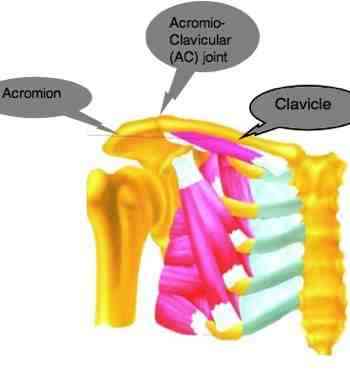
Here you can see the upper arm, or humerus, the clavicle and three parts of the shoulder blade, or scapula.
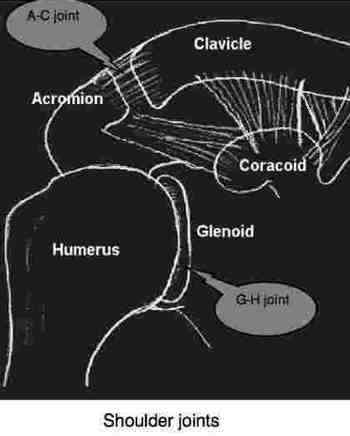
- The glenoid or socket where the humerus fits in.
- The coracoid for the attachment of ligaments, anchoring the clavicle, and certain muscles.
- The acromion attached to the clavicle.
When raising the arm above the head, the scapula rotates, the collar bone acting a strut, connecting the shoulder to the sternum,giving stability and support to the whole girdle.
A fall on the shoulder drives the acromion downwards whilst the collar bone is held up by strong neck muscles, the trapezius and the sternocleidomastoideus muscles, rupturing the AC joint capsule.
Likewise falls onto the outstretched hand can transmit enormous forces to the AC joint; either the ligaments anchoring the clavicle to the scapular may be torn, or a sprain, resulting in a partial or complete rupture.
The AC may rupture, or the clavicle itself may fracture. Usually these heal with immobilisation in a sling for six to eight weeks, with strapping of the shoulder, though occasionally surgical fixation may be required.
Many sportsmen have ruptured AC ligaments, allowing the clavicle to pop up. It looks serious, but most attest to the fact it gives little trouble after a few months.
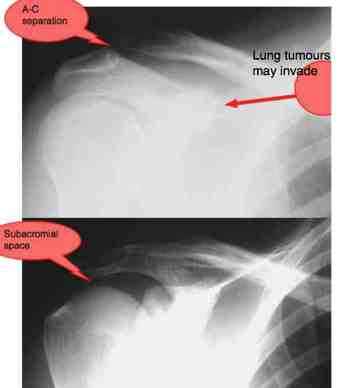
Notice the space between the ball of the humerus and the overhanging acromion. It's through this space that the tendon of the very important supraspinatus muscle passes.
Very occasionally tumours of the lung may invade the shoulder. Smoker? Expect trouble, because it's coming.
Subacromial bursa
Within the subacromial space lies a bursa, protecting the supraspinatus tendon from a friction rub against degenerative changes in the overlying AC joint. The bursa is richly endowed with nerve endings and mechanoreceptors from the C5/6 nerve roots; hence the strong association between neck and shoulder pain. Spurling's test is used to decide if it is a frankly pinched nerve or a shoulder condition.
Scientists have found that these neural structures have "high density elements" explaining why pain is often experienced at rest; hence the persistent complain that patients are woken at night by pain.
It remains a moot point whether the associated neck pain is a cause of the progressive shoulder pain, and degenerative changes with in the soft tissues, or is a "centralisation" of the shoulder injury. This is important clinically as researchers found that in the presence of centralisation, surgery facillitates the sensitisation, increasing the pain.
The is of importance for the chiropractor too; mobilising treatment that is too robust may also increase this central sensitisation. All in all, your chiropractor walks a tightrope; if the treatment is too mild, nothing is achieved. If overly robust, central sensitisation occurs. In my experience, patient feedback during the treatment helps to find the right balance.
It is the presence of associated neck pain that makes chiropractic effective in the treatment of these shoulder conditions.
Why does my shoulder hurt? This review of the neuroanatomical and biochemical basis of shoulder pain from an authoritative journal makes interesting reading.
Frozen Shoulder
Frozen shoulder is one of the most painful and debilitating conditions faced at the chiropractic coalface; it can last up to four years if not properly managed.
Chiropractors are trained to adjust and mobilise the AC joint, vital for the management of shoulder conditions such as Frozen Shoulder, when it feels as though the AC-joint has turned to concrete, causing severe arm pain.
Normally total external-internal rotation should approach 180 degrees; in the frozen shoulder is often less than 90 degrees.
Chiropractic help treatment of many other shoulder conditions, all of which may cause arm pain, such as Rotator Cuff syndrome are also dependent on correction of any AC-joint fixations.
Immobilisation Arthritis
The Acromioclavicular joint is the second most likely (after the thumb) structure to become arthritic. In part, because of so much use - every time you move your arm - and partly because of so many falls on the arm and shoulder.
The Acromioclavicular joint is the second most likely (after the thumb) structure to become arthritic. In part, because of so much use; every time you move your arm, but also because of so many falls on the limb.
New research is now proving that when a joint becomes fixated, fluids vital for the healthy nutrition of the joint cartilage are not adequately replenished. This leads to diminished oxygen and nutrients and a build up of noxious wastes; read here for more about the clinical significance of immobilisation arthritis and what you can do to prevent it.
Arm pain Quick Dash questionnaire
Arm pain is a daily complaint at the chiropractic clinic; just how bad is your pain?
DASH - Disability Arm Shoulder Hand
Many folk find it very difficult to assess just how bad their arm pain is. The Quick Dash score gives you a more objective measure of your pain. A score above 40 is considered quite serious.
From the medical literature
Legendary shoulder expert, Dr Neer, proposed that degeneration of the acromioclavicular joint may contribute to subacromial impingement and a number of other authors have supported this hypothesis. Arthritic spurs that protrude inferiorly from the undersurface of a degenerative acromioclavicular joint can contribute to irritation where the supraspinatus tendon passes beneath the AC.
In 1977, Kessel and Watson brought additional attention to the acromioclavicular joint as a cause of subacromial impingement. They found that patients who had so called painful arc syndrome could be divided into three categories.
Approximately two thirds of the ninety seven patients in the study had lesions of either the posterior or the anterior aspect of the rotator cuff. All of these patients had resolution of the symptoms after subacromial injection of a local anesthetic and a steroid or division of the coracoacromial ligament.
The remaining patients had pain in the superior aspect of the rotator cuff, which usually was associated with degeneration of the acromioclavicular joint. The authors found that excision of the distal one centimetre of the clavicle provided consistent relief of the discomfort.
Penny and Welsh subsequently found that osteoarthrosis of the acromioclavicular joint can lead to failure after the operative treatment of subacromial impingement. However, resection of the AC should not be performed routinely for all patients; rather, the joint should be operated on only if the patient has symptoms in the region of the joint and if osteophytes definitely contribute to pain when raising the arm. See the Journal of Bone and Joint Surgery, volume 1854, for more details.
Fish Soup
The ratio of dietary omega 6 to 3 fatty acids is vital in the fight against inflammation in the body. When it's high with too much ω6, or little ω3, the organs becomes angry, red and inflamed.
To raise your omega 3, try making a delicious, simple fish soup recipe regularly.
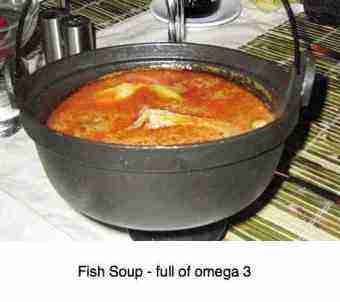
Search for more information about "anti-inflammatory omega 3" by typing this snippet into the Site Search function above.
Rotator cuff strengthening
Rotator cuff strengthening is just like any injury; rehab is vital if the injury is not to reoccur with a short period.
IMPORTANT CONSIDERATIONS
Every meal should include some raw food. Perhaps an apple for
breakfast, lettuce and peanut-butter sandwich for lunch,
and with dinner don't forget our simple
Olive Garden salad recipe.
When browsing these links use right click and "Open Link in New Tab", or you may get a bad gateway signal.
Did you find this page useful? Then perhaps forward it to a suffering friend. Better still, Tweet or Face Book it.
MONTHLY NEWSLETTER. Signed up yet? It is free.
BACK ISSUES
Chiropractic Help Backissues ... our monthly newsletter, click here for all the old issues.
- Issue #53: No short cuts to better health / Simple balance and quad strengthening exercises
- Issue #52: Needs an adjustment / Everything must change
- Issue #51: Elective surgery in the elderly / Cooling and reheating starches
- Issue #50: Make time for breakfast / Scrambled eggs and parsley
- Issue #49: Consulting a locum / Green salad /Eggs Florentine
- Issue #48: Hips and the sacroiliac joints/ Bacon and eggs
- Issue #47: Life without medication/ Eight coloured foods
- Issue #46: Lower backs and ankles/ kaempferol and cancer prevention
- Issue #45: Tingling, weakness and malaise/ vitamin B1
- Issue #44: Applying general chiropractic principles to the hand / Omega-3
- Issue #43: Art and science of chiropractic / Kale
- Issue #42: Tum sleeping / Flaxseed
- Issue #41: Adult potty training / Beetroot constipation
- Issue #40: Ominous lumbar signs / Too much medication?
- Issue #39: Swapping chiropractors / Butter is back
- Issue #38: Making a correct diagnosis / Make your own pesto in five minutes.
- Issue #37: Have your wisdom teeth out in the chair
- Issue #06: Safety on the Stairs / Ginger
- Issue #05: Safety in the home / Red foods
- Issue #04: Whiplash and the Joints of Luschka / Parsley
- Issue #03: How to stop falling / Danger of a low fat diet
- Issue #01: Tingling in the arms and hands / Apples
(PS. If you find them irrelevant to your needs or an exercise in tedium, one click will UNsubscribe you.)
