Tietze's Syndrome
Tietze's syndrome causes pain and tenderness over the breastbone and ribs.
Chest pain is a not uncommon complaint at the chiropractic coalface. In its severe form a swollen node appears at one of the sternal joints; either with a rib, or the collar bone.
This condition and costochondral syndrome were initially described as two separate diseases, but the sole difference is the amount of swelling of the cartilage.
Breastbone pain is commonly caused by this little understood, and generally poorly managed condition.
It also affects the joint between the collarbone and the sternum; the SC joint.
It was first named by a German physician early in the twentieth century.
It is now recognized that the presence or absence of swelling is only an indicator of the severity of the condition.
This is what one writer asks. Can you please advise me? I have had pain for nearly two years in the rib, sternum and breast region; sometimes it radiates to my mid back, right under the shoulder blade.
Also, I have had pain in my arm, with tingling in my fingers.
I cannot lie in certain ways; I definitely could not sleep on my front and I cannot twist without severe discomfort. I am unable lift things for any length of time.
It is seriously affecting my life; I am so down every day and I have three gorgeous girls who are not seeing the best of their mum and we are suffering.
This page was last updated by Dr Barrie Lewis on 17th January, 2019.
Swollen Sterno Clavicular (SC) joint
A swollen sterno clavicular (SC) joint is typical of Tietze's syndrome.
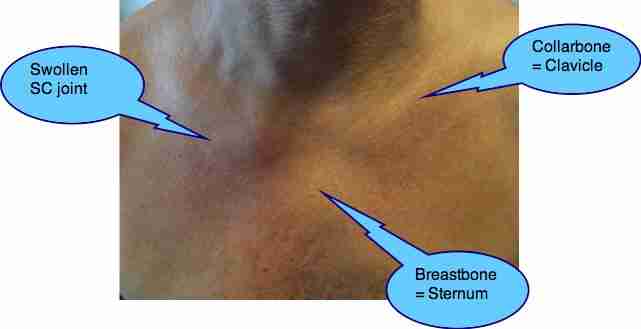
It's seriously affecting my life that I'm so down every day and I have 3 gorgeous girls who are not seeing the best of their mum and I am suffering.
I'm ok if I don't move but I can't go on every day like this, my daughters have health problems and severe skin conditions and I think years of doing their skin routine has over worked my muscles.
I've had scans and xrays, blood tests and nothing is showing up. I would just love a dianosis of something and a promise it will get better as I can't face life like this every day. Please can you help.
Any advice is welcome as I have the pain clinic at the hospital soon, and no one knows what to do with me. They are saying I'm a hypochondriac so I just shut up and persevere now.
- Chiropractic Conditions is a central page at our site. It provides you simply and easily with the sorts of diagnoses that the average DC would be treating.
- Healthy Living Tips is another vital page at Chiropractic Help. Sparkling wellbeing is not just about having your subluxations adjusted. This link gives you some insights into different foods you could and perhaps should be eating.
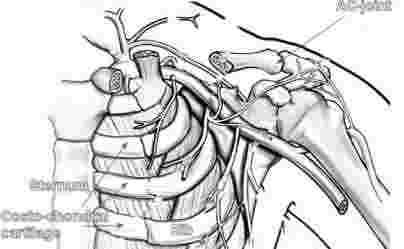
Tietze's syndrome
Tietze's syndrome is one cause of chest pain; costosternal ache may often be confused with a heart attack.
Chest pain is commonly caused by a sprain of the joint between the rib and the sternum or breastbone. It is usually associated with discomfort along the course of the rib, and in the midback, but this is not necessarily the case.
You can easily test for Tietzes syndrome yourself; press firmly on the breast bone, and then let your fingers slide right and left over the junction with the rib and between the ribs. It will be very tender over some of the joints if you have it, usually on one side only, more commonly the left, but it may be bilateral. It can also affect the breastbone collarbone joint, called the sterno clavicular articulation in anatomical terms.
You are almost certainly not having a heart attack, though this should always be considered. It's name is the costosternal syndrome, or Tietze's; in its mild form it really is quite common. Deep breathing may aggravate the pain, but does not usually, unless it is severe.
This is a common condition which responds well to the correct chiropractic treatment. I stress correct, as it took me over twenty years to work out how to treat this nasty painful condition, and, like me, your chiropractor might not know about it.
Whilst she he should be aware of it, it may be worth repeating, that a heavy adjustment in the middle of the back may well aggravate this problem. In fact it may cause it.
How do I know? Because I have provoked it myself. It's known as iatrogenic or doctor caused disease.
There's not a doctor alive who hasn't aggravated or caused some condition; I regret to say, including myself. That's why we call it a practice.
Because that's where we practise the art of doctoring all day long, and you dear patient are the guinea pig. There is, I regret to say, no other way.
Your medical doctor too, I'm afraid, may have no clue. How do I know this? Because I treat so many people with it, and non steroidal anti inflammatory drugs like brufin just don't work. Usually they have unsuccessfully done the medical rounds.
Perhaps I am making an ass of myself by making such an assertion. I would be pleased to hear from any of you reading this who have been cured of Tietzes syndrome by anti inflammatory medication, without having got an ulcer.
Bone scan
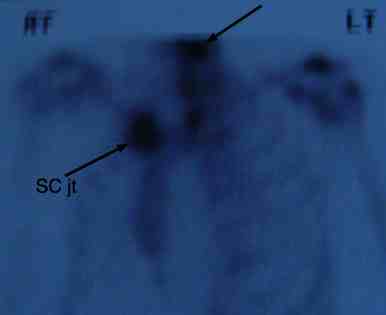
The increased uptake in the right sterno clavicular joint is immediately apparently. Of concern, also in the left shoulder and neck, however the radiologist assures me that those are the features of osteoarthritis.
Happily, within three weeks of chiropractic help the oedema and pain were gone. Worryingly, two weeks after discharge, she went to the gym, did weights and immediately developed acute radiating arm pain, but that's another story. The Tietzes syndrome is healed to all intents and purposes, and she is weighing prayerfully whether to go for neck surgery, or give chiropractic help a chance with the much more serious neck condition.
My worry; did my treatment of the Tietzes syndrome set off the severe neck and arm pain? She had had tingling in arm and hand for over two years, a failed carpal tunnel syndrome operation... She assures me not, as for two and a half weeks she had almost no pain in the neck, arm, shoulder or sterno-clavicular joint. Until she went to the gym and decided to become the next Miss World.
Honestly, I have my doubts. Chiropractic Iatrogenic Illness is a concern for every Chiropractor too. Doctor caused disease, the third most common disease on planet Earth.
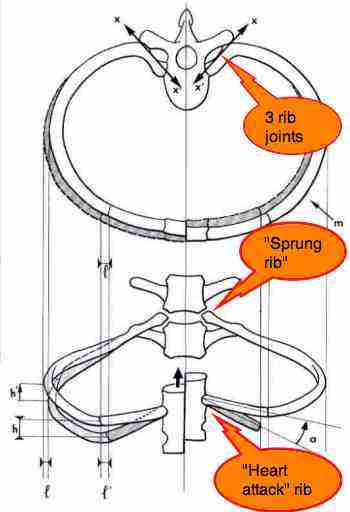
Chest pain
Chest pain at the costo sternal joint, which may be acute, where the ribs meet the breastbone is the most common presentation of Tietze's syndrome.
There is tenderness and may be some swelling of the cartilages adjacent to the sternum, which is commonly palpable on examination.
Although many times it can be extremely painful, to the point of being debilitating, Tietze's Syndrome is considered to be a benign condition that may, like many conditions, resolve in 6 to 8 weeks.
Tietzes syndrome pain is sometimes exacerbated by deep breathing, the pain radiating from the midback along the ribs to the sternum.
Costochondritis symptoms may be similar to and are often confused with the chest pain associated with a heart attack.
Sterno Clavicular syndrome of Tietze
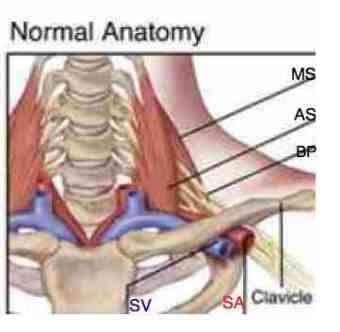
Secondly, Tietzes syndrome may affect the first rib and/or collarbone, causing pain in the
collarbone joints and, because the artery and nerves to the arm pass
between the collar bone and the first rib, it may cause pain in the neck
and tingling in arms and hands.
Because the diaphragm attaches to the lower six ribs, Tietzes syndrome is sometimes association with abdominal discomfort of one sort or another.

If you love to read, you will probably enjoy my first Chiropractic book of anecdotes, funny and healthful, Frog in my Throat
Says chiropractor Emma Maria Nygren:
"I am looking forward to your third book, Dr Preston. I really enjoyed reading Frog and Bats! They make you think, laugh and relax just like a good book should!"
For more information, click here, Frog in my Throat.
Google appears to frown on too many links, so phrases in bold, like that above, need to be put into the Site Search function in the navigation bar on your left if you want more information.
Costochondral joint
Costochondral joint pain is often a sign of Tietze's syndrome; it can also be caused by a heavy manipulation of the thoracic spine.
Tietze's syndrome is often caused by a physical strain or minor injury, such as repeated coughing from a chronic chest infection, vomiting or a blow to the chest. I recently had a case where a young man was violently turned over on a water-slide, falling heavily on his fist whilst it was tightly clenched against his chest.
"I read your article on sternum pain and Tietzes syndrome this afternoon and would like to submit a question to CHIROPRACTIC HELP questions . I saw a chiropractor over the summer in June of 2008. I had pain in my neck and mid back. He gave me numerous adjustments over the course of several weeks, some with heavy force.
After some of my appointments I noticed pain in my sternum, something I'd never felt before. He said it might just be muscle related. I stopped seeing him as I felt he was a lousy listener and kind of arrogant. It is now January and I still have the pain in my sternum. Should I see a chiropractor? And if so, what should I look for so as to avoid getting yet more pain?"
REFERRED PAIN
Many conditions of course can cause chest pain. Heart, lung, midback, stomach, pancreas, gall bladder and liver, and no doubt others... it's a definitely a team job, but once the others have been excluded, a Tietzes syndrome certainly responds to the correct Chiropractic care.
Rare conditions such as Mesothelioma, a nasty lung cancer usually caused by exposure to asbestos, and greatly aggravated by asbestos plus smoking, should also be kept in mind if there is weight loss, malaise...
Mesothelioma Prognosis - Information on mesothelioma and the treatment options available. PleuralMesothelioma.
Rib pain treatment
The usual chiropractic rib pain treatment must be modified in the management of Tietze's syndrome.
The treatment of Tietzes syndrome remains something of an enigma. It is does not respond well to NSAIDs, and ultrasound doesn't help either. Massage of the muscles between the ribs may help.
This author acknowledges that he was unable to treat this condition successfully for 25 years. After many years of struggling with the treatment of rib conditions, he worked out a cure that almost always works, how quickly depending how much actual swelling there is of the joints. The pain may not go away completely, particularly if you've had it for months.
Heavy posterior to anterior PA manipulation usually aggravates the condition.
My treatment?
- Alternating ice and heat (eg an ice cube in a hot shower)
- Gentle posterior to anterior chiropractic adjustments of the involved costo vertebral joints.
- Examining the costo sternal joint to determine the fixation with inhalation and exhalation.
- An adjustive technique which involves placing the doctor's hands along the rib, from the sternum to the spine, thrusting either cephalad or caudad depending on the fixation, counter to the breathing.
- An activator treatment may help.
- Soft tissue therapy of the muscles involved.
- As always, the pelvis and neck should be examined and if necessary treated.
Because of the proximity of the breast tissue in the female, the doctor
discreetly removes his grip on the rib during the inactive phase of breathing. Asking the female patient to place her hand over the breast, and pulling the tissue out of the way gives her a modicum of decorum.
I recommend that the anxious female patient should ask a
family member to attend the treatment; certainly for the first
consultation. Sexual advances chiropractor or medical doctor for that matter happens.
Usually there will be some improvement within a week or two, depending on how long the costosternal pain has been present. However it may take a month or more to resolve. Tietzes syndrome is definitely one of those conditions where patience may be needed. Like any chronic condition it may not resolve completely and require an occasional regular treatment from your chiropractor.
If your chiropractor has no clue, don't be irritable. I was such for 25 years. Suggest she he contact me.
Click on this link for more information.
Costosternal anatomy.
Tietze's syndrome casefile
Anecdotes from a casefile have no scientific clout but they often reveal gems of truth. Also Costochondral syndrome aka Tietzes syndrome is a condition I see almost daily at the Chiropractic Coalface. It can be mild, and it can be extremely disabling if allowed to become chronic. Tietzes syndrome casefile.
Pleural Mesothelioma
Most of us know that exposure to asbestos is extremely dangerous. Because this disease is really quite rare (less than 1% of lung cancers) it is usually diagnosed late and the prognosis is poor. Few doctors ever see this pleural mesothelioma in their practices.
Common symptoms are:
- Shortness of breath (due to fluid around the lungs)
- Chest pain (and hence on this page that concerns the chest)
- Chronic cough
- Weight loss
USEFUL LINKS
Have a question or story about Tietzes syndrome?
Something about breastbone pain to tell? Share it! If you suffer from indigestion and heartburn as well please tell us about that too.
What Other Visitors Have Said
Click below to see contributions from other visitors to this page...
Swollen sterno clavicular joint 
I have had a hard lump on my collar bone near my throat, swollen collar bones & sternum for the past 11 months. The lump near my throat & the sternum are …
Swollen around sc joint
I was on vacation with my family and know I was pulling luggage and carrying my heavy laptop bag which I always do for work. On the second day of vacation …
Tietzes syndrome costochondritis
Hi Doc, I am 52 yr old, healthy,active (live on a farm and ride and train horse) slightly overweight, married female who routinely sees my awesome Chiro, …
Problems regarding the chest and sternum
Home > Tietzes syndrome > Problems regarding the chest and sternum
I've had this bump on my chest for over a year. My rheumatologist …
Problems regarding Tietzes Syndrome Not rated yet
Home > Tietzes syndrome > Dr Barrie Lewis gives chiropractic advice about Tietzes syndrome
I am a 46 yr old female. For …
Dr Barrie Lewis answers questions regarding the chest and sternum Not rated yet
Home > Tietzes syndrome > Dr Barrie Lewis answers questions regarding the chest and sternum
About a year ago I sneezed …
Visitor submissions of Tietzes Syndrome cases Not rated yet
Home > Tietzes syndrome > Visitor submissions of Tietzes Syndrome cases
Hi I live in Johannesburg, South Africa. My 15 year …
Questions about tietzes syndrome answered by Dr Barrie Lewis Not rated yet
Home > Tietzes syndrome > Questions about tietzes syndrome answered by Dr Barrie Lewis
My symptoms started ten yrs ago …
Did you find this page useful? Then perhaps forward it to a suffering friend. Better still, Tweet or Face Book it.
MONTHLY NEWSLETTER. Signed up yet? It is free.
BACK ISSUES
Chiropractic Help Backissues ... our monthly newsletter, click here for all the old issues.
- Issue #53: No short cuts to better health / Simple balance and quad strengthening exercises
- Issue #52: Needs an adjustment / Everything must change
- Issue #51: Elective surgery in the elderly / Cooling and reheating starches
- Issue #50: Make time for breakfast / Scrambled eggs and parsley
- Issue #49: Consulting a locum / Green salad /Eggs Florentine
- Issue #48: Hips and the sacroiliac joints/ Bacon and eggs
- Issue #47: Life without medication/ Eight coloured foods
- Issue #46: Lower backs and ankles/ kaempferol and cancer prevention
- Issue #45: Tingling, weakness and malaise/ vitamin B1
- Issue #44: Applying general chiropractic principles to the hand / Omega-3
- Issue #43: Art and science of chiropractic / Kale
- Issue #42: Tum sleeping / Flaxseed
- Issue #41: Adult potty training / Beetroot constipation
- Issue #40: Ominous lumbar signs / Too much medication?
- Issue #39: Swapping chiropractors / Butter is back
- Issue #38: Making a correct diagnosis / Make your own pesto in five minutes.
- Issue #37: Have your wisdom teeth out in the chair
- Issue #06: Safety on the Stairs / Ginger
- Issue #05: Safety in the home / Red foods
- Issue #04: Whiplash and the Joints of Luschka / Parsley
- Issue #03: How to stop falling / Danger of a low fat diet
- Issue #01: Tingling in the arms and hands / Apples
(PS. If you find them irrelevant to your needs or an exercise in tedium, one click will UNsubscribe you.)
