- All You Need to Know
Neck Pain Anatomy

Chiropractic Help
Neck pain anatomy is for those who want to understand their cervical spine problems from a chiropractic help perspective.
This page will help you understand that fragile part of your body; it's no simple organ. Cervical spine conditions are so frequent because of the extreme complexity and sensitivity of the many structures.
This brief survey highlights its
exquisite construction, explaining why discomfort, often extreme, is so
common; usually just a chronic dull ache but sometimes very severe. A torticollis, caused by a facet joint lock hurts a lot.
Headache is a common symptom after injury to the upper cervical spine; it's an area that we excel in, but dangers lurk. Fools rush in where angels fear to tread.
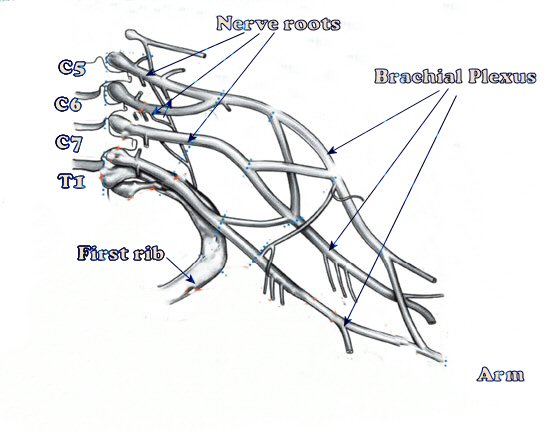
A complex variety of syndromes in the upper extremity occur after injury to the lower cervical spine, depending on which of the five nerve roots are affected.
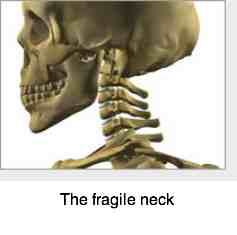
The heavy skull and brain are precariously balanced on seven highly complexly engineered and exquisitely made cervical bones or vertebrae, each a possible source of discomfort. That part of the spine starts below the cranium and ends just above the shoulder.
It normally has a lordotic curve; a backward C shape which, if altered by injury, almost always is associated with chronic neck pain. The cervical spine is much more mobile than both of the other spinal regions; think about all the directions and angles you can turn your head, normally without any discomfort.
Neck Pain Anatomy
The structure is tightly bound together by discs, ligaments and muscles, all potential sources of neck pain.
It's not so tight though that it cannot move. Thirty three joints make the cervical spine highly mobile, yet stable; each may be a source of the common painful neck.
Though the cervical spine is very flexible, it is also very much at risk from injury due to powerful, sudden movements, such as whiplash type accidents and falls.
This high risk of harm is due to the limited muscular support that exists in the neck, and because this part of the spine has to support the weight of the head.
This is a lot of weight for a small, thin set of bones and soft tissues to bear. Therefore, sudden, strong head movement can cause damage.
Horse riders and gymnasts, boxers and rugby players almost always have injuries in this region causing a painful neck.
Through the neck travel the most exquisitely sensitive pain structures in the human frame; the spinal cord and nerves emerging to supply various parts of the body, particularly the arms and scalp.
They are very prone to injury by stretching, as in whiplash, by pinching by facet joints, uncovertebral joints, disc joints and other conditions such as tumours and aneurisms.
The BONES, known as vertebrae
Two vertebrae in the cervical spine, the atlas and the axis, differ in their neck pain anatomy from the other vertebrae because they are designed specifically for rotation. These two vertebrae are what allow your neck to rotate in so many directions, including looking to the side. Because of their proximity to the brainstem and the spinal cord, any injury, fracture, displacement, or fixation (jamming) has the potential to cause severe neck pain, headache and a host of neurological conditions. Car accidents, falls, blows to the head commonly injure this part of the spine. The Hangman’s knot is specifically designed to fracture the axis, and rupture the spinal cord. Hence the so-called ‘Hangman’s fracture’, found in serious accidents.
The atlas is the first cervical vertebra -- the bone that sits between the skull and the rest of spine. The atlas does not have a vertebral body, being made up of a complex ring. The atlas sits on top of the second cervical vertebra -- the axis. The axis has a bony knob called the odontoid process, also known as the the dens that sticks up through the hole in the atlas. It is this special arrangement that allows the head to rotate so far from side to side. Special ligaments between these two vertebrae allow a great deal of rotation to occur between the two bones.
Atlanto Axial Joint
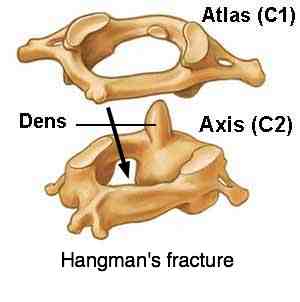
Seven delicate and highly complexly engineered vertebrae make up the bony structure of the neck pain anatomy, cushioned by the "inter-vertebral disc".
The black arrow shows where the so-called "hangman's fracture" occurs - through the pedicle on both sides. This is also caused by the head hitting the dashboard in a head on collision. One more reason to use a safety belt. Research shows that in most suidicidal hangings there isn't sufficient drop to fracture the pedicles, and the victim dies a horrible prolonged death by asphyxiation.
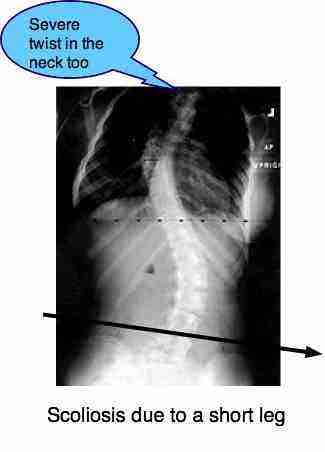
Notice in this X-ray below how a short leg, giving a tilted pelvis and a scoliosis, goes all the way up into the neck. New research suggests that a heel lift to correct a leg length inequality may also help neck pain.
Joints in the neck.
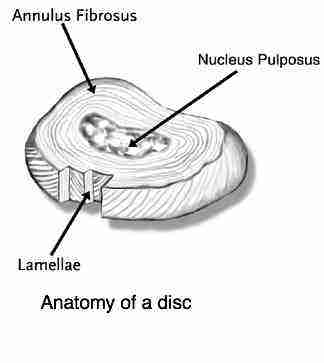
There are 33 tiny joints between the bones of the neck and between the neck and the skull. The bones are separated by discs, made up of concentric circles of fibrous material with a bubble of gel in the centre, acting as shock absorbers for the all bouncing, jogging, jumping movements of the neck.
There are several different types of joints in neck pain anatomy. Disc joints, facet joints, unco vertebral joints, and some other highly specialised joints in the upper neck, but they all have one thing in common: important nerves, the most sensitive tissue in the body, travel close by.
Any injury, swelling, strain and sprain has the immediate potential to affect the nerves traveling to the neck, shoulder, arm, head and the whole body, causing pain, headache, tingling and dysfunction of the organs they supply.
- Skull-neck joint: ATLANTO OCCIPITAL JOINT ... (C0-C1)
- Atlanto axial joint anatomy (C1-C2)
- Lower Cervical facet anatomy (C3-C7)
TMJ ANATOMY
What's more, the sensory nucleus of the nerve to the jaw joint is located in the upper neck. Thus jaw and neck pain are often intimately related, and to be jointly and separately addressed in teh management of facial, neck, and jaw joint pain. TMJ ANATOMY ...
Why do we hiccup ? Hiccuping is a reflex contraction of the Diaphragm muscle, causing a sudden intake of breath that snaps the epiglottis closed. A hic. Irritation of the Phrenic nerve roots (C3-C4-C5), the nerve itself or one of the tissues supplied by the Phrenic nerve are the usual causes. Read more …WHY DO WE HICCUP ?
Nerves and Discs
- Upper Limb Tension Test ... for a pinched nerve in the neck.
The so-called brachial plexus is a large group of nerves that emerge from tiny foramena in the neck. They travel to and from the arms, as explained in neck pain anatomy, where they initiate muscle action (eg picking up a sandwich) and sense changes at the skin. Cold, hot, touch, vibration etc. They also tell the brain where the hand is in space for example, without your eyes having to look.
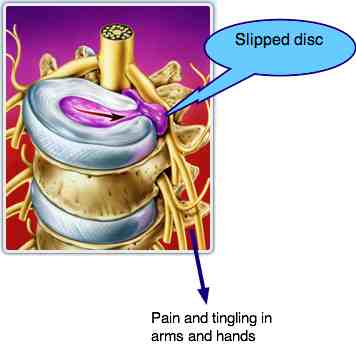
Tingling in arms and hands
Between each pair of spinal bones is a large disc. It consists
of two parts, an outer washer made of very tough fibres and an inner
bubble of gel which is like a large shock absorber. whilst reading about
neck pain anatomy I feel sure you have heard of the so-called
slipped disk
in which the gel has bulged out through the surrounding washer. it may cause for example very specific pain, numbness and tingling in fingers one and two ...
Frank pinching of these nerves may cause severe pain and disability in the arm, but even irritation of the nerve roots will cause shoulder pain, and make one prone to other conditions in the lower arm:
Ligaments
The cervical spine is stabilised in the upright position by many very strong ligaments, that stretch from bone to another maintaining the correct posture and giving stability. Some are tiny, for example those holding the ring of the atlas in position, whilst others are very large, thick and long. They are a very important part of neck pain anatomy.
Neck pain can originate in the muscles of the neck. The head and cervical spine are able to move because of muscles that control and initiate the movements. Looking up at the ceiling, checking under your bed for your shoes, and looking for traffic as you cross the street; all these movements are controlled by the soft tissues.
There are also stabilising muscles whose primary function to maintain the neck in the upright position.
Muscles were designed to move.
Even maintaining a healthy muscle in the same position for a long period of time, as in sitting in front of a computer, driving a car, or lying on the stomach all night with the head turned will cause fatigue and neck pain.
There are many large and tiny muscles in the neck, each a source of neck pain anatomy.
I found a page that will give you a simple test that you can do find out how strong your neck muscles are, and some really quite profound neck exercises: JULLS TEST ...
Manipulation of the neck has recently received strong condemnation from Chiropratic's critics as being highly dangerous and can cause a stroke. While this is acknowledged, it is so rare that it can largely be ignored (approximately equivalent to being struck by lightning on the golf course).
What our critics conveniently ignore is just how much more dangerous anti inflammatory drugs and analgesics are. All forms of treatment of any and every condition have potential dangers it should be candidly admitted, and in this regard chiropractic is no different.
I hope NECK PAIN ANATOMY has given you some idea of the complexity of your neck.
We haven't forgotten you, Maureen. One of those very special people. She was one of the 14,000 Americans who die every year from a bleeding ulcer, directly caused by anti inflammatory drugs. That's medicine's own research figure.
WHIPLASH CHIROPRACTIC
Any very sudden, traumatic jolt to the head and neck has the potential to injury all of these structures. That could be when the body suddenly stops, but your head keeps going (as when a car hits a tree), or when something smashes into your head.
This week it was young woman whose head was very forcibly struck by a water ski, last week a child kicked on the head and neck by a horse, every week car accidents, old and new. Falls from a horse, sport, bicycles... all need to be carefully managed, otherwise Immobilisation Arthritis and irritation of nerves almost invariably occurs.
- IMMOBILISATION ARTHRITIS ...
- WHIPLASH CHIROPRACTIC ...
DANGERS OF ANTI INFLAMMATORIES
Go to Kidney.org and see what drugs can do to your organs: http://www.kidney.org/atoz/atozItem.cfm?id=145
Tip: Especially don't take medication before your consultation with your chiropractor. Deaden the pain and you may confuse him/her. It's far more difficult to diagnose and assess the problem of the drugged patient.
An apparently insoluble neck problem?
Posturite
It's not often that I rave about a commercially available product. However there is no doubt whatsoever that She-who-must-be-obeyed needs less than half the amount of chiropractic help since I bought her a Posturite, quite expensive, worth every cent.

Notice too the small 3 watt LED lamp. We are rapidly changing over to LEDs. Requiring extremely little energy, a fifteen year warranty on the globes, they will quite soon be the only globes available.
Chiropractic Help
I alluded above that there are dangers associated with manipulation of the cervical spine. It's true, but the chances of serious adverse effects are very slim; very. About one chiropractor in twenty will once in his lifetime stroke a patient; statistically that considered very safe. Far safer than taking aspirin every day, for example.
Manipulation, like most other orthopaedic procedures, in an art as well as science; chiropractors start learning how to be highly specific and how to use the very least force to achieve their purpose from the very beginning of their training. It's not something you learn at a few weekend courses.
Medical physical therapists have been banned from frank manipulation of the cervical spine after several serious adverse effects in a short term. In short, it's a complex procedure, done expertly by highly skilled doctors after a long training.
IMPORTANT CONSIDERATIONS @ Neck Pain Anatomy
- Proven arthritis protection: INTERESTING FACTS ABOUT STRAWBERRIES ...
- Dangers of Anticholinergic side effects ....
- From NECK PAIN ANATOMY to CHIROPRACTIC NECK PAIN TREATMENT
- Go from NECK-PAIN to CHIROPRACTIC HELP home page …
Did you find this page useful? Then perhaps forward it to a suffering friend. Better still, Tweet or Face Book it.
MONTHLY NEWSLETTER. Signed up yet? It is free.
BACK ISSUES
Chiropractic Help Backissues ... our monthly newsletter, click here for all the old issues.
- Issue #53: No short cuts to better health / Simple balance and quad strengthening exercises
- Issue #52: Needs an adjustment / Everything must change
- Issue #51: Elective surgery in the elderly / Cooling and reheating starches
- Issue #50: Make time for breakfast / Scrambled eggs and parsley
- Issue #49: Consulting a locum / Green salad /Eggs Florentine
- Issue #48: Hips and the sacroiliac joints/ Bacon and eggs
- Issue #47: Life without medication/ Eight coloured foods
- Issue #46: Lower backs and ankles/ kaempferol and cancer prevention
- Issue #45: Tingling, weakness and malaise/ vitamin B1
- Issue #44: Applying general chiropractic principles to the hand / Omega-3
- Issue #43: Art and science of chiropractic / Kale
- Issue #42: Tum sleeping / Flaxseed
- Issue #41: Adult potty training / Beetroot constipation
- Issue #40: Ominous lumbar signs / Too much medication?
- Issue #39: Swapping chiropractors / Butter is back
- Issue #38: Making a correct diagnosis / Make your own pesto in five minutes.
- Issue #37: Have your wisdom teeth out in the chair
- Issue #06: Safety on the Stairs / Ginger
- Issue #05: Safety in the home / Red foods
- Issue #04: Whiplash and the Joints of Luschka / Parsley
- Issue #03: How to stop falling / Danger of a low fat diet
- Issue #01: Tingling in the arms and hands / Apples
(PS. If you find them irrelevant to your needs or an exercise in tedium, one click will UNsubscribe you.)
