Short anecdote
More stories from the Chiropractic Coalface
Short anecdote is as common as they it's scientifically inadmissable yet, behind the stories often lie little gems of truth. For the record though, always do your homework before giving any any of these case histories significant weight in making important decisions. They are NOT the same as gospel truth.
Nor are they scientifically validated.
Update: This page is now full so, when you've read all of these, new anecdotes can be found at
- Another ANECDOTE OF THE JAR ...Chiropractic excels in the management of tennis elbow, vertigo ...
- CHIROPRACTIC COALFACE anecdotes ...
- CHIROPRACTIC COALFACE 2 - what makes a good doctor?
- Short anecdote: Uncomplicated low back pain
Even chiropractors injure their spines! Two weeks ago I lifted a heavy beehive, and had moderate lower back pain. Bending was mildly painful but the Slump Test for Sciatica was negative.
- How to start beekeeping ...
In order to reduce the number of links on a page, we have left some in bold; to find them please copy and paste into the site search function in the navigation bar on your left; for example how to start beekeeping above, many more below.
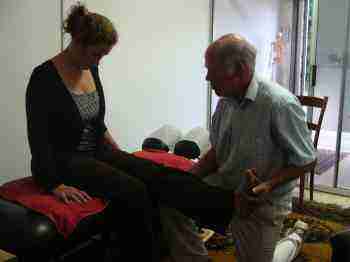
Then I attended a three-day chiropractic congress. The low back pain increased, but was still not unreasonable. No leg pain.
Then she-who-must-be-obeyed ask me to lift some sweet pototoes. A sharp stab in the back and the rest of the day I was in severe pain. A very painful night's sleep ensued, and Slump Test was positive in the left leg, but without leg pain ...
After three Chiropractic adjustments, resolute exercises, staying away from Whats potting in the Garden and beekeeping equipment ... and
I'm a new man. Still, I too will have to be careful for a few weeks.
The key was two lumbar rolls, first on L3 on the left, the side of pain,
and then laying on my left side, L5. Both "released" with audible
clicks and within a few hours the pain relieved. Today, the fifth day I
can work and bend normally.
None of us find it easy to
slow down, and sometimes stop after a back injury. Me too.
- Planting sweet potatoes ...
Update: Even chiropractors have to swallow some of their own medicine. Every day I'm warning patients that 50 percent less pain is the dangerous time... the pain goes away faster than it heals.
I mowed the grass, and paid the price. All the bending and twisting, and wheelbarrowing the grasscuttings for my next making a compost pile ... and I had quite a bad setback. Now, discplining myself doesn't come easy, but after three more chiropractic adjustments it's finally improving again.
The moral of the story: never forget that 5% of acute lower back pain attacks end up under the knife. And that applies to chiropractors too!
- Short anecdote: Severe headaches
This week a 42-year old woman taking 40 pills per week, and has been for years, for severe headaches above the right eye, side of her head, right upper neck.
The headaches started when she was 11 years old, after a fall from parallel bars. They became much worse at 26 when she had her wisdom teeth removed under anaesthetic. Also, a car accident from the side...
On examination, both jaws joints clicked
mercilessly on opening. The external pterygoid muscles was exquisitely
tender. Her neck was not particularly painful but severe fixations were
found at C5 and C0. There was 90% numbness in the course of the
ophthalmic branch of the trigeminal nerve, the nerve that supplies the
jaw joint.
X-rays of her neck show a cervical kyphosis, a
complete reversal of the normal curve in the neck, and marked rotatory
subuxation of all cervical vertebrae, associated with a mild scoliosis.
Can Chiropractic help her? I think so, a conservative think so, as she also gets headaches from nuts, Brie cheese and prementral. Severe headaches are complex and may have varied aetiology.
Certainly, dual antiinflammatory drugs will severely shorten her life expectancy.
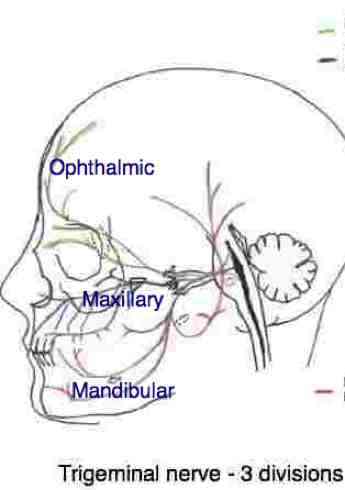
The ophthalmic branch of the Trigeminal nerve supplies the area above the eye. Irritated, the Trigeminal nerve causes severe migraine headache, facial pain and sometimes a particularly nasty condition called Trigeminal Neuralgia.
Lower back and leg pain
Lower back and leg pain is the common complaint at the chiropractic clinic.
I place today three patients in juxtaposition.
Patient 1: Young woman Mrs T, 25-year old woman consulted me six months ago with fairly acute lower back pain. She came twice and, when she had 50 percent less pain, cancelled her next appointment. She was too busy...
Patient 2: Middle aged man Mr P has had lower back pain episodes regularly for the last few years, but the latest was very severe. He had acute disc herniation written all over him, I didn't even need to examine him to make the diagnosis. He came today for his seventh consultation, and only prolonged sitting remains painful.
Patient 3: Young man Mr M has the trophy for the worst lower back condition that I've treated in a year. He has a prolapsed disc with a foot drop. A surgical emergency in the eyes of many. Today he came for his tenth treatment. He says the pain is 80% less, he can now raise his heel off the ground. The test of Lasegue is still strongly positive however, the crossed sign confirming a Postero medial Disk herniation a condition that frequently ends up under the knife. I'm not going to win with Mrs T. When she's desperate, she comes for one or two treatments, then cancels. It's not going well...
Mr P is doing fantastically well. I've convinced to accept that it will take 6 weeks to heal, and wait before going crazy.
Mr M remains a challenge. He's happy, and compared to a month ago
he's a different man. But that Lasegue is still very positive. It's very
encouraging he can now raise his heel off the ground.
The long and short of it: listen to your chiro, do what s/he
tells you to do, even if it's very disconcerting. The alternative is too
ghastly to contemplate!
- SHORT ANECDOTE : Two diseases
One of the more sobering reminders to any clinician is the old saying: "Remember the patient can have more than one disease." Or more than one process, interacting with another. Miss J, a 28-year old woman consulted me for the first time two weeks ago with acute right neck pain. Right rotation and looking up (extension) were very painful. She also had a ten year history of very disabling right shoulder pain. On examination, there was clearly a lower cervical / first rib fixation. What I missed was, this was the cause of her chroinic shoulder pain, and not the cause of her current acute neck pain. Adjustment of the first rib increased the stiffness and neck pain. Re-evaluation, revealed a C2 subluxation, the cause of her current acute condition. Standard chiropractic adjustments brought immediate relief, before she left the clinic in fact, she declared that it was 80% better. A cervical facet syndrome. Now the challenge of fixing the chronic Right shoulder pain, the source of which lies in the inter scalene triangle ...
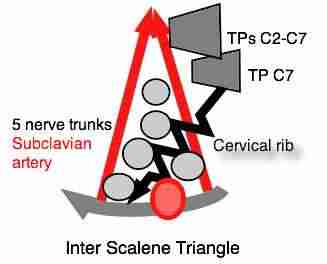
Update: Her acute neck pain is over, but that shoulder is going to be a bear. Ten years of pain. Still, rotator cuff syndromes are one of my favourite conditions.
- Short anecdote ANKYLOSING SPONDYLITIS
Surely one of the most fearful of diagnoses, ranking alongside conditions like MS, bamboo spine as it is called turns the spine and especially the sacroiliac joint to concrete.
The diagnosis is usually made on the basis of a blood test: the HLA B27 antigen. However, research reveals that the test has a significant number of false positives. People who carry the gene but have absolutely no symptoms or signs of AS.
Mr T, a 43 year old man, has been told that he has been has AS and has been on very powerful medication for five years. These drugs have had a very toxic effect on his liver, to the extent that his job is on the line... he works in a high risk domain.
Yet interestingly, ranges of motion of all his joints is quite full and free (though some are painful at the end of range of motion). He has symptoms and signs of conditions that I treat on a daily basis - I'm of the opinion that he has absolutely no trace of AS.
We'll see how he gets on with chiropractic help treatment for his midback, neck and ankle pain.
- SHORT ANECDOTE : FALL OFF HIS MOUNTAIN BIKE
Mr D, aged 73 is very fit for his age. He played golf twice a week, and went cycling in the forests three days a week. Until he fell from his bicycle, five months before the first consultation. Within a few days he started getting low back pain; three months later it started in the right buttock, and his leg started collapsing when he walked. The pain woke him sometimes at night, and walking became very painful.
On examination, none of the orthopaedic or neurological tests,
surprisingly were positive. He could bend, twist, raise his legs, stand
on his toes and squat without pain or weakness.
The only two significant findings were marked fixations in the
right sacroiliac joint and the right L5 facet joint. He came today for
his sixth consultation. The pain is 90% better, he can walk and play
golf again and is a very happy man. He is doing his lower back exercises
faithfully.
LOWER BACK EXERCISES ...
- SHORT ANECDOTE: CHILD CAN'T WALK
One of the joys of the Chiropractic Coalface is the huge variety of conditions that challenge one. M is 18 months old and won't /can't walk. In fact he can't stand for more than a few seconds, and then he sinks back onto his haunches. Otherwise, he is a normal child in every respect. Speech is beginning, he is bright and responsive, there's no history of infantile colic, no injuries, he just won't stand or walk.
First thought of course was the hips, but all the hip tests, looking for hip dysplasia were normal, as were the X-rays of the pelvis. There were no fixations in the pelvis, and the lower limbs and feet were quite normal. Could chiropractic help him? I wasn't sure, but what was clear was two fixations, one at L5, and the other at C6. Could that stop him walking?
At the second consult, M was standing as I entered the treatment room. And stayed standing, holding onto his mother. She led him across the floor, holding onto his hands, something he couldn't do before. We watch with interest... perhaps he'll walk this week or next.
At the third? M is walking! You could have blown me away, and we're expecting a heap of referrals from M's parents.
Remember this is an anecdote. It has no scientific basis. The problem is to find 100 eighteen-month old children without obvious pathology who can't walk. Well, his mother is convinced. Me too! You?
- SHORT ANECDOTE : ANKLE FRACTURE
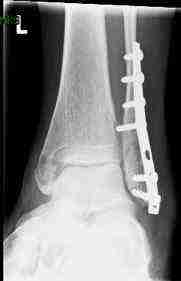
Two ladies: (1)Sometimes we chiropractors are very dumb! I've treated Mrs P for three years for chronic neck and back pain. She's a teacher and that puts a lot of stress on the neck. She's very happy, and comes for a consult once every six weeks. Three weeks ago on one of her regular consults I asked her if she had any other complaints. Her ankle, so sore! Her doctor told her it was arthritis and there was nothing to do. Indeed quite severe arthritis, an old fracture. Nothing to be done? This morning after only three treatments she says she can walk better than she has for over year. Just a straightforward subtalus fixation. Now the alphabet exercises. (2)Mrs T is much younger. She fell from her bike and fractured both malleoli in the ankle. The bones healed nicely, but she still couldn't walk. She came in "voet-voor-voet". After three weeks she can walk normally. It still swells alarmingly in the evening. Foot and ankle problems? Told your chiropractor? Has the dumb man asked?! ANKLE FRACTURE ...
Short anecdote
Short anecdote tries to give some insights to the extent of a chiropractor's practice regimen.
SHORT ANECDOTE: LEG LENGTH INEQUALITY
Mr P, a gentle Dutch giant of well over 2 metres, blonde and very handsome, has had severe repetitive episodes of low back pain, and nasty headaches for over twenty years. I confess to being slow when he came in for his first few treatments.
He stood in an antalgic posture to the right, (the Pisa sign), and because he responded so well and quickly, I neglected to consider a short leg. He responded well, did the exercises faithfully, but... within a month or two, he was antalgic again.
Eventually the penny dropped. Could he have a short leg? Magic. From the day he started wearing a 5mm lift in his right shoe, Mr P has been a different man. It's now over a year since he has been wearing the lift, and not once gone into an antalgia. Also it's helped his headaches. The problem of 20 years solved.
At Christmas: he's Santa, for children with no family. Tis more blessed to give than receive, one of those delightful people. Leg Length Inequality ... has your chiropractor considered a short leg?
SHORT ANECDOTE : SCHEUERMANN'S DISEASE
Mr S, 34 year old man consulted me nine months ago with a twenty year history of mid thoracic pain. On examination it was immediately clear that the likelihood of Scheurermanns disease was reasonably high. X-rays confirmed it.
I never realised until today that he is a concert soloist. He shared how much better he can now sing after the treatment on his back. I'll never cure him: he comes once a month. Once or twice he was quite sore for a day or three, as they say in Holland.
Scheurermanns is a condition that doesn't take kindly to brute force and ignorance treatment. But to achieve anything a certain amount of forceful manipulation is necessary. A fine line, between the devil and the deep blue sea! What is Scheuermann's disease?
It all starts with the teenager with poor posture and an aching back.
SHORT ANECDOTE: LEG PAIN
Health continues to astonish and surprise one at the Chiropractic Coalface. And challenge, and give you grey hairs... Mr P, a 46 year old man was referred two weeks ago by his company doctor. Frankly, I was surprised. Mr P had just a little back pain, severe pain in the front of his left leg, pain in the lower abdoman, pain in the testicle, and pain urinating... a chiropractic case?
It started four weeks previously and by the time he got to me the pain in the penis and testicle and abdomen had ceased... but still I was (and am) worried. This wasn't routine.
Two years ago he had a serious slipped disc radiating down the back of the other leg, and so both he and his doctor presumed it was another case of a pinched nerve. It remains a bit of a mysterious case as he does have signs of a high lumbar back injury, a pinched Femoral nerve in the groin with a strong Femoral stretch test.
I gave him ten days, after which if there was no significant improvement, an opinion from his own medical doctor. I immediately sent a letter to his personal GP outlining my misgivings. It's now two weeks. Mr P reports that the pain in the front of his leg is 60% better, he has no pain in the testicle of penis and whist there has been a slight increase in his back pain, he can walk and sit again, and is feeling much better.
Obviously we continue to monitor carefully... the company doctor yesterday was more than pleased.
Thoracic outlet syndrome
Thoracic outlet syndrome is often the underlying cause of many shoulder and arm syndromes.
Mrs B has been coming to our clinic every six weeks for a
number of years - for a variety of conditions. Two months ago, because
it's been going so well, we decided to see if we could stretch her
maintenance treatment to eight weeks.
No! After six weeks she started getting horrible tingling in both arms. It woke her at night. A test called Adsons indicated that both the artery and the group of nerves to the arm were being irritated by the first rib. Both sides which is unusual. Happily she reported today, four days after the treatment, that the tingling has all but stopped. So we're sticking with six weeks for her maintenance care. The ribs are free. What is unusual with her neck, is that we get no 'releases' but she still gets better.
- SHORT ANECDOTE : INFANTILE COLIC
There are few things more distressing than a screaming baby. The Rule of Three, do you know it. Baby Reuben fulfilled the requirements in full! And his first-time mother was convinced she was inept and stupid. Not so. Reuben had a nasty subluxation in his lower neck - every time she dressed or undressed him, he would shriek for an hour. Mostly huilbabys, as we call them in Holland, respond very quickly to Colic Chiropractic. Not always, but usually. After only two treatments he was 80% better.After the third we made his next appointment after two months. His mother brought him in today for only his fourth consultation, Prima! It's not always that miraculous, but the happy chappy is taking off. His next consultation: four months. Then we'll probably discharge him. If he has fallen from a Dutch staircase! COLIC CHIROPRACTIC ...
- No Question...just compliments!
Wow, I'm really enjoying your website. I just discovered it today because my orthopedic surgeon suggested I read up on FAIS. Who knew? Lol, I can't believe after so many years of discomfort and complaining to dr's and even chiropractors in the States, no one even thought of FAIS. I'm a twin and it seems probably that "my" FAIS is from 56yrs ago, my twin on my left side, both of us breech, me w/torticolis etc... Even though I was very athletic/active I never knew why/what was bothering me. I live in Israel now and my amazingly wonderful orthopod suggested FAIS and that I look it up online. That's how I came across your site and I just love it. Now..I just need to sit long enough to read everything. I will get to everything. Thank you so much for providing great information and with a great sense of humor. Love it!!!! Again thanks!!!
FEMORO ACETABULAR IMPINGEMENT SYNDROME CASE FILE ..
- SHORT ANECDOTE : ANKLE JOINT PAIN
My mother was a Chiropractor. Sadly cigarettes cut her life
short by the standard ten years. But, despite a serious weakness that
cut her life short, she was a wonderful chiropractor. One of her
favourite sayings was: Miracles we do at once; the impossible takes a little longer...
M. has walked on the toes of her right foot since a fall down the stairs
when she was 25. That was 11 years ago. After only one Chiropractic
treatment of her ankle joint pain she could with her heel on the ground
...
ANKLE JOINT PAIN ...
- SHORT ANECDOTE : MULTIPLE SCLEROSIS
I met a lady in a shop today. We both eyed each other, eventually she asked: "Do we know each other?" I was about to ask, I said, I'm a chiropractor... Ah, she said, I'm ... immediately I remembered, how could I forget. She consulted me 28 years ago with tingling in her arm. I was uncertain of the diagnosis and asked for a second opinion from a neurologist. Bad news: MS.
I convinced her to come for treatment for a few months, as there
is no known cure for MS, which she did. We eventually lost contact.
Now 28 years later, she is hale and hearty. What cured her? Who
knows? Chiropractic? Diet? I also convinced her to avoid all
hydrogenated foods, and to eat plenty of olive oil and avocado, and
fatty fish. The healthy MUFAs and Omega-3 oils. We should all be eating them daily.
MS is a demyelinating disease of the nerves. Nerves are coated with a fatty sheath, without which they cannot conduct. MS is an autoimmune disease that attacks that fatty myelin sheath. There is no known cure.
- SHORT ANECDOTE : Infantile Colic
There are few things a Chiropractor likes to treat more than Infantile Colic, but I had to wonder if it would be different with Baby M. Poor mite, she had a traumatic start to life: Her father, aged 37, had a heart attack and died when she was three months old. By that I mean really "minus 6 months old". Yes, when does a baby's life start? When she's born? Or when she's conceived? In any event, Baby M's mother was three months pregnant when her husband suddenly had what we in the Netherlands call a hartstilstand. Simply put, his heart stopped. The average smoker loses ten years of his or her life. Baby M's father lost rather more ...
The first month of Baby M's "post-birth" life was relatively normal. Family and friends stepped into the breach, grandparents were absolute saints, only she didn't have a father to cuddle her. And then she started to cry. And cry, and cry. Baby M was the Rule of Three was strongly positive. Baby M is a "huilbaby". She has infantile colic. COLIC CHIROPRACTIC ...
In particular, sitting in a Maxi-cosi (a car seat) made her absolutely miserable. She screamed.
On examining Baby M it was immediately obvious that if I touched her neck she immediately was a very unhappy little lady. The sixth vertebra in the neck was severely fixated. Stress in utero? The long journey through the birth canal? A bump, droppped as a baby ... who knows? Baby M came today for only her third consultation. She sat the whole journey (half an hour) in the maxi-cosi without a murmur, and wakes only once during the night for her feed. Miracles we do at once ...
Another short anecdote
Severe chronic low back pain
Mrs M, a 59 year old woman has had severe low back since a slipped disc when she was 24 years old. The pain has never left, but 3 years ago, for the umpteenth time it became really severe, radiating down her left leg. During her only pregnancy, her back gave her absolute hell, and she vowed to have no more children. She was told so many times that she has lost count that there was nothing to be done, and she had to just live with her condition. "You have arthritis, accept it, and learn to live with it."
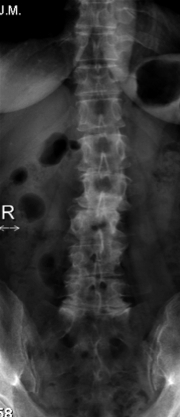
Here are her X-rays: Notice the general loss of disc space, but severe reactive degenerative changes at L2-L3. Fortunately, I started treating her BEFORE seeing her X-rays. They could have misled me, because all her symptoms were coming from the L5-S1 joint, just above the sacrum, and in her sacro-iliac joint, and not at L2-L3.
Short anecdote gives you true case histories from the chiropractic clinic.
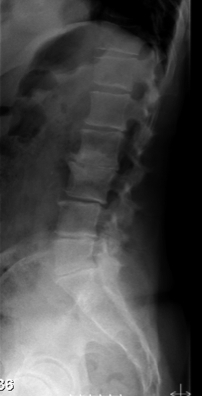
Notice the mild scoliosis, curvature, and severe sideways slip of L2.
I have to pinch myself. She is a very beautiful woman, despite her 59 years with a huge head of curls, and a wonderful sense of dress. SHE HAS ALMOST NO PAIN, she declared on Friday. Quite marked stiffness, but NO PAIN.
Can the improvement be sustained? She is very faithful about the rehab exercises I have given her. I too watch with bated breath. It's almost too good to be true.
SHORT ANECDOTE : The Nightingale
Mrs S, a forty-two year old professional singer consulted me six weeks ago with neck pain of some four months duration. She had a 'minor' car accident last year that left with a bit of stiffness and some pain in the neck for a few weeks but it soon passed over. Then early in the new year the pain returned with a vengeance, also causing headaches. Worst of all, she was having increasingly difficulty with her singing. Control was difficult and shouldn't reach her top notes.
Theoretically that shouldn't happen, as the vocal cords are supplied by a cranial nerve, and has little to do with the neck. But breathing is controled by the diaphragm and that is supplied by the lower neck nerves, most frequently affected in a whiplash.
We are now in the rehab part of the treatment, the pain is nearly gone, and excitedly she told me yesterday that in a concert last weekend she again managed to reach E flat, no mean task I'm told. Neck pain ...
SHORT ANECDOTE : Slipped disc without back pain
In the final, and most serious stage, of a slipped disc the bubble of gel from the disc escapes beyond the confines of disc. Clinically the patient has repeated episodes of back pain and leg pain and then, whoops, severe pain in the lower leg AND NO, or minimal, BACK PAIN.
In our short anecdote for this week Mr S consulted me for the first time five weeks ago with the above history. To make matters far worse, he could not lift his heel off the ground. This is a situation that even 5 years ago I would not have tackled. It is probably one of the most serious conditions faced by the chiropractor. Straight to the surgeon.
Happily he reported yesterday that he is more than 50% beter, and I could raise his leg without pain for the first time. The MRI shows a large medial herniation of the disc.
In my experience with a sciatica, if the pain in the leg goes away, the strength will return, but it will take several months.
Read more about Postero Medial disk herniation …
What you may well ask has changed my attitude towards immediate surgery when the patient presents with a severe sciatica? Two things:
Increasing skills in the diagnosis and management of health after one has spent more time at the coalface.
And this report from probably the most prestigious medical spinal journal in the world:
"Although 1.5 million lumbar MRI scans are carried
out each year for sciatica (at a cost of $1.5 billion), only about 300
000 (20%) reveal a herniated disk amenable to surgery. About one third
of the surgeries fail to relieve the sciatica. As a consequence, about
1.2 million (80%) receive no clear dialgnosis and 100,000 have spine
surgery that fails."
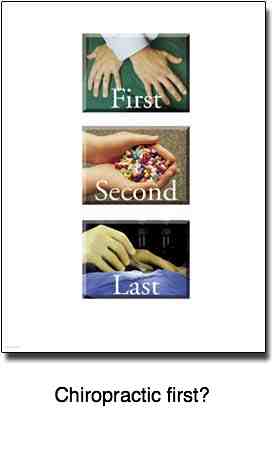
Chiropractic help
Chiropractic help is broad, challenging and supremely interesting.
SHORT ANECDOTE : Severe groin pain
Two elderly women consulted me this week, providing rich material for our Short Anecdote, with one of my favourite conditions. Severe pain in the groin with numbness spreading into the thigh, sometimes the side of the thigh, sometimes the front. Ouch, it hurts.
It really is a syndrome, meaning a mixture of different features, that often don't quite fit, making it a bit mysterious.
One had pain when moving her thigh, as in climbing stairs or getting out of the car, the other woman not. Both had severe pain in a muscle in the groin, one the Adductor Magnus, the other the Iliopsoas. Both had severe fixations in the sacro-iliac joint, but no pain. One had a fixation, also with no pain, at the third lumbar vertebra L3.
The important feature to rule out here is weakness in the Quadriceps muscle and loss of the knee reflex. Then it's another ball game. An arthritic hip is rarely a consideration because of the sudden onset. An inguinal hernia is another less common cause. I've never seen one, but the literature warns us that it can be caused by a tumour or abcess in the psoas mucle. Rare.
Frequently, it's what we call a "double crush syndrome", meaning that the nerve is irritated in two places. In the spine and as it passes through the groin. There are two different nerves that can be affected.
Because of chiropractic's ability to manage joints in the spine, the sacroiliac joint and the hip joint, the muscles in buttock and groin and rehabilitate the syndrome, we are I believe the treatment of choice. Pills don't help. Both women had been on powerful medication for 2-3 weeks. They'll get better. Unfortunately the treatment of the groin is very painful. Briefly.
Update: After only one of these painful treatments, one of the
ladies said that the pain was 50% less. The other is being more
recalcitrant: within a week the pain in the groin has stopped
completely, as has the numbness in her thigh, and she can walk up the
stairs, but movements of the hip remain very painful (when I rotate her
thigh), as is the pain on the front of her leg. I have decided to order
an X-ray of her pelvis.
Read more about Meralgia Paresthetica: UPPER LEG PAIN ...
"I do not know what I may appear to the world; but to myself I seem to have been only like a boy playing on the seashore, and diverting myself in now and then finding a smoother pebble or a prettier shell than ordinary, whilst the great ocean of truth lay all undiscovered before me."
- Isaac Newton
SHORT ANECDOTE :
A Frozen Shoulder
Pieter, a fifty-five year old businessman consulted me one month ago with a very painful shoulder. Since he only recently had a second surgery for bowel cancer, and had a stoma fitted, the first thing was to rule out a metastasis to the shoulder. Sleep was disturbed and all movements, particularly internal rotation, were very limited. Since the Dutch have a very good sense of humour, I promised that he would get to the annual "Pinkster" (Ascension Day) church service, and would be able to participate!

Being a Christian myself, and not adverse to raising my arms in praise from time to time, I hope you don't mind me having a bit of fun!

Pieter reported yesterday that he is at least 50% better. He is no longer wakened at night by his shoulder, and I noticed on leaving that he could get his wallet out of his pants pocket (internal rotation), something very important at the chiropractor! It's interesting that with minimal support from insurance schemes, our offices are still bulging with patients.
Back pocket Wallet
Read more about Frozen Shoulder …
"If you do not love what you do, and do what you love, you have chosen mayhem over music."
- Wayne Dyer
SHORT ANECDOTE ... A short leg?
Our next short anecdote this week is about unequal leg
lengths, which is not uncommon. My usual policy when faced with a short
leg is to have a trial of treatment for a few weeks before applying a
heel lift. After all the patient has spent a lifetime with the problem,
often without many symptoms. That policy is under review.
For one month I have been treating a 30-year old man with a long
history of nasty low back pain. There was little improvement, frankly he
was getting worse not better. Instantly, there has been a dramatic
improvement since giving him a 5mm heel lift. He says all the tension
has gone out of his back, and the pain in his leg, which was getting
worse not better, and almost completely gone. All within one week.
Remember, this is only a short anecdote, not hard research.
Update: he continues to improve, and gives most of the credit to the heel lift. Rightly or wrongly, neither of us are sure.
Read more … LEG LENGTH INEQUALITY. Use the site search function to find it.
SHORT ANECDOTE: WHY DO WE HICCUP ?
Our short anecdote this week is of a small boy, two-and-a-half months to be precise, who hiccups 60 times a minute for every waking hour of the day. Correction, hiccupED. It all started one week after he was born, for no obvious reason. His mother was breast feeding him, and continued to do so, so that was not a factor. Interestingly, more and more people are visiting chiropractors for 'medical' problems. However, medicine had nothing to offer, and both the wee lad and his mother were totally exhausted. Have you heard the line, C3-4-5 keeps the diaphragm alive? If you, or your baby have a problem with hiccuping, then you should know about C3-4-5, it could change your life. Read more … WHY DO WE HICCUP?
SHORT ANECDOTE : Iatrogenic Illness
Mrs S is a thirtyish woman who has significant Low Back Pain
sinds shortly after the birth of a her first child, about three years
ago.
Opinion has it that low back pain in young women mostly starts
during pregnancy, but in my experience it also often starts soon after
the birth of the child. All the lifting ... and so it was for this short
anecdote for Mrs S.
Her pain didn't improve with various other ministrations, and six months ago started radiating painfully down her leg.
She has responded very well, and after a month her low back and leg pain is almost gone.
But ... I adjusted a subluxation between her shoulder blades,
where she had no pain, and she is now really suffering from MY
ministrations! It's a little better, but she's not a happy lady.
That's what we call Iatrogenic Illness, or doctor-caused disease.
Read more … IATROGENIC ILLNESS .
Update: Mrs S is again a very happy lady. She has almost
no pain in her midback, that pain which started after my overly-robust
treatment, and only 5% remains of the pain she had in her low back. She
has no leg pain. We are in the rehab phase of the care, which involves
little treatment, but learning about prevention of a relapse, including a
vigorous exercise program. Another short anecdote from the coalface.
SHORT ANECDOTE : Bedwetting / Eneuresis
There are multiple causes of bedwetting, most of them probably of an emotional nature. For this week's short anecdote, a woman has brought her daughter, aged 8, who wets her bed every night. EVERY NIGHT.
I have only had success with eneuresis when there has been a sacral fixation and, lo and behold, Karen has a sacral fixation. To date, there has been no change after one adjustment.
We'll keep you informed. Watch this space!
Update: Three dry nights, two nights only wet panties, and then woke up. As we say in Holland: vooruitgang! PROGRESS. Her first dry nights in months and months, and that after only two treatments. But will the progress hold?
Update 2: Yes! Two nights when she woke up and went to the toilet herself. The subluxation is gone, and I have discharged her for a month. We watch with bated breath!
Update 3 of our Short Anecdote. The fixation in her sacrum has returned, and so has the bed wetting. She has a short leg, so we have added a heel lift to see if that helps. Frankly, the improvement is not as expected. Medicine has nothing further to offer, and neither has this chiropractor, I fear.
"Miracles we do at once. The impossible takes a little longer!"
- My mother, Dr Unity Lewis, BA, DC, now deceased.
SHORT ANECDOTE : Chronic Lower Back Pain
For our next short anecdote I'll tell you about Gys Lunt, aged 60 was travelling in Mozambique when the bus he was in hit a pothole. (PS. All the names are fictitious, of course. But not the short anecdote !) He was literally catapulted out of his chair, hit is head on the roof of the bus, and dropped directly back into his seat. He immediately experienced severe lower back pain. On returning to the Netherlands his doctor sent him for physiotherapy, but it was so painful that he stopped.
Three years later (one month ago) he consulted me. Here are the x-rays of his back.
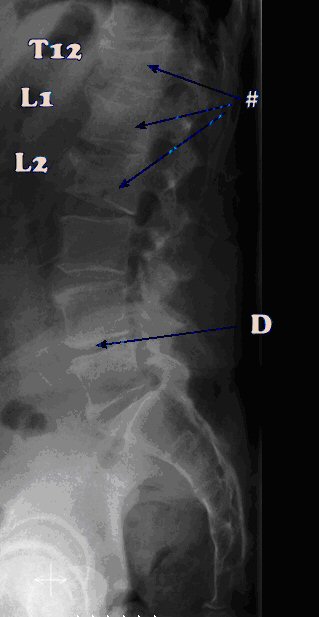
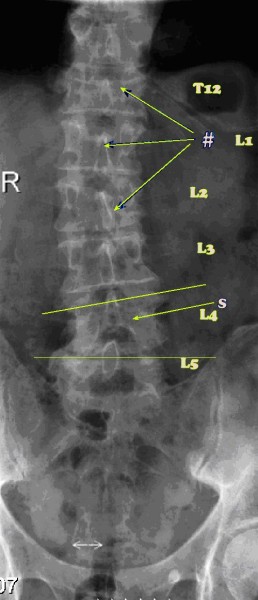
See the fractures at T12, L1 and L2? And the severe subluxation of L4? Sorry, this is no short anecdote. Rather a long one!
Interestingly, on examination, Gys's pain was coming from none of these sites, but from L5 which was severely fixated.
X-rays are extremely useful, but sometimes they can also be very misleading. His doctor really should have x-rayed him right in the beginning, but doctors are reluctant for some reason in Holland. Gys is extremely lucky that there are no 'long tract signs' as we call them - Spinal Cord pressure causing pain, weakness and parathesias in his legs. He should have been in a brace, and confined to home for 6 weeks, in my opinion.
I won't pretend it's been plain sailing. It hasn't, but after a month of treatment Gys declares that the pain is about 80% decreased, and his wife says he no longer walks like he has a carrot stuck up you know where!
We are now into the rehab phase of his treatment. Lots of exercises. He'll never have a great back, but he's no longer in severe pain, and he can walk again. Not unimportant for a formerly vigorous man of 64.
Update: Gys spent the whole of Sunday travelling on the train to a Christmas market in Maastricht, walking around the town and in nearby Valkenburg, through the caves. He did it! But wasn't in great shape this week again. Having been set free from pain, he want to do too much. I don't want to discourage him, but ... there are limits to what this back can achieve.
Update: At his 6-weekly visit, Gys again says he has very few problems. He is doing his exercises faithfully, and recognises that slow meanders around the town are a NO-NO. He says he just gives his wife the credit card when she want him to go shopping with her. She's pleased, he has minimal pain, and I'm happy!
March 2009. Gys is doing very well.
Februari 2010. Gys is still doing great. It's not perfect, but in
comparison with two years ago ... he has maintenance every six weeks.
Read more about Low Back Pain …
SHORT ANECDOTE : Foot pain
The next short anecdote is a more personal one. It's been said you should never allow family to treat you. In general, I would go along with that, except for the 'never' bit. Doctors have to work very hard to give non-paying family the same care as their regular fee-paying patients. About 18 months ago my wife sprained her ankle quite badly. Because I was able to treat it promptly, it responded very quickly, so quickly in fact that I failed to do proper follow up. Now she is getting mid foot pain from a subluxation of the cuneiform bones. Actually it created a good opportunity for me. Whilst I know that patients with this problem respond well to Chiropractic, I was interested to know how painful the treatment really is, and how quickly the condition improves. Just asked her - the treatment was really quite painful, but she has no pain at all - after just one treatment. It's not always like that!
Update 30/11 - still no pain. 20/2/09 - still no
pain.
Februari 2010: I hear few complaints, but a maintenance treatment
every few months is needed. Got to keep the boss happy! In Nederland
vrouw is thuis baas! Got that?
Read more … FOOT PAIN
Spines can be the most unpredictable things. I was doubtful how
much and how quickly I could help him. Surprisingly his concrete facet
joint was quite easy to manipulate, and the arthritic hip is responding
to a traction/ mobilisation technique using a Mulligan mobilisation
belt. The arthritis is in its early stages, and we've caught it in time.
Now he is exercising it every day. Within three weeks he was back on
the golf course, walking the nine holes without much trouble.
It's not always that simple, but you can guess what he thinks of chiropratic. A golfer kept from his twice-weekly game is like a bear with a sore head!
Update 15 December 2008: He played 18 holes last weekend for the first time in several years.
February 2009: Mr Huygens comes in every
two months now for his adjustment. He is doing fine, and we are
gradually increasing the time between adjustments. He is very committed
to the back exercises I have given him, of course.
PS. These short anecdotes are all dinkum true!
Want those exercises? CHIROPRACTIC TIPS ...
LOWER BACK EXERCISES ...
SHORT ANECDOTE : Torticollis
Our next short anecdote is about a Mrs Scheffers who consulted me about a year ago with a very difficult condition. The dead give-away was that she sat with her elbow on the desk and her fingers lightly placed against her cheek. The moment she removed her hand, her neck resolutely, in an uncontrolled manner slowly turned to the right. She came for help with the pain in her neck, and severe headaches started some thirty years previously after a fall whilst skating. She cracked her head a terrible blow on the ice. The bizarre neck movement started a few months after the injury, but nobody had made the connection between the fall and the torticollis which started soon after her sixteenth birthday.
A dreadful dilemma for a young girl which has remained with her for the rest of her life.
On examination, two things were very evident. Extreme spasm of a muscle in the neck called the SCM, that turned her head relentlessly to the right unless she stopped the movement by placing her fingers against her cheekbone. The second was a severe fixation of the Atlas bone in her neck. Could they be associated? I wasn't sure, and umpteen neurologists have told her there is no known cause or cure.
The SCM is supplied by a nerve generally known as a "social
climber". It has its nucleus in the upper neck, travels up through the
foramen magnum into the skull, briefly pretends to be a Cranial Nerve,
and then exits again via another foramen to supply the SCM and another
muscle. For more about the spinal anatomy of this area,
Click here. ATLANTO AXIAL JOINT ANATOMY ...
Injury to this Spinal Accessory nerve is rare, usually only in what is called
Iatrogenic illness / disease ...
- surgeons sometimes cut the nerve whilst doing radical dissectomy of
cancerous lymph nodes in the neck. Mrs Scheffers injury was of a
different sort.
The long and the short of it is that I promised her nothing but
she has reported that the condition is about 60% better. Much less pain
and headache, and that spastic muscle that twists her neck is far more
relaxed.
Needless to say we are both well pleased but I don't expect we will cure her. But it makes an interesting short anecdote.
Migraine headache
For our next short anecdote Mr Jacobs frightened me. Yes, frightened me. Can a doctor be frightened? Well, I was. A 50 year old top manager of one of Holland's largest cities, he was pestered to consult me by his wife, who happily was very pleased with the management of her chronic low back pain. His symptoms started three days previously with a bizarre blurriness in one eye, on questioning he thought in one quadrant, spreading to the other eye. Then pain started in his neck, followed by a severe headache. The pain rebated with a good night's sleep, but repeated itself the following day, only worse. Frightened? A very rare condition in the neck, called a dissecting aneurism, is a chiropractic and medical nightmare. It progesses usually to stroke and frequently sudden death. Not the kind of short anecdote that a chiropractor wants to be writing about! On the plus side, his blood pressure is exceptionally good, a non-smoker, and his weight is excellent. On the negative, he has a very stressed business life, has little time for exercise, and takes little leave.
Was this an aneurism in progress? Extremely rare though it is, about one in two million, a neck manipulation may cause a stroke. Does cause a stroke. Almost always it associated with a dissecting aneurism that is in progress, and has not been diagnosed. It's extremely difficult to diagnose. Very frightening research found that patients having a stroke where five times more likely to have consulted a chiropractor in the last two weeks. It frankly worried us stiff - until further research revealed they were just as likely to have consulted a medical doctor. The researchers concluded that the treatment, whether a manipulation from the chiropractor, or the medical treatment were not the cause of the stroke - but both doctors simply missed recognising a stroke in progress. Was I witnessing a dissecting aneurism in progress?
Fortunately a careful neurological exam revealed absolutely no abnormalities except a very slight abnormality in rapidly rotating his left hand. Was it significant? Maybe.
Orthopedic examination of his neck did reveal a marked fixation in the upper cervical spine. I concluded this was not an aneurism, but for safety sake referred him to his doctor. The doctor concurred with my diagnosis: a migraine. I treated Mr Jacobs very conservatively, and today he reported that the headache and eye symptoms have abated, but he still has pain in the neck. It's early days, let's see what transpires shall we? Once it is very clear that this not something ominous I will treatment his neck more aggressively.
Update 29-11-08. Mr Jacobs is doing fine. He has none of the serious symptoms experienced a month ago. I have now been adjusting him and the pain in his neck is much reduced. He still has for short periods (15 mins) what he describes as 'pressure' in his head, but no headaches, and no visual symptoms. He remains a worrying case, and I'm treating him very gently and conservatively.
Update 14.12.08. Mr Jacobs is doing great. Actually, we are now wondering if the blurriness in his eye was not caused by some new medication he had just started taking. Did you know that 50% of medicines have an "anti-cholinergic side-effect"?
February 2010. He's had none of those frightening attacks again, but like most chronic problems, his neck needs maintenance. He comes for an adjustment of his neck and back every two months.
February 2011. I had an email from his wife yesterday (I am back in sunny South Africa). J is fine, and has had no more attacks.
Go from Short Anecdotes to CHIROPRACTIC HELP home page ...
Did you find this page useful? Then perhaps forward it to a suffering friend. Better still, Tweet or Face Book it.
MONTHLY NEWSLETTER. Signed up yet? It is free.
BACK ISSUES
Chiropractic Help Backissues ... our monthly newsletter, click here for all the old issues.
- Issue #53: No short cuts to better health / Simple balance and quad strengthening exercises
- Issue #52: Needs an adjustment / Everything must change
- Issue #51: Elective surgery in the elderly / Cooling and reheating starches
- Issue #50: Make time for breakfast / Scrambled eggs and parsley
- Issue #49: Consulting a locum / Green salad /Eggs Florentine
- Issue #48: Hips and the sacroiliac joints/ Bacon and eggs
- Issue #47: Life without medication/ Eight coloured foods
- Issue #46: Lower backs and ankles/ kaempferol and cancer prevention
- Issue #45: Tingling, weakness and malaise/ vitamin B1
- Issue #44: Applying general chiropractic principles to the hand / Omega-3
- Issue #43: Art and science of chiropractic / Kale
- Issue #42: Tum sleeping / Flaxseed
- Issue #41: Adult potty training / Beetroot constipation
- Issue #40: Ominous lumbar signs / Too much medication?
- Issue #39: Swapping chiropractors / Butter is back
- Issue #38: Making a correct diagnosis / Make your own pesto in five minutes.
- Issue #37: Have your wisdom teeth out in the chair
- Issue #06: Safety on the Stairs / Ginger
- Issue #05: Safety in the home / Red foods
- Issue #04: Whiplash and the Joints of Luschka / Parsley
- Issue #03: How to stop falling / Danger of a low fat diet
- Issue #01: Tingling in the arms and hands / Apples
(PS. If you find them irrelevant to your needs or an exercise in tedium, one click will UNsubscribe you.)
