- Home
- Sciatic nerve
- Piriformis syndrome
- Home
- Sciatic nerve
- Piriformis syndrome
Piriformis syndrome
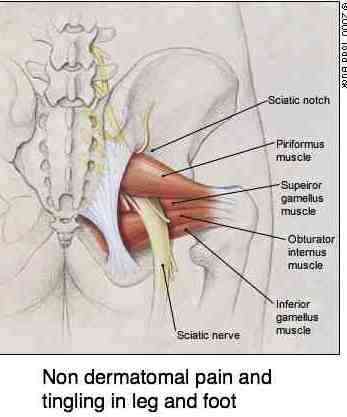
The name arises from the piriformis muscle, a small structure that passes from the sacrum, [or tailbone, the large wedge-shaped bone that forms the base of the spine], deep in the buttock to its attachment on the side of the hipbone. It is a small muscle compared to other muscles around the hip and thigh, aiding in external rotation (turning out) of the thigh bone (femur).
The sciatic nerve passes close by the piriformis, and sometimes through the fibres of the muscle.
- Chiropractic Conditions is a central page at our site. It provides you simply and easily with the sorts of diagnoses that the average DC would be treating.
- Healthy Living Tips is another vital page at Chiropractic Help. Sparkling wellbeing is not just about having your subluxations adjusted. This link gives you some insights into different foods you could and perhaps should be eating.
AN ENTRAPMENT SYNDROME
This is what is called an entrapment neuropathy. It is
postulated that when the muscle becomes tight, it may press on the
sciatic nerve which lies close by. Pain along the course of the sciatic nerve is called
sciatica.
The piriformis muscle and its tendon have an intimate relationship to
the sciatic nerve - the largest nerve in the body - which supplies the
legs with motor and sensory function. It drives many of the leg muscles,
and brings sensation and other information back to the Central Nervous
System. (For example hot and cold, position sense, vibration sense.)
Misdiagnosis
Medically, it is acknowledged that about a quarter of surgeries for sciatica fail and lead to FBS, Failed Back Syndrome.
In the United States alone, each year 1.5 million people have lumbar MRI scans to look for the cause of the buttock and leg pain called 'sciatica'.
More than 1.2 million (over 80%) of those scans fail to find the cause in the spine.
But three hundred thousand of the scans are sufficiently positive that the patient has lumbar spine surgery. Of the 300,000 surgeries, as many as 25% fail to relieve the pain - in many cases this is because the diagnosis of a spinal cause for the sciatica was incorrect. Was it an irritation of the sciatic nerve by the piriformis muscle?
Diagnosis
Physical findings include tenderness of the buttock region, increased pain with adduction, internal rotation and flexion of the affected thigh, weakened abduction of the flexed thigh and frequently sacroiliac joint derangement and/or an associated iliotibial band syndrome. Sacro-iliac joint tests are often positive. Electrodiagnostic tests may be positive if the thigh is placed in a position which places the piriformis under extreme stretch (flexed, adducted and internally rotated).
Sometimes referred to as "deep buttock pain," other causes of this type of pain include spine problems (including herniated discs, spinal stenosis, etc.), pinched and irritated nerves, and tendonitis. The diagnosis of this syndrome is often given when all of these diagnoses are eliminated as possible causes of pain. Other signs of of this syndrome include examination maneuvers that attempt to isolate the function of this muscle, and the finding of pain directly over the tendon of the piriformis muscle, which then radiates down the leg.
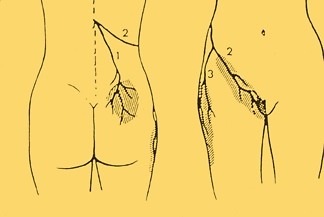
Maigne's syndrome
A high lumbar facet syndrome can irritate the superior cluneal nerves which supply part of the buttock, and the groin, and can easily lead one to suspect a piriformis syndrome.
Exclusion diagnosis
In medicine it is freely acknowledged that no one really knows exactly what causes piriformis syndrome, or if it really exists. Some physicians believe that it is the name given to hip/buttock pain that cannot be otherwise diagnosed. However, others believe that piriformis syndrome is a very real cause of pain and disability.
Medical Treatment
Unfortunately, the treatment of piriformis syndrome is quite general, and it is acknowledged by orthopedists that it is often a difficult problem to recover from. Some treatment medical suggestions are:
* Physical Therapy - Emphasis on stretching and strengthening the hip rotator muscles
* Rest - Avoid the activities that cause symptoms for at least a few weeks
* Anti-Inflammatory Medication - To decrease inflammation around the tendon
* Deep Massage - Advocated by some physicians
On some occasions, when these treatment fail, patients have surgery to release, or loosen, the piriformis muscle tendon. This surgery is not a small procedure, and generally considered the last resort if a lengthy period of conservative treatment does not solve the problem.
Searching for something specific? For example, type " help for sciatica pain " in this box.

CHIROPRACTIC HELP
Chiropractors treat the piriformis syndrome with confidence. Treatment is based on findings of a fixated sacrum (based on motion palpation and the Derefield test) and active trigger points in the piriformis muscle.
A true short leg may be a part of the problem, in which case a heel lift may be employed.
Some chiropractors consider that carrying of a wallet in the back pocket may be part of the problem.
Manipulation of the sacral portion of the sacroiliac joint anatomy and stretching of the piriformis muscles, cross-friction of the muscle and possibly needling, and rehabilitative exercises.
Piriformis syndrome
Piriformis syndrome is a medium sized muscle in the buttock that can cause a gnawing pain down the leg called sciatica.

Note the proximity of the sacro-iliac joint to the piriformis muscle which has its origin on the anterior surface of the sacrum and passing to the hip bone. They have a profound effect on each other.
Motion palpation inevitably reveals a FIXATION of the Sacro-iliac joint. Releasing this fixation is what gives chiropractic the edge in treating the piriformis syndrome.
Because the piriformis muscle forms part of the pelvic floor, it is often associated with groin and pubic bone pain, especially in pregnancy. Read more about pubic bone pain …
See the piriformis? It's striped...

Useful links
- Home
- Sciatic nerve
- Piriformis syndrome
We have a free monthly Better Health email letter. Monthly so you don't suffer from information overload.
Should you wish to receive it, please fill in the Enter your E-mail Address at the bottom of this page. It is free.
Clicking on the orange XML/RSS will enable you to get our blog every time a new page is added.
Did you find this page useful? Then perhaps forward it to a suffering friend. Better still, Tweet or Face Book it.
MONTHLY NEWSLETTER. Signed up yet? It is free.
BACK ISSUES
Chiropractic Help Backissues ... our monthly newsletter, click here for all the old issues.
- Issue #53: No short cuts to better health / Simple balance and quad strengthening exercises
- Issue #52: Needs an adjustment / Everything must change
- Issue #51: Elective surgery in the elderly / Cooling and reheating starches
- Issue #50: Make time for breakfast / Scrambled eggs and parsley
- Issue #49: Consulting a locum / Green salad /Eggs Florentine
- Issue #48: Hips and the sacroiliac joints/ Bacon and eggs
- Issue #47: Life without medication/ Eight coloured foods
- Issue #46: Lower backs and ankles/ kaempferol and cancer prevention
- Issue #45: Tingling, weakness and malaise/ vitamin B1
- Issue #44: Applying general chiropractic principles to the hand / Omega-3
- Issue #43: Art and science of chiropractic / Kale
- Issue #42: Tum sleeping / Flaxseed
- Issue #41: Adult potty training / Beetroot constipation
- Issue #40: Ominous lumbar signs / Too much medication?
- Issue #39: Swapping chiropractors / Butter is back
- Issue #38: Making a correct diagnosis / Make your own pesto in five minutes.
- Issue #37: Have your wisdom teeth out in the chair
- Issue #06: Safety on the Stairs / Ginger
- Issue #05: Safety in the home / Red foods
- Issue #04: Whiplash and the Joints of Luschka / Parsley
- Issue #03: How to stop falling / Danger of a low fat diet
- Issue #01: Tingling in the arms and hands / Apples
(PS. If you find them irrelevant to your needs or an exercise in tedium, one click will UNsubscribe you.)
- Home
- Sciatic nerve
- Piriformis syndrome
