- All You Need to Know
Pain in upper leg
Mrs V, a 63 year old woman has had left LBP for about ten years. There was no obvious cause. Twelve months before her first consultation severe pain began in the left groin, radiating down the front of the thigh towards the knee. Periodically her upper leg would suddenly give, partly with a sharp stab, and also due to a weak feeling.
Frequently she could barely walk, the ache in her upper left leg was so bad.
She wore a heel lift in her right shoe; that brought some measure of relief.
Treatment by an orthopaedic surgeon specialised in manipulation brought some relief of pain, and especially the insert in her shoe, but her leg continued to buckle under her, and walking remained very difficult. After several months, this doctor referred her to our clinic for evaluation.
On examination, bare foot, it was clear that she had a very short right leg, a sharply tilted pelvis, low on the right, and an accompanying scoliosis, convex right; or, was it left? Was I going crazy? The xrays told a completely different story.
Ranges of motion of the lumbar spine were good, without radiation of pain to the leg, or significant pain in the back.
Left hip: Flexion and internal and external rotation were full, and without pain; thus, no hip arthritis. However, adduction, pulling the knee towards the opposite shoulder caused sharp pain in the groin.
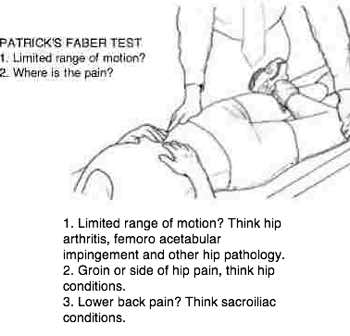
The test called Patrick's Faber test, was also strongly painful and some movements were limited in the groin. Hip arthritis? Femoro Acetabular Impingement Syndrome?
Most odd, was that the Slump test provoked pain in the front of the thigh - it's a test for the Sciatic nerve which, when pinched or irritated, would cause pain down the back of the leg. In that sense, the Slump test for sciatica was negative.
However, the Femoral nerve stretch test was positive, with pain in the front of the left thigh. A pinched nerve, either in the groin or lumbar spine? Upper leg pain always calls for careful examination.
Pain in upper leg
- Right Choices ... follow your instincts.
Neurological examination of pain in upper leg
Once again there were contradictory results: The reflexes were normal and there were no sensory changes, but the Quadriceps muscle was weak - the probably the cause of her leg suddenly giving under her weight, particularly on the stairs. Unusual with a normal reflex.
Chiropractic Help examination
She stood very prominently with a short RIGHT leg, and attendant scoliosis. There were fixations in the right sacroiliac joint anatomy, and at the L1 joint.
With groin and pain in upper leg (front of leg), the involement of the Femoral nerve and a possible Maignes syndrome was high in my list of differential diagnoses of upper leg pain. Sacroiliac joint anatomy ...
X-rays
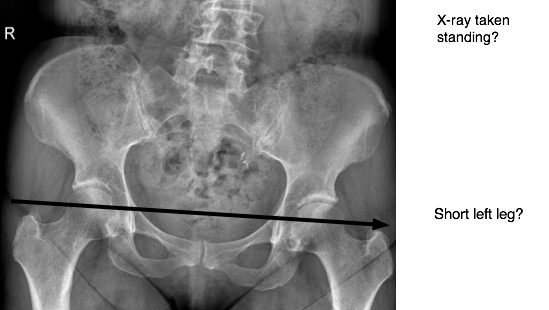
There's no mention whether this X-ray of the pelvis was taken standing, or lying supine. That's important when making decisions about a heel lift. The strong implication here was very short LEFT leg.
Was I going crazy? I have got it wrong before, and sometimes an apparent short leg can change after treatment of the pelvis. So, a phone call to the hospital. Indeed, the radiograph was taken lying supine. It was just a bad set-up by the radiographer.
Confusion
This whole case is loaded with difficulties.
- Severe pain in upper leg, lasting a whole year, despite various medical treatments is obviously a serious concern.
- The X-ray report of the hips was "normal". But she had severe pain in the hip - in the groin.
- No recent X-rays of her back were available.
- Physical examination by both the orthopaedic specialist, and myself, confirmed a short RIGHT leg. But the X-ray of the pelvis suggested a very short LEFT leg.
- Any condition that causes "hard neurological signs" - altered reflexes or sensation, or weakness, are serious.
- But weakness in the large thigh muscle, the Quadriceps, with no change in the knee jerk reflex? That makes no sense. Diabetes mellitus?
Chiropractic Help
Following the Thompson drop protocol we adjusted the sacrum on the right, L1 on the left with the so-called "million dollar" roll.
The left hip was mobilised and the Adductor magnus, pectineus and psoas with treated with the Active Release Technique (extremely painful).
A vigorous rehab programme is always part of chiropractic help for any chronic condition.
Progress
Mrs V consulted me again today. She comes with her husband once every six weeks.
She's a very happy lady, but I'm still confused. She can walk long distances without her leg collapsing under her, and without pain in her thigh. But I still don't confidently have the correct diagnosis. Many years ago I learned an important lesson from Dr Glynn Till, president (now retired) of the Chiropractic College in Durban, South Africa.
"Remember, the patient may have two different conditions."
Dr G. Till, DC
Femoro Acetabular Impingement syndrome

The spot xray of her left hip reveals little arthritis superiorally to speak of, mild signs of Femoro Acetabular Impingement Syndrome Pincer and CAM, and several unnoticed cystic lesion in the ball of the femur.
It's time for new xrays and, depending on the result, an MRI. Those of her lumbar spine, taken standing with the heel lift in place in the right shoe, and a new spot of the left hip; and a test for diabetes.
That diabetes test is just routine. I'm not expecting it to be positive. She is not obese, there is no urinary frequency, no loss of weight, no abnormal thirst and, when a diabetic neuropathy causes weakness in the quadriceps muscle, there's no pain in the upper leg usually; it's silent and deadly.
Like all case files, this is in development, and will always remain so. She thinks the future is rosy, but I have unanswered questions. Meantime, she walks, she does her back and pelvis rehabilitation exercises, and she's happy. They are off hiking in the Black Forest in the south of Germany this week; life is full.
Three years later, I've just had the good fortune to see her whilst doing a locum in the Netherlands; she continues to do fantastically well, coming in every six to eight weeks for maintenance care.
Here is another difficult pain in upper leg file.
Mrs S came for treatment for terrible headaches. An elderly woman, I was shocked at how many analgesics she was taking. Rebound headache is actually caused by taking bucketfuls of pills.
There was nothing simple about her upper neck headaches, but they have now stabilised at about 80 percent better and she needs little medication.
The problem is that she is always very sore for about three days after an adjustment. So now she comes once in two months, and is very happy.
But her upper leg?
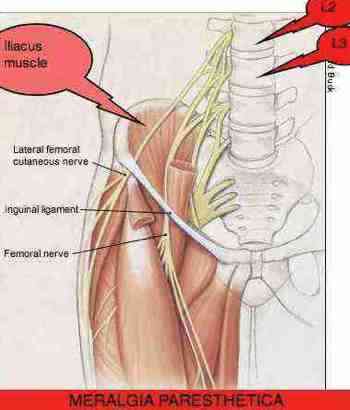
After an operation to remove a sickly ovary she developed severe pain in the groin and upper thigh. I suspected they knicked a branch of the femoral nerve and there was little to be done. But she did have a L2 fixation; the femoral nerve comes from the upper lumbar spine.
As with her neck, she was very sore in her lower back for three days, but hey presto, no more restless legs at night, no more hanging the leg outside the blankets, no more pain. And she does her lumbar exercises very faithfully.
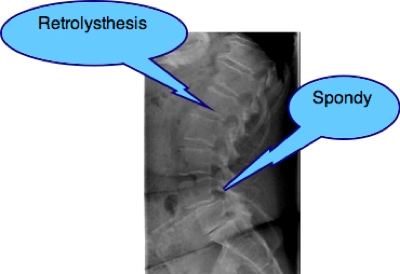
Spondylolysthesis
Health is additive. The positives and the negatives. This lady has been
has heavy as 160kg, now 117kg has a double spondylolysthesis (old trauma
most likely), has Femero Acetabular Impingement Syndrome and severely
arthritic knees.
Useful links @ Pain in upper leg
Groin and/or thigh pain?
Do you have a question about leg pain? Share it!
What Other Visitors Have Said
Click below to see contributions from other visitors to this page...
Intolerable pain in left hip and back 
Pain started in middle of left back, saw a chiropractor and was told it was soft tissue and after third treatment with him he told me there was nothing …
Reoccurring back pain
Good morning.
In Oct 2014 I was 3 months pregnant when I was diagnosed with symphysis pubis dysfunction. I suspect now I actually had an undiagnosed disc …
Left Front Thigh Pain
Left Front Thigh Pain can be a diagnostic saga.
Dear webmaster. It is Tim, male, 41 years old from Hong Kong. I've read several of your articles before …
Femoral nerve pain
Chiropractic Help homepage » Patricks faber test » Femoral nerve pain
My husband is 62 and recently diagnosed within the last year as …
Pain in right groin
I have had a chronic aching pain in my right groin coming from my lower back, for some time, mainly when I sit down or lie in bed overnight. When I first …
Another case of undiagnosed hip dysplasia
Hi all-
I was diagnosed with dysplasia at 38 after a couple of years of weakness and a "weird unstable feeling". The ortho did not mention Peri Acetabular …
pain across side and front of thigh
Pain across side and front of thigh
I started walking and exercising a year ago. I was then and am now 200 pounds and sedentary. I got up to walking …
Femoral Nerve pain with weakness in the leg Not rated yet
Right side front and inner thigh, groin area, excruciating pain goes into my knee down in my shin area to toes where they are spreading into a V.
Unbearable …
Left thigh upper Not rated yet
My left leg is 33cm bigger than my right thigh; on the top of the thighs I have pain below buttocks and pain running down just after saddle bag; only those …
Hips pain Not rated yet
I have severe disc degeneration due to hard work, and heavy load carrying since the age of 14, I am now 69.
I have a left hip resurface, of 20 years …
Vibration/buzzing in groin area Not rated yet
Hello,
Two years ago I injured my L4, the MRI showed that I had a torn my L4, as my doctor put it I was broken; two weeks later shingles set in and …
Pain in upper thigh Not rated yet
I have pain in my upper thigh. The pain becomes more intense with extended periods of movement.
Eventually leg(s) feel as though it will give out. …
Pain in upper thigh and outer calf/shin Not rated yet
I started having leg pain that caused me to buckle over...it was a weakness/shooting pain in front inner thigh. It was on and off over a couple of months. …
inner thigh and back Not rated yet
Respected doctor,
How is inner thigh and back pain caused?
I was regular doing ground exercises in the morning and evening. And in the evening after …
Marlex Mesh Implant/Nerves Injury Not rated yet
In 1990 had Marlex Mesh implanted for Obturator Hernia repair. I did not walk for several months; severe foot drop.
Have suffered with sciatic pain/neuropathy/parath …
Bilateral pain in hip and pelvis area for 10 years Not rated yet
Bilateral pain in hip and pelvis area for 10 years will be problematic.
Hello. I am a 46 year old Woman, 5'1", about 130 lbs and I have had severe …
Is walking a risk for thigh numbness? Not rated yet
Male, age 63, Ht 178, Wt. 85 kg. DM, HT 20 yrs
- need to walk brisk for 45 mins daily.
Do have occasional lower back ache generally under control. …
Sudden Femoral nerve pain and I can't stretch out my leg or walk, just limp Not rated yet
Sudden femoral nerve pain and I can't stretch out my leg or walk, just limp; it's worrying when you've already had one "failed surgery".
After a spring …
pinched nerve around inguinal ligament Not rated yet
At the junction of my thigh and and my right lower abdomen I get a pinch as I rotate my leg to the outside and pain comes when I try to bring my leg to …
Meralgia Paresthetica treatments Not rated yet
My son has developed this condition 3 months a go with pain and weakness in left thigh and sensitive in lateral thigh and less in anterior thigh. Has severe …
Lower right abdominal pain - groin and hip area. Not rated yet
I had a suspected appendicitis 10 months ago with bleeding in bowel. No cause has been found despite extensive investigations (CT, MRI, Ultrasound). Findings …
Did you find this page useful? Then perhaps forward it to a suffering friend. Better still, Tweet or Face Book it.
MONTHLY NEWSLETTER. Signed up yet? It is free.
BACK ISSUES
Chiropractic Help Backissues ... our monthly newsletter, click here for all the old issues.
- Issue #53: No short cuts to better health / Simple balance and quad strengthening exercises
- Issue #52: Needs an adjustment / Everything must change
- Issue #51: Elective surgery in the elderly / Cooling and reheating starches
- Issue #50: Make time for breakfast / Scrambled eggs and parsley
- Issue #49: Consulting a locum / Green salad /Eggs Florentine
- Issue #48: Hips and the sacroiliac joints/ Bacon and eggs
- Issue #47: Life without medication/ Eight coloured foods
- Issue #46: Lower backs and ankles/ kaempferol and cancer prevention
- Issue #45: Tingling, weakness and malaise/ vitamin B1
- Issue #44: Applying general chiropractic principles to the hand / Omega-3
- Issue #43: Art and science of chiropractic / Kale
- Issue #42: Tum sleeping / Flaxseed
- Issue #41: Adult potty training / Beetroot constipation
- Issue #40: Ominous lumbar signs / Too much medication?
- Issue #39: Swapping chiropractors / Butter is back
- Issue #38: Making a correct diagnosis / Make your own pesto in five minutes.
- Issue #37: Have your wisdom teeth out in the chair
- Issue #06: Safety on the Stairs / Ginger
- Issue #05: Safety in the home / Red foods
- Issue #04: Whiplash and the Joints of Luschka / Parsley
- Issue #03: How to stop falling / Danger of a low fat diet
- Issue #01: Tingling in the arms and hands / Apples
(PS. If you find them irrelevant to your needs or an exercise in tedium, one click will UNsubscribe you.)
