Plantar Myofascitis
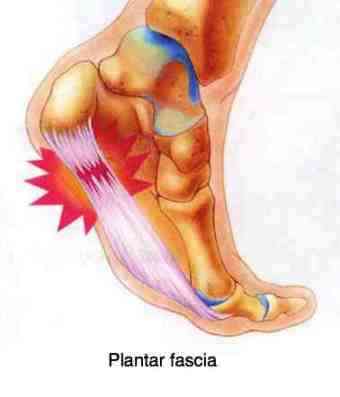
Plantar myofascitis refers to pain on the sole of the foot. Do you have it? Is lower leg frustrating your daily walk? Chiropractic help is for you.
This page was last updated by Dr Barrie Lewis on 31st March, 2020.
Foot pain
Foot pain is a nasty malaise far beyond the local affects; anything that makes you walk more slowly, research shows, will reduce the length of your life.
It is the sole that usually hurts with plantar myofascitis. It may be worse when you stand bare foot, especially first thing in the morning.
It usually occurs on the underside of the foot, near the spot where your heel and arch meet, but in fact can occur anywhere along the under side of au pied. The pain may refer towards the toes.
What is interesting is that patients usually discover inadvertently that chiropractic help is also for foot pain. They consult us for LBP, perhaps, or headaches, or even unrelated tingling in hands and fingers; in passing, the DC asks about other conditions that may be affecting their wellness.
Quite often even then, patients, not expecting a chiropractor might treat foot pain, only raise the subject when they see a model of the foot prominently displayed, or posters on the wall.
What then is the plantar fascia? It consists of a complex band of fibres which run from the calcaneus, or heel bone to the base of the toes.
A myofascitis occurs when these tissues are irritated and become inflamed. Bony spurs may form on the heel at the attachment of these fibres if this condition is not correctly treated.
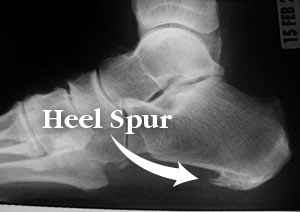
This heel spur forms where the plantar fascia attaches to the calcaneus, in response to the increased tug on the bone.
It is a condition that tends to respond poorly to traditional treatment. The pain and muscular dysfunction can seriously affect the normal life of an individual, but in an athlete it is a disaster in both training and racing performance.
And, because how fast you can and do walk directly affects longevity, it really is a serious problem. Bad enough to actually shorten your life.
Conventional therapy without surgery usually requires six weeks to three months. In contrast, with the appropriate chiropractic treatment it often resolves within a few weeks. If it is chronic, then an occasional regular treatment may be necessary.

Heel spur
Heel spur is characterised by severe pain, often worst first thing in the morning. What is odd is that it is very treatable with chiropractic help, but the offending spike of bone is still there after the pain has gone; it is one of the causes of plantar myofascitis.
- Ankle Joint pain
- Sacroiliac joint anatomy
- a short leg also known as a Leg length Inequality.
- sacroiliac joint treatment
Ankle joint
Ankle joint fixations are the main cause in the opinion of chiropractic help; however others have been identified.
Plantar myofascitis makes walking misery and an end to golf and the countryside.
What causes this painful condition on the sole of the foot?
- Improper warm up by athletes and hikers alike,
- fixations in one or more foot joints especially the calcaneus and cuboid,
- over pronation of the ankle,
- a tight calf muscle and achilles tendon,
- a high arched foot,
- flat feet,
- an imbalance in the pelvis, especially in the sacroiliac joints or the hip joint
- a short leg or
- a sudden increase in training mileage all may cause plantar fascitis.
There are also certainly other causes in the knee, hip and lower leg. There is no substitute for a thorough examination to discover where it is emanating from. Another, is your weight; are you significantly obese and want to walk to lose pounds, but cannot because of foot pain?
Consider first then our free weight loss programs. Just getting five to ten pounds off would be a great start to helping your foot cope.
Long distance walking, running and cycling, or just standing can overwork these muscles. As they are chronically stressed, they start to shorten causing this nasty condition of the foot called plantar myofascitis.
When a muscle shortens, it is less resilient and is more easily damaged, and becomes painful. This applies equally for example to the rotator cuff in the shoulder, just as it would in the foot.
It may also develop years after a poorly managed ankle sprain that permanently changed your gait; the way you walk. The body compensates by trying to strengthen the attachment for muscles now undergoing undue stress.
For more about the chiropractic ankle sprain treatment, use the search function at our site.
Heel spurs, the attachment of the plantar fascia to the heel bone, may be a part of the problem.
Heel spurs are relatively uncommon in young people. If you are less than thirty-five say, and have a bony growth seen on x-rays in both feet, and a stiff lower back, then ask for a test for a relatively uncommon but potentially serious condition called ankylosing spondylitis.
That spur is under the heel, or calcaneus bone.
A positive test for the presence of the offending gene does not mean that you definitely have the disease; but you are at risk and must make the correct dietary changes, and exercise regularly; otherwise your spine may become as stiff as bamboo.
It is controversial but I add what can only be described as an opinion. Ankylosing spondylitis usually goes for the sacroiliac joints. I have treated numerous cases over the years and they have responded well to chiropractic if caught in the early stages. Allowed to become chronic it turns into what is known as bamboo spine. Healthy living, plenty of exercise and a diet high in omega-3 is vital. Your doctor may try to convince you that you are wasting your time and money.
Specific chiropractic treatment has been shown to be very effective in the treatment of plantar myofascitis, restoring unimpeded motion and function to the ankle and foot joints; the subtalar, cuboid and cuneiforms are often the spoke in the wheel.
Chiropractors interested in the foot excel in the treatment of this problem because they look at the whole kinematic chain; the sacroiliac joints, the hips, the knees, the feet and so on.
While it is not adequately researched, there is a suggestion that a night splint which pulls on the plantar fascia may help. Ankle exercises and stretches of the calf muscles and the arch of the foot are extremely important.
These must be done on a regular basis, especially first thing in the morning; it is best done barefoot, with a cushion or carpet under the heel and the toes on the plinth.
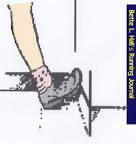
Place the toes against a plinth (BARE FOOT), lean forward keeping the heel on the ground until a stretch can be felt along the length of the foot and calf.
Reduced training may be important for an athlete in the acute phase. Icing of the sole is much safer than anti-inflammatory pills. Use a block of ice directly over the painful area, and follow it with moist heat. Do it, repeating several times, in the bath.
Weight loss may be appropriate. Smoking aggravates the healing of all such conditions; it reduces the oxygen in the blood, vital for healing.
If you are suffering from pain such as plantar fasciitis, check out the only cushion on the market today that has an acupressure bar embedded in the heel to help relieve it by stretching the fascia tendon with every step you take.

MORE ABOUT FOOT PAIN
If the pain runs to the ball of the foot, then you may have a condition called Metatarsalgia that is a frequent cause of foot pain. Neglected it leads to a nasty called Mortons neuroma. Prevention is better; and plantar myofascitis may be in the differential diagnosis.
Useful links @ Plantar myofascitis
- Tingling and pain in the toes? A Mortons neuroma is a possibility.
- Strawberries have been proven to reduce arthritis pain. INTERESTING FACTS ABOUT STRAWBERRIES ...
- Injured your foot on the stairs? The Enemy Within ... a short story.
- FOOT PAIN ...
Have A Question About Your Foot?
Share your question. Perhaps I or someone else can contribute to the misery that foot and ankle joint pain can cause.
Did you find this page useful? Then perhaps forward it to a suffering friend. Better still, Tweet or Face Book it.
MONTHLY NEWSLETTER. Signed up yet? It is free.
BACK ISSUES
Chiropractic Help Backissues ... our monthly newsletter, click here for all the old issues.
- Issue #53: No short cuts to better health / Simple balance and quad strengthening exercises
- Issue #52: Needs an adjustment / Everything must change
- Issue #51: Elective surgery in the elderly / Cooling and reheating starches
- Issue #50: Make time for breakfast / Scrambled eggs and parsley
- Issue #49: Consulting a locum / Green salad /Eggs Florentine
- Issue #48: Hips and the sacroiliac joints/ Bacon and eggs
- Issue #47: Life without medication/ Eight coloured foods
- Issue #46: Lower backs and ankles/ kaempferol and cancer prevention
- Issue #45: Tingling, weakness and malaise/ vitamin B1
- Issue #44: Applying general chiropractic principles to the hand / Omega-3
- Issue #43: Art and science of chiropractic / Kale
- Issue #42: Tum sleeping / Flaxseed
- Issue #41: Adult potty training / Beetroot constipation
- Issue #40: Ominous lumbar signs / Too much medication?
- Issue #39: Swapping chiropractors / Butter is back
- Issue #38: Making a correct diagnosis / Make your own pesto in five minutes.
- Issue #37: Have your wisdom teeth out in the chair
- Issue #06: Safety on the Stairs / Ginger
- Issue #05: Safety in the home / Red foods
- Issue #04: Whiplash and the Joints of Luschka / Parsley
- Issue #03: How to stop falling / Danger of a low fat diet
- Issue #01: Tingling in the arms and hands / Apples
(PS. If you find them irrelevant to your needs or an exercise in tedium, one click will UNsubscribe you.)
