- Home
- Sciatic nerve
- Nobles test
- Home
- Sciatic nerve
- Nobles test
Nobles Test
Nobles test is for lateral knee pain.
This orthopaedic manoeuvre is used to assess lateral knee pain especially in the absence of trauma for athletes, cyclists, and the general public.
The iliotibial band, or ITB, is a broad tendon that runs from the
Tensor Fascia Lata muscle on the side of the upper thigh and pelvis, and
has its insertion just below the outer side of the knee.
Repeated flexion of the knee, as in running and cycling, may cause a friction syndrome between the ITB and the lateral femoral condyle. It is in essence a tendonitis not unlike say tennis elbow.
There is tenderness just proximal to or higher than the lateral knee joint, where the tendon may rub over the femoral condyle, causing pain and sometimes swelling. Tests for the meniscus and the ligaments will be negative. The definitive test for this condition is Nobles test. Your chiropractor will place his thumb over the side of your knee and, whilst repeatedly flexing the joint, will look for a painful nodule in the ITB. She or he will compare the two knees, as it's a tender spot even in the normal knee.
Ilio tibial band syndrome

Should
Nobles test be positive, it always wise also to examine the sacroiliac
joint, and also look for signs of an old ankle sprain and foot pain. It's not unusual for the ilio tibial band syndrome to be a symptom of some other condition, rather than the primary condition causing the upper leg and knee pain. A short leg should also be considered; it's the underlying cause of so many leg and back problems. Authorities disagree on how many millimetres difference should be considered a leg length inequality. I've found that even five millimetres can make a significant difference.
If all the extremity tests are negative, the hip should also be carefully examined, as hip pathology often refers to the knee. Femero acetabular impingement syndrome is a condition not infrequently found in young athletes, and the presenting syndrome could be pain elsewhere, as in the ITB.
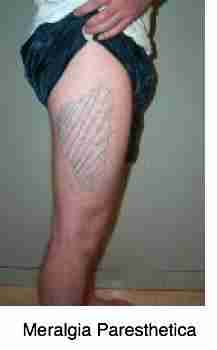
So too, Meralgia Paresthetica should be considered as it causes pain and or numbness on the side of the thigh.
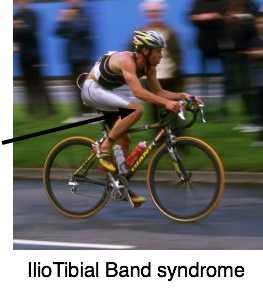
Nobles Test

SCIATICA
- SACROILIAC JOINT
- FEMORO ACETABULAR IMPINGEMENT SYNDROME CASE FILE - the stiff hip, with an arthritic feel, but in the young person.
- SPRAINED ANKLE ...
- FOOT PAIN ..
- MERALGIA PARESTHETICA ...
Last, and not least, we are assuming this is not a pinched nerve in the spine or buttock in which the classic Straight Leg Raise test of LASEGUE with a positive Braggard's test will be positive, and the more useful Slump test since it can be done at home by you the patient. A piriformis syndrome too, of course, can cause pain in the upper leg. Use the search function in the navigation bar to find our more about these tests.
Usually a sciatica will have associated LBP but this is not always the case. When the disc prolapses into the intervertebral foramen, or beyond, there may be minimal back pain, but there is a severe aching pain in the leg that may confuse the clinician, causing him to think of a muscular problem in the lower limb.
On a quite different tack, unrelated really, but are you ever at your wit's end when it comes to a gift for a friend or family member? Or perhaps your best friend's spouse or mother has died, and you simply don't know what to say or do. Then think about giving a memorial tree. It makes a lovely birthday present too, of course.
Chiropractic help
Noble's test confirms a classic tendonitis; given time, rest and chiropractic help virtually all cases will resolve satisfactorily.
The difficulty is with the athlete who wants to continue his sport during treatment; then any form or care, chiropractic help or other is likely to be difficult.
MEMORIAL GIFT IDEA
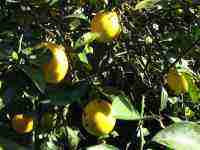
There are few more kind and noble things to be done after the loss of a loved one; giving of a tree, and offering to dig the hole and plant it, can serve to remind your friend or relative of their loss in a positive way.
Choosing the right tree of course is important; was he crazy about making salads for example? Then the giving of a lemon tree would have much merit.
Your friend might even choose to bury their loved one's ashes among the roots of the tree. My own mother is buried under a yellowwood tree in our garden; I often imagine her peeping out from amongst the branches. She adored the garden.
Adding lemon juice to a salad becomes a daily exercise of picking fresh fruit. I becomes a ritual of honouring the loved one; a fond memory.
You of course will probably choose a quite different tree, or plant; spend some time thinking about which would be most appropriate. Don't you love gifts that you know were lovingly chosen and give daily pleasure?
A lemon just happens to be a relatively small tree that adds so much by way of scent, colour and health to the garden. In a pot it can be brought in doors for the worst of the winter.
Searching for something specific? Say, "growing lemon trees". Just type it in here.

USEFUL LINKS
- Home
- Sciatic nerve
- Nobles test
Did you find this page useful? Then perhaps forward it to a suffering friend. Better still, Tweet or Face Book it.
MONTHLY NEWSLETTER. Signed up yet? It is free.
BACK ISSUES
Chiropractic Help Backissues ... our monthly newsletter, click here for all the old issues.
- Issue #53: No short cuts to better health / Simple balance and quad strengthening exercises
- Issue #52: Needs an adjustment / Everything must change
- Issue #51: Elective surgery in the elderly / Cooling and reheating starches
- Issue #50: Make time for breakfast / Scrambled eggs and parsley
- Issue #49: Consulting a locum / Green salad /Eggs Florentine
- Issue #48: Hips and the sacroiliac joints/ Bacon and eggs
- Issue #47: Life without medication/ Eight coloured foods
- Issue #46: Lower backs and ankles/ kaempferol and cancer prevention
- Issue #45: Tingling, weakness and malaise/ vitamin B1
- Issue #44: Applying general chiropractic principles to the hand / Omega-3
- Issue #43: Art and science of chiropractic / Kale
- Issue #42: Tum sleeping / Flaxseed
- Issue #41: Adult potty training / Beetroot constipation
- Issue #40: Ominous lumbar signs / Too much medication?
- Issue #39: Swapping chiropractors / Butter is back
- Issue #38: Making a correct diagnosis / Make your own pesto in five minutes.
- Issue #37: Have your wisdom teeth out in the chair
- Issue #06: Safety on the Stairs / Ginger
- Issue #05: Safety in the home / Red foods
- Issue #04: Whiplash and the Joints of Luschka / Parsley
- Issue #03: How to stop falling / Danger of a low fat diet
- Issue #01: Tingling in the arms and hands / Apples
(PS. If you find them irrelevant to your needs or an exercise in tedium, one click will UNsubscribe you.)
- Home
- Sciatic nerve
- Nobles test
