Hypermobile hip dysplasia CAM FAIS
Whew, what a mouthful that is; hypermobile hip dysplasia CAM FAIS is all about chronic buttock, upper thigh and groin pain. It's nasty stuff, starting in the young person. Shall we discover what these terms mean? Understanding this huge, weight bearing joint can make the difference between a complete replacement, or not.
Yes, it's worth
trying to grasp this material if you are suffering from upper leg and groin pain that won't resolve, or respond to current treatment. And remember too that it's hereditary; catching it early is vital for your children.
There are two conditions, one which causes stiffness in the young hip, and the other causing a very hypermobile joint; in other words, exact opposites. In this page we look at how femoro acetabular impingemnt syndrome and hip dysplasia can coexist in the same leg, confusing all and sundry.
First let's briefly consider each of these two conditions.
- DDH and the hypermobile hip.
- FAIS and the very stiff joint in the young person, who will of course become older, so you find it later in life too.
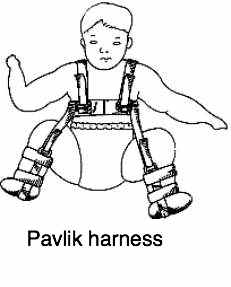
Hip dysplasia is characterised by a shallow acetabulum, or socket, that slopes upwards; the roof is not fully formed. In addition, a part of the ball is improperly roofed. It's caused by the foetus lying in utero in the wrong position. For more details of this phenomenon, and information about the Pavlik harness, see Developmental Hip dysplasia (DDH) ...
Hypermobile hip dysplasia CAM FAIS
Clinically, there is a greatly increased range of motion of the hip, in both the child and the young adult, with or without pain. Sitting in the lotus position is readily done, and they often make great gymnasts and sportsmen and women.
A clicking sound may be heard or felt as the ball subluxates in and out of the socket, depending on the shallowness of the socket, and the slope of the acetabular roof.
Beyond the immediate concerns of pain in the upper leg and hip, there is an increased tendency for early hip arthritis due to decreased area of contact between hip and acetabulum. Careful management of hip dysplasia is vital, and it fits well within the chiropractic domain; it often has a knock on affect on the sacro iliac joints.
However, the chiropractor must also address the hip joint itself and,
in the infant with a clicking hip, in my opinion a paediatrician should
also be consulted. Daily exercises are vital to strengthen the buttock
and upper leg muscles to reduce the tendency of the hip to subluxate. The Pavlik harness must be worn for about four months to form a deeper socket.
Periodically,
even in the young child, walking may be painful, either in the groin,
or on the side of the hip; an even more serious condition, Perthes disease must be ruled out.
The hypermobile hip likewise has an increased range of motion, but without the developmental changes of the socket seen in DDH. Clicking sounds are less likely, but there may still be pain in the hip. The pain may radiate towards the knee and the inner thigh muscles; the adductors are often extremely tender on palpation.
This may be generalised hypermobility of all the joints of the body or, if it's limited to one or both hips, then we may think of it as a Grade I Development Hip Dysplasia. A mild case of HDD, but enough to cause pain.
Only an Xray can distinguish between hypermobility which is normal and hip dysplasia which certainly is not.
ASIDE: There is some debate between chiropractors as to whether hypERmobility (increased movement, highly flexible) or hypOmobility (stiff joints) is more serious . Both are a concern, but in my opinion, it's easier to loosen up stiff joints than to stabilise hypermobile joints. Both, unmanaged, lead to a higher incidence of arthritis.
CASEFILE: Hip dysplasia or Hypermobility?
A young woman, 16-years old, I couldn't call her a child! recently consulted me with lower back, sacroiliac joint and groin pain particularly on standing and slow walking.
She had a long contradictory history of hip pain. Her mother was told by a paediatrician
when the lass was only four that she urgently needed an operation on her hip for
HDD; but at five a professor of child orthopaedics said that there was no
sign of HDD on X-ray, but that she was merely hypermobile. No treatment was needed. But hip and groin pain began at an earl age.
New X-rays confirmed the learned professor's advice: no hip dysplasia. But on examination, indeed a grossly increased hip range of motion and a sacro-iliac joint syndrome. It's going to take careful chiropractic management, and a vigorous exercise programme to keep this young woman from a life-long hip pain and ultimately perhaps hip arthritis.
Femoro Acetabular Impingement Syndrome (FAIS)
In general FAIS on the other hand causes a DECREASED range of motion in the hip (hypOmobility). It always comes as a surprise to find the appearance of stiffness of advanced hip arthritis in the examination of a young person. But no, not hip arthritis, but FAIS...
FAIS comes in two kinds and a mixture of the two:
- Pincer
- CAM
- Mixed Pincer / CAM is the most common.
For more about FAIS... FEMORO ACETABULAR IMPINGEMENT SYNDROME
Femoro Acetabular Impingement Syndrome, because of the reduced flow of
synovial fluid through the joint, also leads to premature hip arthritis
and total hip replacement if not carefully managed. Range of motion
exercises, done on a daily basis, are vital.
Because of a change in gait, FAIS also affects the sacroiliac joint anatomy ... and the buttock and lower back muscles.
Short leg
Both these conditions, FAIS and DDH, are greatly exacerbated if there is a significantly short leg leading to a scoliosis. Leg length inequality needs to be carefully evaluated in every young person suffering from lower back and hip pain. Sometimes an inexpensive insert in the shoe could save them a life time of pain.
A short leg also occurs after Perthes disease.
There are concerns that once you start with chiropractic, you become a lifelong captive. It is a legitimate concern, and the truth is there is nothing more that some chiropractors would like than to make you into a life long patient. Same as the pharmaceutical companies want you to take their medications, like Statins for example, for life to lower your cholesterol instead of making the simple dietary changes necessary.
I say simple; actually new research suggesting it is high glycemic carbohydrate, and not animal fat that causes high cholesterol, has thrown dieticians into a quandry. What's more it's now be proved that there is no solid evidence that a change from butter to margarine has an iota of benefit; butter is back.
Both are completely unethical. Good doctors try to get you to make lifestyle changes, not take medicines for life, and good chiropractors try to persuade you to start exercising regularly, losing weight if necessary and perhaps going for a massage occasionally... instead of manipulation every few weeks.

- Foods that lower cholesterol ...
Google appears to frown on too many links, so phrases in bold, like that above, need to be put into the Site Search function in the navigation bar on your left if you want more information.
Nevertheless, the truth is some conditions are serious and incurable
and there is no alternative to becoming a lifelong patient. Hypermobile hip dysplasia CAM FAIS is one of them. It's as true
of diabetes in the medical realm as these hip impingement and hypermobile hip deformities in the chiropractic realm. You will be a patient for life.
We can't cure you, nobody can, but we can ease the pain and
disability, and do our level best to prevent it developing into a
full-blown
hip arthritis ...
Concerns of once you start... are no more valid that your
dentist asking you to brush your teeth and come for a six month check up
or your doctor sternly telling you that you must have your hypertension
tested twice a year.
For the ethical doctor, dentist, chiropractor it's not about money. We earn quite enough. It's about an ounce of prevention, always better than a pound of cure.
But, it's true, there are rotten apples in every barrel. Greed prevails in every aspect of health care... carefully assess your doctor - is s/he interested in you, or your money? A hard question.
Mixed HYPERMOBILITY with a CAM deformity
Occasionally at the Chiropractic Coalface one comes up with bizarre
cases of INCREASED range of motion but a FAIS deformity (expecting
decreased ROM) is found on X-ray.
The long and the short of it is that hip and groin pain come in any number of shapes and sizes. All of these conditions, poorly managed, are far more likely to progress to premature hip arthritis and total hip replacement.
CASE FILE @ Hypermobile hip dysplasia CAM FAIS
Mrs B, 50 years old, has had bilateral knee pain since she was 16 years old; and lower back, midback and neck pain since she was 30 years old; and now left hip and groin pain for some five years.
She was diagnosed with "hypermobility" as a teen, and responded reasonably well to chiropractic treatment of her neck and back by another chiropractor, who did however not address her hip and knee problems.
X-ray of her knees revealed a condition called Chondrocalcinosis which causes
Patello Femoral Pain Syndrome - kneecap pain.
Chondrocalcinosis is strongly associated with chronic arthritis and a magnesium deficiency.
FRESH SPINACH RECIPES ... the richest source of magnesium.
Her knee responded well to a regimen of patella mobilisation to to gently grind down the fine calcium crystals forming in the
HYALINE CARTILAGE ...,
knee exercises and a diet rich in magnesium.
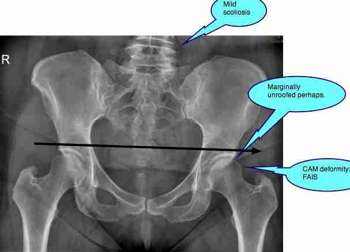
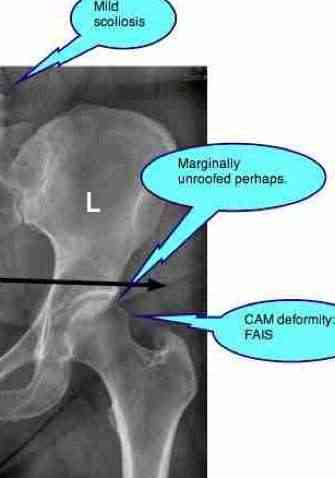
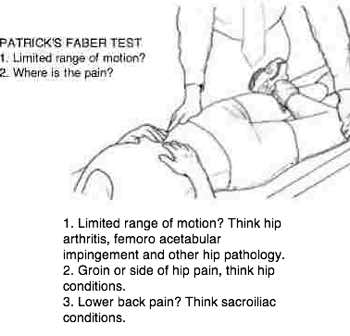
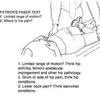
However, her hip shows no signs of chondrocalcinosis or chronic arthritis. What it does show is HYPERMOBILE HIP DYSPLASIA CAM FAIS - a mixture of hypermobility and a CAM deformity. Ranges of motion of the hip were grossly increased and she had marked pain in the groin (capsule) as the CAM deformity came into contact with the labrum of the acetabulum; the lateral hip and the adductor muscles in the groin were very tender. The Faber test was not limited, but painful in the groin.
X-rays @ Hypermobile hip dysplasia CAM FAIS
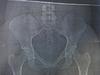
X-rays of her pelvis revealed no true hip dysplasia, perhaps a slight unroofing of the ball, but a CAM deformity, all aggravated by a short leg causing a lumbar scoliosis.
She responded well to sacroiliac joint adjustments, mobilisation of the hips, soft tissue therapy applied to the capsule and adductor muscles and a vigorous rehab program.
It remains to be seen what the long term prognosis is.
What is uncertain is what effect increasing the magnesium in her diet will have on all her joints. Only research in which patients with chondrocalcinosis are treated in different ways, one of which is an increase in mangnesium will reveal the overall effect of the mineral supplementation.
Orthotics to address the leg length discrepancy in the future is likely.
The specialised hip exercises at developmental hip dysplasia page are vital; like brushing teeth, they must be done life long.
Have A Great Story About This Topic?
Do you have a query or comment about upper leg pain or, for that matter, tingling in the legs and feet?
What Other Visitors Have Said
Click below to see contributions from other visitors to this page...
Ehlers Danlos and clicking painful hips 
Ehlers Danlos and clicking painful hips
Hello and thank you for your very interesting site!
I have ehlers danlos syndrome and was diagnosed about a …
Upper leg pain, Inner thigh and groin pain.
What could be causing my frequent but sharp and intermittent pain in my right groin and inner thigh. Difficult to walk or lift leg when this happens. Seems …
Groin pain right leg crease Not rated yet
Hi for about the last few months have experienced groin pain when lifting leg to put socks on or sitting in any position for awhile. When I lift leg to …
Inner thigh pain Not rated yet
65 year old carpet installer and while standing I get a dull achy feeling which turns into a burning sensation at the crease of my right leg and thigh …

Severe groin pain, numbness and tingling from the knees up to my buttocks Not rated yet
I had my 2nd back fusion on May 23 of this year. On Oct 4 of this year, I had a nasty fall into the shallow end of an empty pool. ( don't ask !!) I thought …
Hypermobile hips with popping and pain Not rated yet
Hello,
I am 30 years old. I have known of my hypermobile hips since I can remember. As a kid I was told not to run and jump a lot, in case it wore …
USEFUL LINKS @ Hypermobile hip dysplasia CAM FAIS
- Go from HYPERMOBILE HIP DYSPLASIA CAM FAIS to CHIROPRACTIC home page …
- Return from HYPERMOBILE HIP DYSPLASIA CAM FAIS to Developmental-Hip-Dysplasia …
In short Hypermobile hip dysplasia CAM FAIS is a confusing condition, with mixed signs, but once recognised it too responds well to Chiropractic. Alas, you will be a life long patient. Accept it.
Did you find this page useful? Then perhaps forward it to a suffering friend. Better still, Tweet or Face Book it.
MONTHLY NEWSLETTER. Signed up yet? It is free.
BACK ISSUES
Chiropractic Help Backissues ... our monthly newsletter, click here for all the old issues.
- Issue #53: No short cuts to better health / Simple balance and quad strengthening exercises
- Issue #52: Needs an adjustment / Everything must change
- Issue #51: Elective surgery in the elderly / Cooling and reheating starches
- Issue #50: Make time for breakfast / Scrambled eggs and parsley
- Issue #49: Consulting a locum / Green salad /Eggs Florentine
- Issue #48: Hips and the sacroiliac joints/ Bacon and eggs
- Issue #47: Life without medication/ Eight coloured foods
- Issue #46: Lower backs and ankles/ kaempferol and cancer prevention
- Issue #45: Tingling, weakness and malaise/ vitamin B1
- Issue #44: Applying general chiropractic principles to the hand / Omega-3
- Issue #43: Art and science of chiropractic / Kale
- Issue #42: Tum sleeping / Flaxseed
- Issue #41: Adult potty training / Beetroot constipation
- Issue #40: Ominous lumbar signs / Too much medication?
- Issue #39: Swapping chiropractors / Butter is back
- Issue #38: Making a correct diagnosis / Make your own pesto in five minutes.
- Issue #37: Have your wisdom teeth out in the chair
- Issue #06: Safety on the Stairs / Ginger
- Issue #05: Safety in the home / Red foods
- Issue #04: Whiplash and the Joints of Luschka / Parsley
- Issue #03: How to stop falling / Danger of a low fat diet
- Issue #01: Tingling in the arms and hands / Apples
(PS. If you find them irrelevant to your needs or an exercise in tedium, one click will UNsubscribe you.)
